If you’ve ever typed something into Google and wondered how certain websites always show up first, you’ve already brushed up against the world of SEO. Learning SEO basics is the first step toward getting your own website noticed, whether you run a blog, an online store, or a local business.
This beginner SEO guide breaks down everything you need to know in plain English. No jargon overload, no fluff — just a clear path from “I have no idea what SEO is” to “I understand how to make my website rank.” By the end, you’ll have a working knowledge of search engine optimization and a simple checklist to put it into action.
Let’s get started.
What Is SEO?
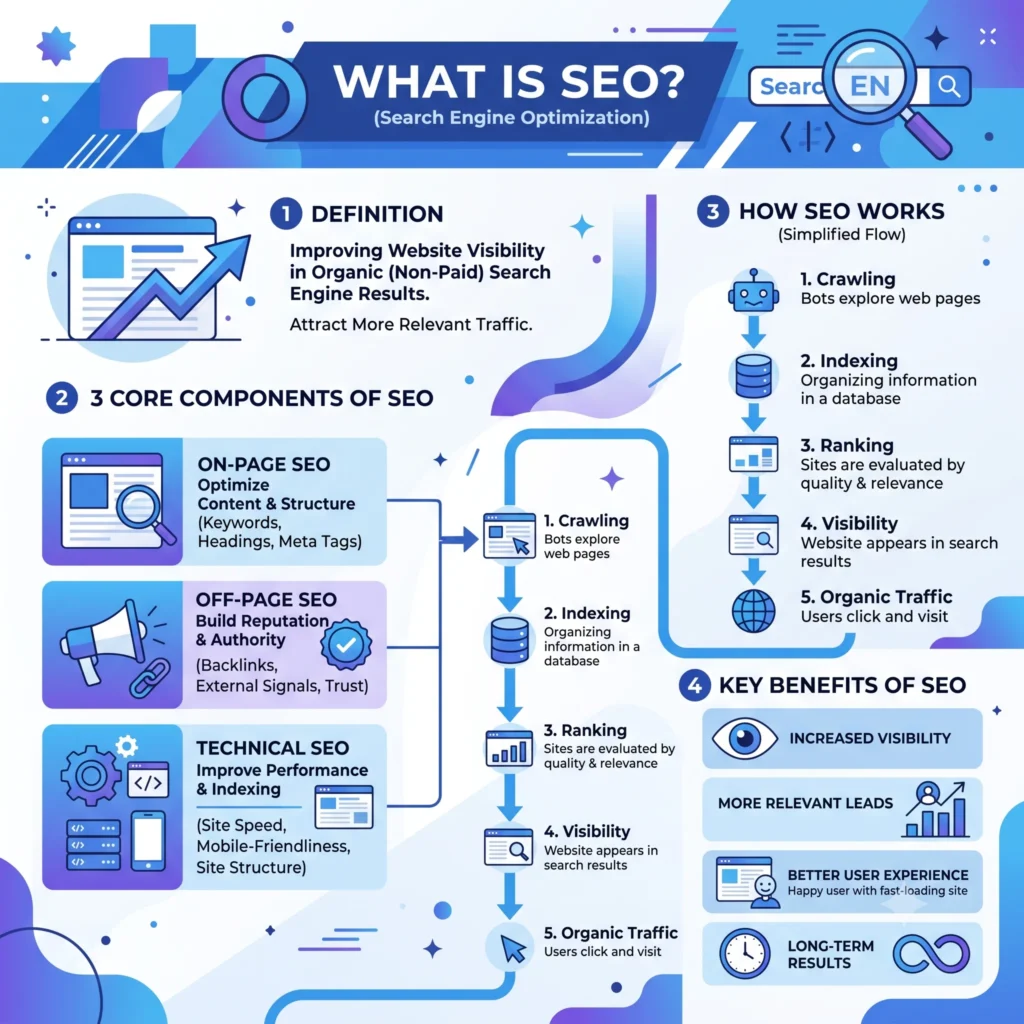
SEO stands for Search Engine Optimization. It’s the practice of improving your website so that search engines like Google and Bing — and increasingly, AI platforms like ChatGPT, Gemini, and Perplexity — can find, understand, and recommend your content to people searching for it.
At its core, SEO is about matching what your website offers with what someone is actually looking for. When you search for “best running shoes for flat feet,” Google’s job is to show you the most relevant, trustworthy, and useful pages. SEO is how you make sure your page is one of them.
Search engine optimization touches several areas of a website:
- Content – what you say and how well it answers a question
- Technical structure – how easily search engines can crawl and index your site
- Authority – how trustworthy and credible your site appears to others
- User experience – how enjoyable and fast your site is to use
Understanding these fundamentals is what separates guesswork from a real SEO strategy. Google’s own SEO Starter Guide is a great companion resource as you go through this article.
SEO Basics vs. Advanced SEO
Beginners often ask whether they need to learn advanced tactics right away. The honest answer: no. SEO fundamentals — solid content, a crawlable site, and basic keyword research — will take you further than most advanced tricks. Master the basics first, and the rest becomes much easier to layer on later.
Why Is SEO Important?
Search engines are often the first place people go when they have a question, a problem, or a purchase in mind. If your website doesn’t show up in the search results, you’re invisible to a huge share of potential visitors.
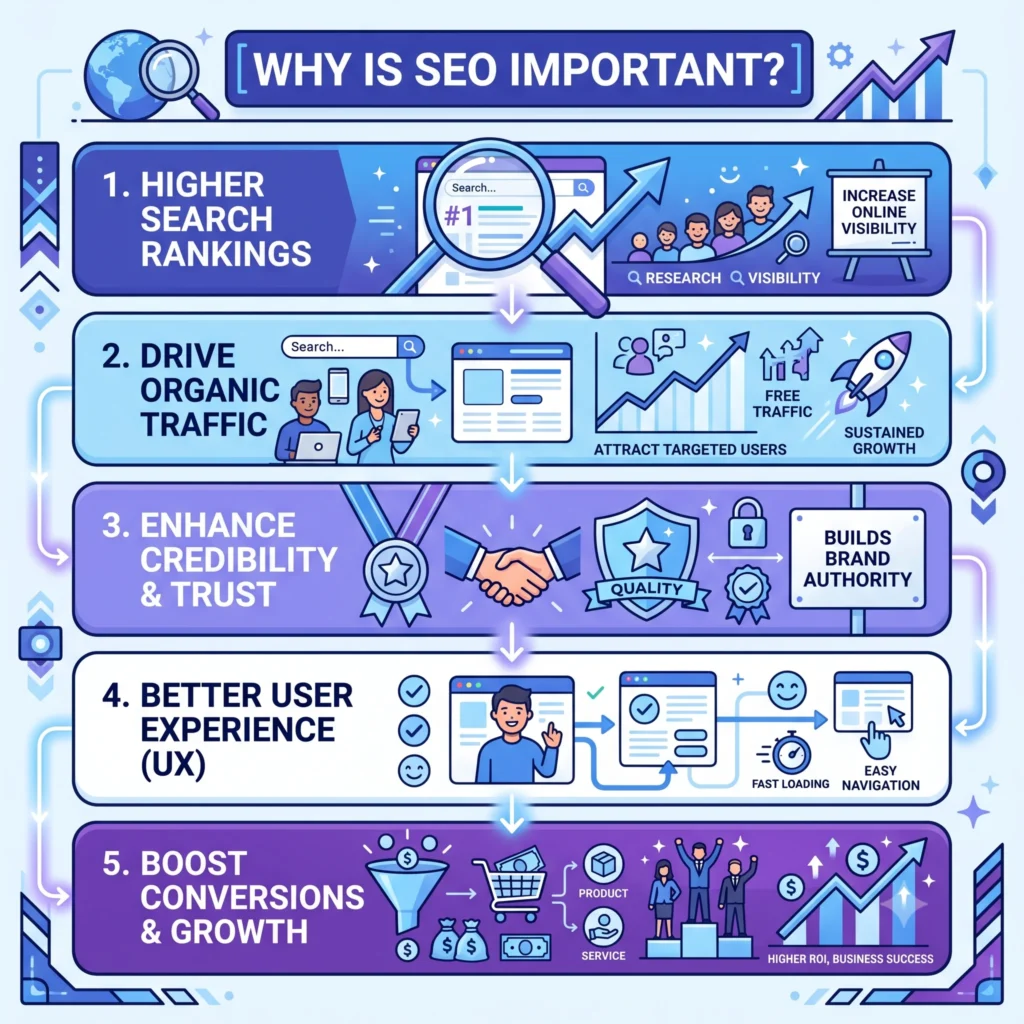
Here’s why SEO matters:
- Organic traffic is free, long-term traffic. Unlike paid ads, once a page ranks well, it can keep bringing in visitors for months or years without ongoing ad spend.
- It builds trust. People tend to trust websites that appear naturally in search results over paid placements.
- It compounds over time. A well-optimized site keeps gaining momentum, while unoptimized sites often stay stuck.
- AI search is expanding the playing field. Google AI Overviews, ChatGPT, Gemini, and Perplexity now pull information from websites to answer questions directly. Good SEO increases your odds of being cited by these AI assistants too.
In short, SEO is one of the highest-value skills you can learn if you want consistent visibility and traffic without paying for every single click.
How Google Search Works
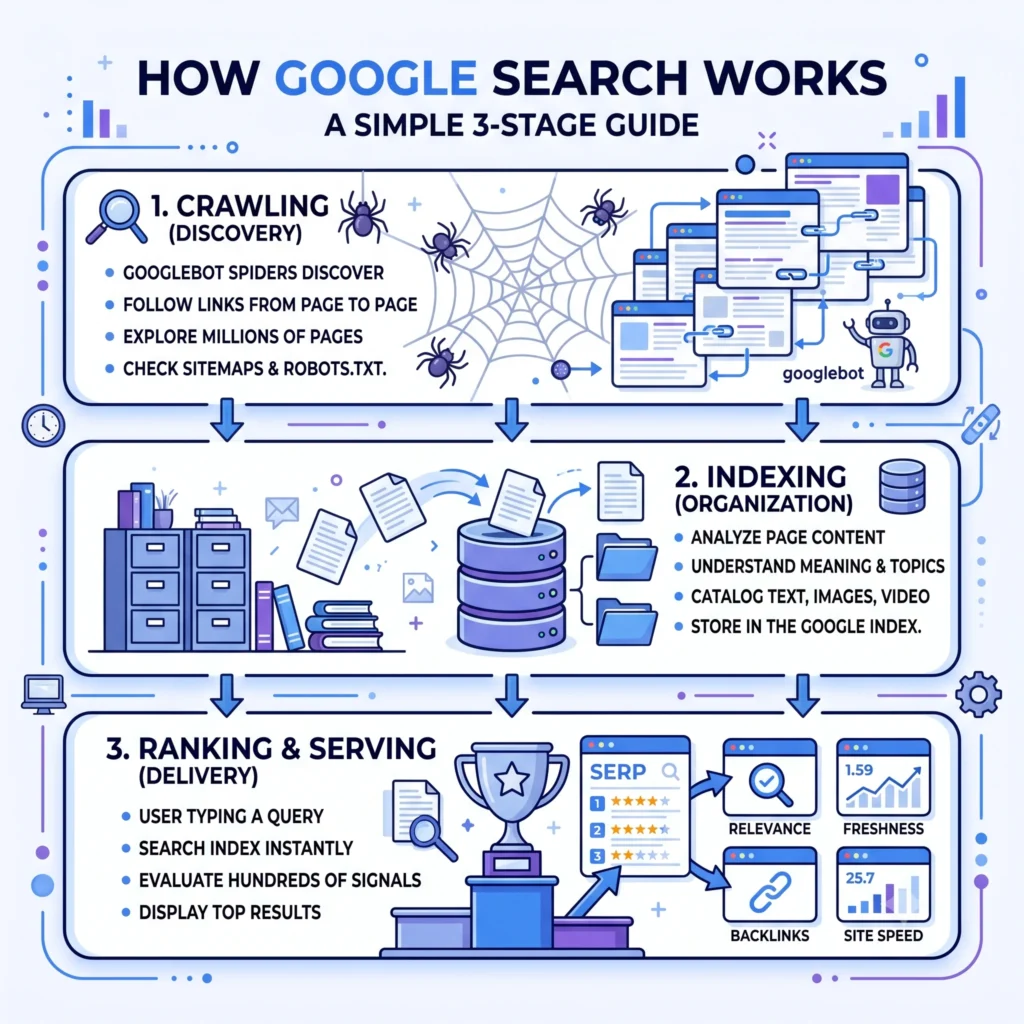
Before you optimize anything, it helps to understand how Google (and search engines generally) actually work. The process happens in three main stages: crawling, indexing, and ranking.
- Crawling – Google uses automated bots, commonly called Googlebot, to travel across the web by following links from page to page, discovering new and updated content.
- Indexing – Once a page is crawled, Google analyzes its content and stores it in a massive database called the index. If a page isn’t indexed, it can’t appear in search results at all.
- Ranking – When someone performs a search, Google’s algorithms sort through the index and rank pages based on relevance, quality, authority, and hundreds of other signals.
This same basic model — discover, understand, sort — applies to Bing Search and, in a modified form, to AI platforms that crawl and summarize web content. Getting familiar with this flow is one of the most useful SEO fundamentals you can learn, because most SEO work is really about helping search engines crawl, index, and rank your pages more effectively.
How to Make Your Website Eligible for Google

Before your content can rank, Google needs to be able to find and access it. This is where technical eligibility comes in.
Steps to make your website eligible:
- Submit an XML sitemap through Google Search Console so Google knows which pages exist.
- Check your robots.txt file to make sure you aren’t accidentally blocking search engines from crawling important pages.
- Verify indexability by searching “site:yourdomain.com” in Google to see which pages are already indexed.
- Fix crawl errors flagged in Search Console, such as broken links or server errors.
- Avoid duplicate content issues that can confuse search engines about which version of a page to rank.
Google Search Console is a free and essential tool here — it directly shows you how Google sees your site, including indexing status and any crawlability problems.
Keyword Research Basics
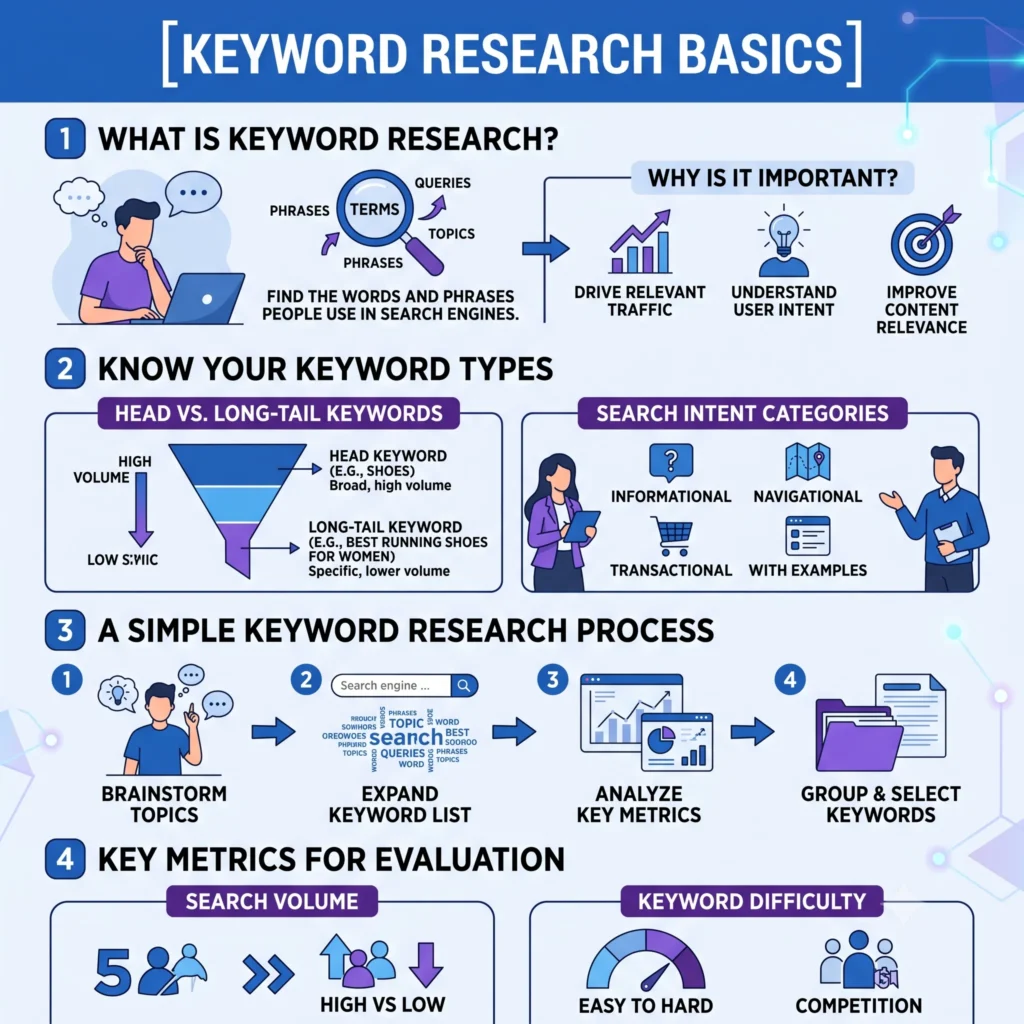
Keyword research is how you figure out what your audience is actually typing into search engines. Skipping this step is one of the most common reasons beginner websites struggle to gain traction.
Here’s a simple process:
- Brainstorm topics related to your business or niche.
- Use a keyword tool like Google Keyword Planner or Ahrefs’ Keyword Explorer to find related search terms and estimated search volume.
- Study search intent. Is the person looking to learn something (informational), buy something (transactional), or find a specific website (navigational)? Your content should match that intent.
- Check the competition. Look at what’s currently ranking to gauge how difficult a keyword might be for a new site.
- Group keywords by topic rather than targeting one page per keyword — this supports a more natural content structure.
A good rule of thumb: your primary keyword should reflect exactly what your page delivers. If someone searches “beginner SEO guide” and lands on a page about advanced link-building tactics, that mismatch hurts both user experience and rankings.
Create SEO-Friendly Content
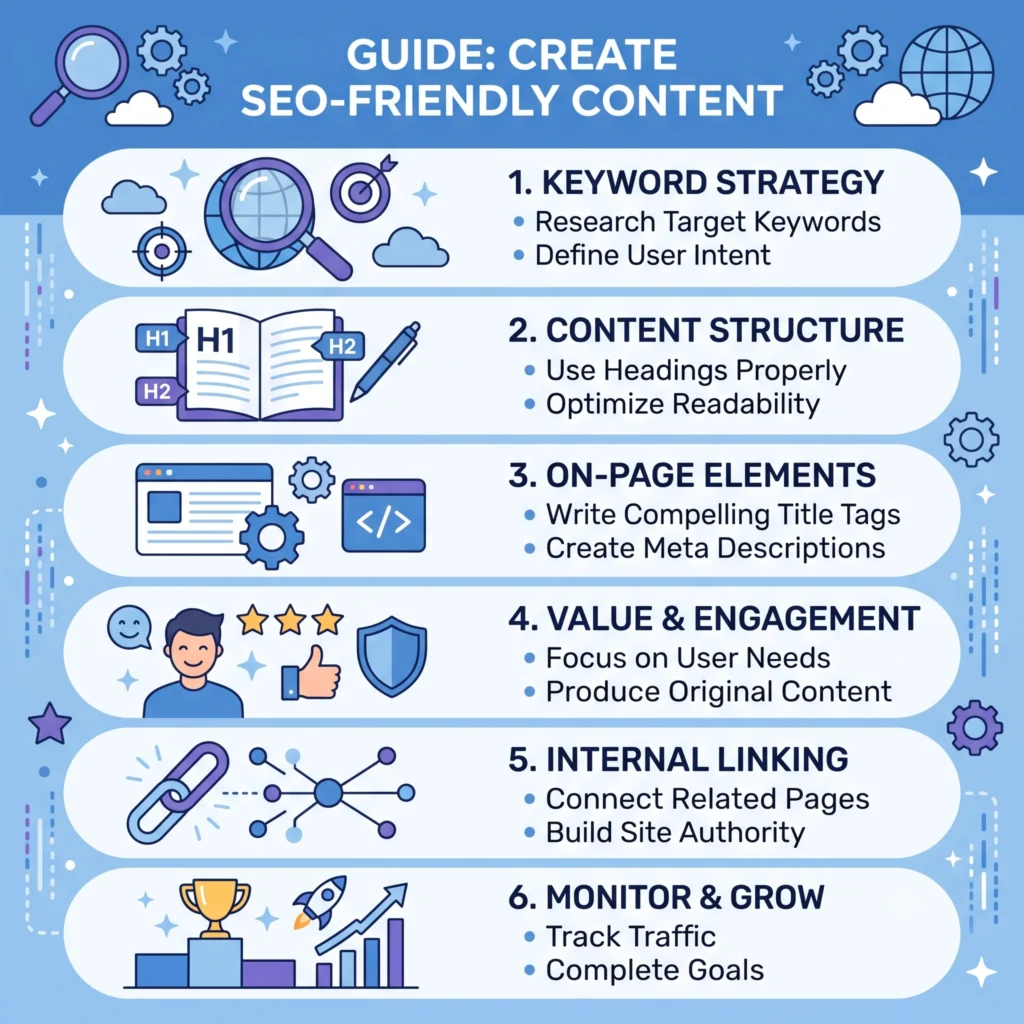
Content is still the foundation of SEO. Google’s own guidance emphasizes rewarding “helpful content” — material created primarily to help real people, not just to rank.
Tips for SEO-friendly content:
- Answer the question clearly and completely. Don’t make readers dig for the answer.
- Use natural language. Write the way you’d explain something to a friend, not like a robot repeating keywords.
- Structure content with headings so both readers and search engines can scan it easily.
- Add original insight. First-hand experience, examples, and data help your content stand out — and this is also what AI Overviews and tools like ChatGPT and Perplexity favor when summarizing information.
- Keep it updated. Outdated content loses trust and rankings over time.
Well-written, genuinely useful content is also what earns backlinks, shares, and repeat visitors — all of which reinforce your SEO efforts.
On-Page SEO Basics
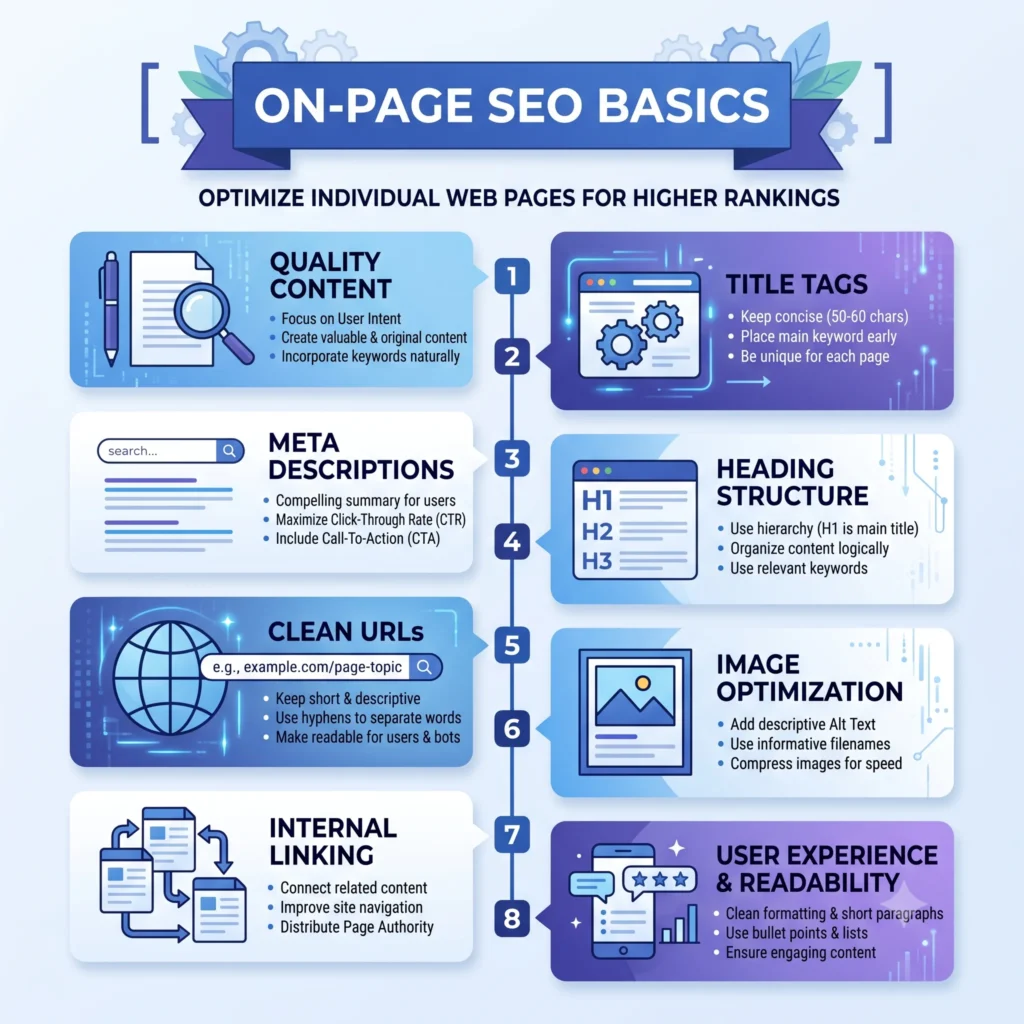
On-page SEO refers to everything you optimize directly on your webpage to help it rank and make sense to both users and search engines. This is only a beginner overview. If you want step-by-step optimization techniques, read our complete On-Page SEO guide covering title tags, content optimization, internal linking, image SEO, and more.
Key on-page SEO elements:
- Title tags – Include your primary keyword naturally, and keep it compelling enough to earn clicks.
- Meta descriptions – A short summary that influences click-through rate from the search results page.
- Headings (H1, H2, H3) – Organize content logically, with your focus keyword appearing in at least one heading.
- URL structure – Keep URLs short, descriptive, and readable (avoid strings of random numbers or symbols).
- Internal linking – Link to other relevant pages on your site using descriptive anchor text, which helps both users and search engines navigate your content.
- Image optimization – Use descriptive file names and alt text for accessibility and image search visibility.
On-Page SEO Checklist for Beginners
- Keyword in the title tag
- Keyword in at least one H2 or H3
- Descriptive, keyword-friendly URL
- Meta description under 160 characters
- Internal links with relevant anchor text
- Alt text on all images
Technical SEO Basics
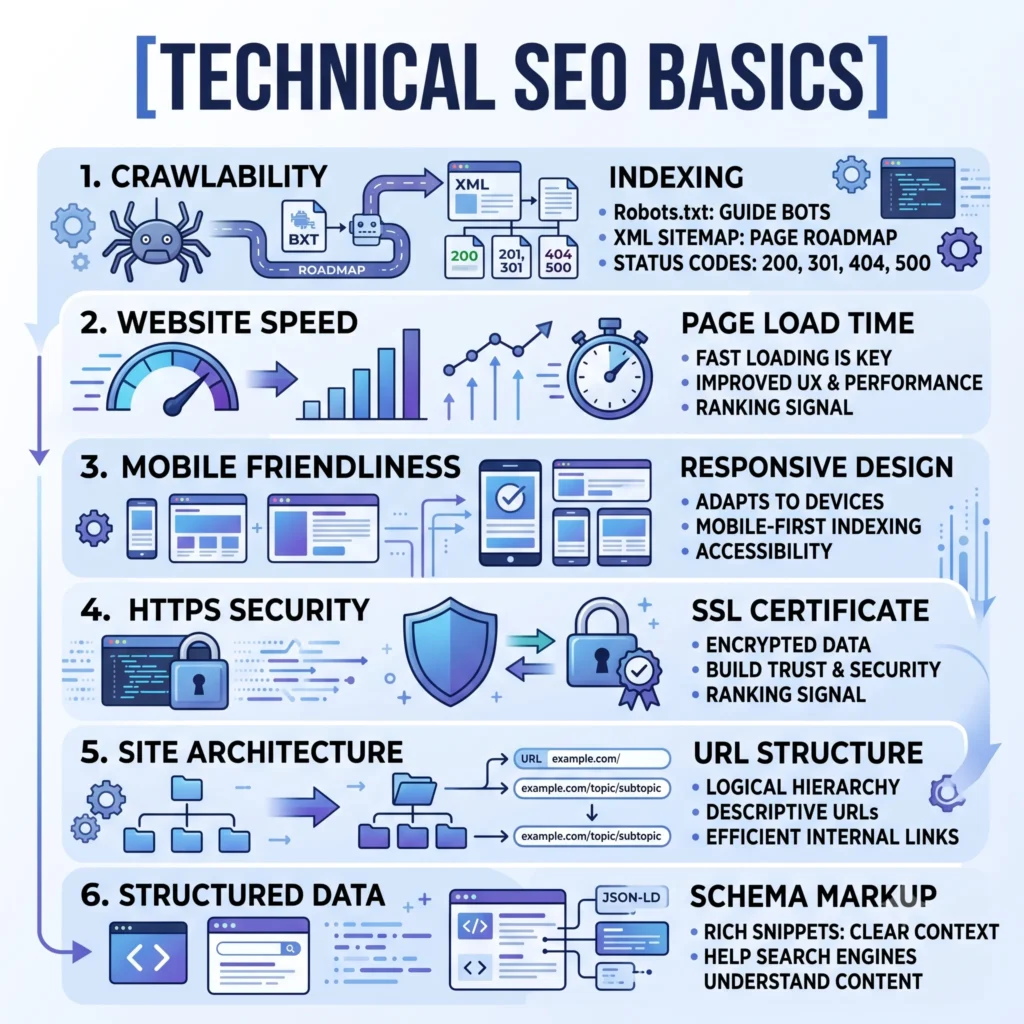
Technical SEO makes sure the backend of your website supports strong performance in search results. Even great content can underperform if technical issues get in the way.Technical SEO covers much more than the basics discussed here. Our complete Technical SEO guide explains crawling, indexing, Core Web Vitals, XML sitemaps, robots.txt, structured data, and website architecture in greater detail.
Core technical SEO basics include:
- HTTPS and SSL certificate – Secure sites are a baseline trust signal for both users and Google.
- Website speed – Slow-loading websites frustrate visitors and can hurt rankings. Compress images and minimize unnecessary code.
- Core Web Vitals – Google’s specific metrics for loading speed, interactivity, and visual stability.
- Mobile-friendly website design – With most searches happening on phones, a responsive design is non-negotiable.
- Clean website structure – A logical structure with clear categories makes crawling and indexing easier.
- CDN usage – A content delivery network can speed up load times for visitors across different locations.
Technical SEO isn’t glamorous, but it’s the plumbing that lets everything else work properly.
Off-Page SEO Basics
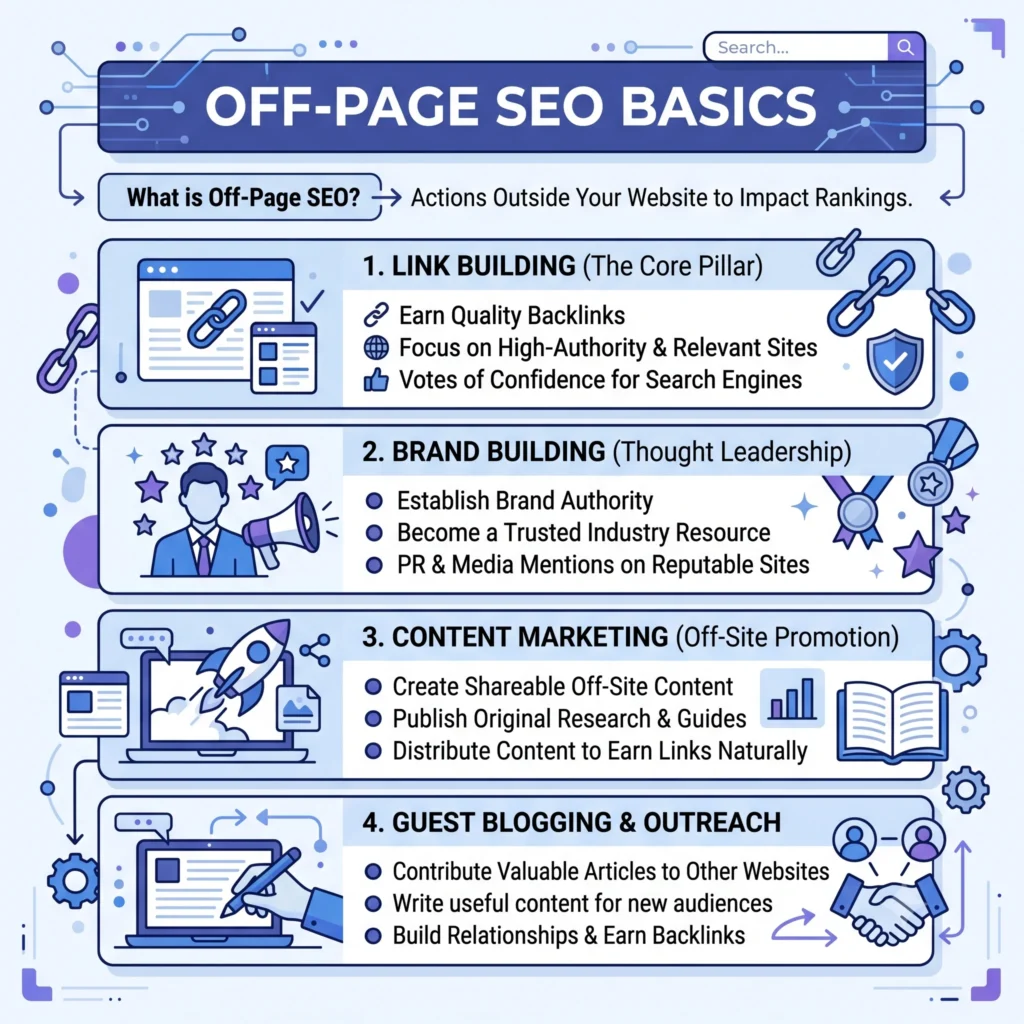
Off-page SEO covers actions taken outside your own website that influence how search engines perceive its authority and trustworthiness.Want to learn proven link-building and authority-building strategies? Explore our complete Off-Page SEO guide for practical techniques that improve trust and rankings.
The most important off-page factor is backlinks — links from other websites pointing to yours. Google treats quality backlinks as a vote of confidence, tracing back to its original PageRank concept, which still influences ranking systems today.
Other off-page SEO basics:
- Brand mentions – Even unlinked mentions of your brand can contribute to your online authority.
- Guest content and outreach – Contributing valuable content to reputable sites in your niche can earn natural backlinks.
- Social signals – While not a direct ranking factor, social sharing increases visibility and the chance of earning links.
- Digital PR – Getting featured in credible publications builds both authority and referral traffic.
Focus on earning links naturally through useful content rather than manipulative link schemes, which can violate search engine guidelines and lead to penalties.
Local SEO Basics
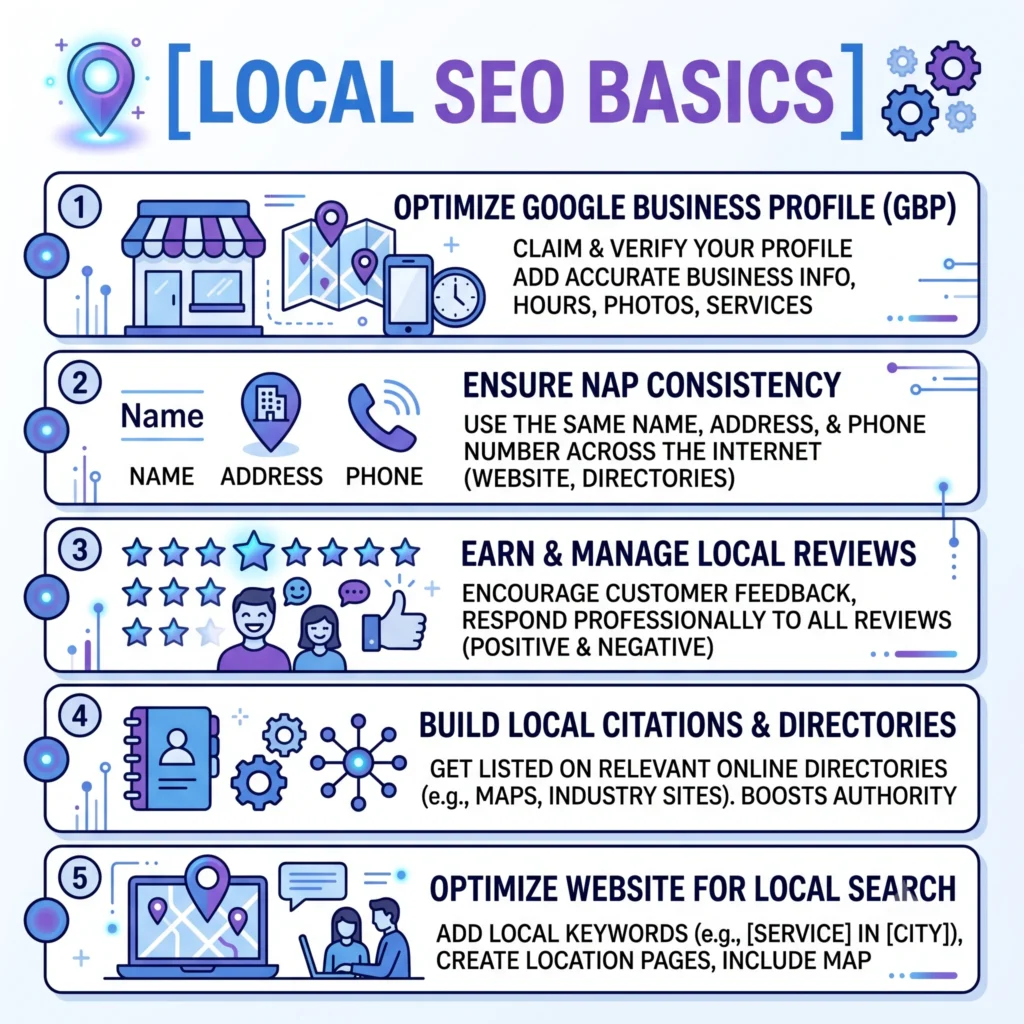
If you run a business that serves a specific area, local SEO helps you show up when nearby customers search for your products or services.
Local SEO essentials:
- Claim and optimize your Google Business Profile with accurate hours, address, phone number, and photos.
- Keep your business information consistent across directories and websites (name, address, phone number).
- Collect genuine customer reviews, which influence both trust and local rankings.
- Use location-based keywords naturally in your content, such as city or neighborhood names.
- Show up on Google Maps by ensuring your profile is complete and regularly updated.
Local SEO is often the fastest way for small businesses to see tangible results, since competition is typically narrower than broad national search terms.
AI and the Future of SEO

Search is evolving beyond the traditional list of blue links. AI Overviews, ChatGPT, Gemini, Microsoft Copilot, and Perplexity are increasingly answering questions directly, often pulling from indexed web content to generate their responses.
What this means for SEO fundamentals:
- Clear, well-structured content is favored. AI systems tend to pull from pages that answer questions directly and are easy to parse.
- E-E-A-T still matters. Experience, Expertise, Authoritativeness, and Trustworthiness remain central to how both Google and AI platforms evaluate content quality.
- Being crawlable and indexable is still essential. AI assistants generally can’t cite content they can’t access.
- AI visibility is a new metric to watch. Beyond traditional rankings, tracking how often your brand appears in AI-generated answers (sometimes referred to as share of voice) is becoming part of a modern SEO strategy.
The core principles of SEO basics — useful content, technical accessibility, and credibility — remain the foundation, even as the tools interpreting that content evolve.
How to Measure SEO Success
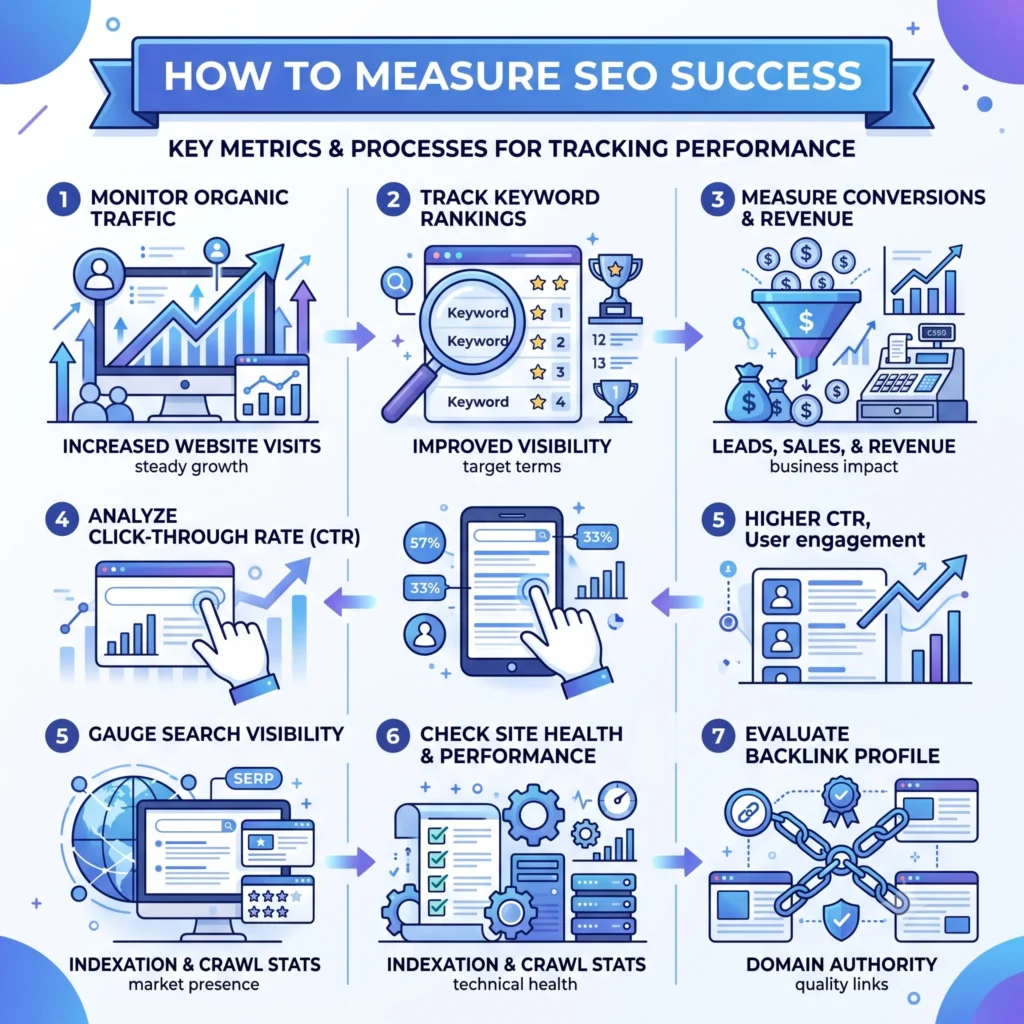
You can’t improve what you don’t measure. Tracking the right metrics helps you understand whether your SEO efforts are actually working.
Metrics worth monitoring:
- Organic traffic – Visitors arriving from unpaid search results, trackable in Google Analytics.
- Keyword rankings – Use a rank tracker to monitor your position for target keywords over time.
- Click-through rate (CTR) – The percentage of people who click your listing after seeing it in search results.
- Indexing status – Confirm your important pages are indexed via Google Search Console.
- Core Web Vitals scores – Monitor site speed and user experience metrics.
- Backlink growth – Tools like Ahrefs’ Site Explorer let you track new and lost backlinks over time.
Set a baseline early, then check progress monthly rather than daily — SEO results build gradually, and short-term fluctuations are normal.
Common SEO Mistakes Beginners Should Avoid
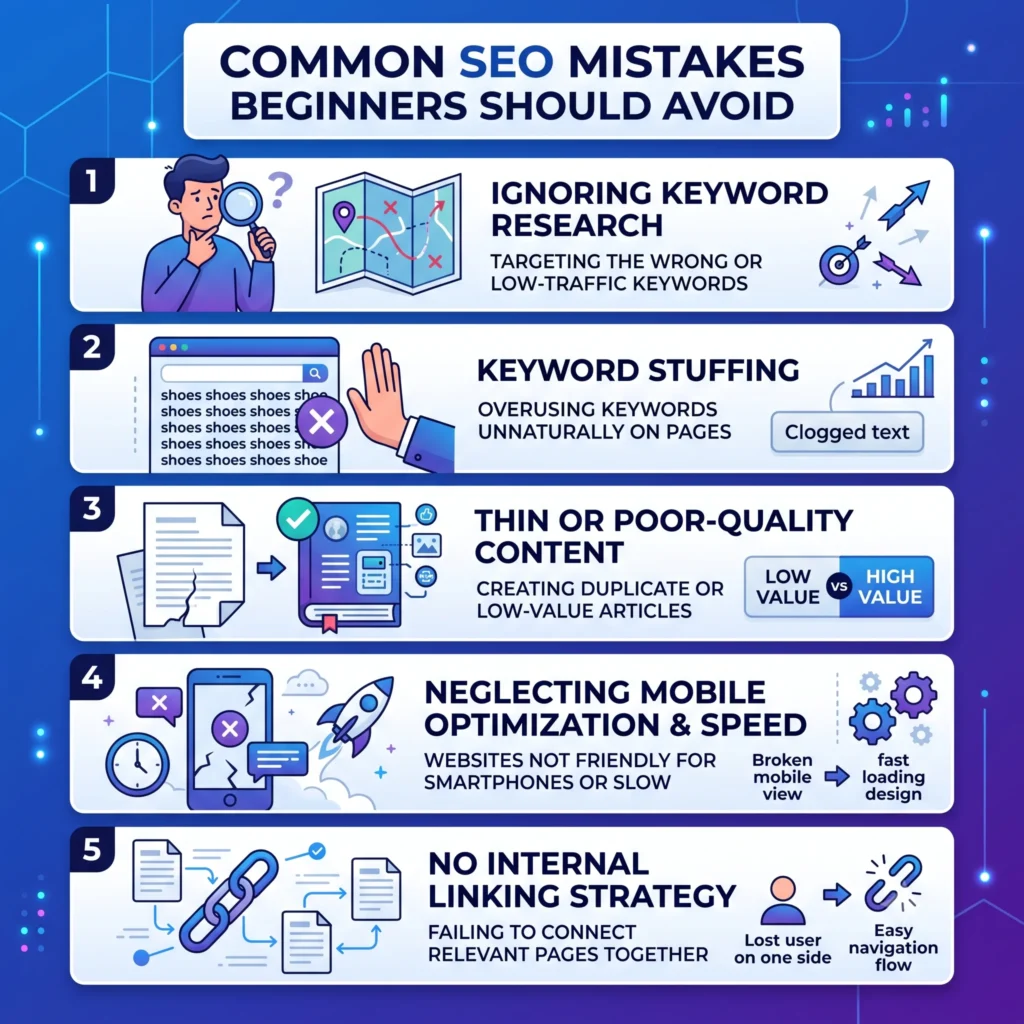
Even well-intentioned SEO efforts can backfire. Watch out for these frequent beginner mistakes:
- Keyword stuffing – Overusing your keyword unnaturally hurts readability and can trigger spam-related penalties.
- Ignoring search intent – Ranking for a keyword means nothing if your content doesn’t match what the searcher actually wants.
- Neglecting mobile users – A poor mobile experience turns visitors away instantly.
- Buying low-quality backlinks – Spammy links can do more harm than good.
- Duplicate content – Copying content, even your own across multiple pages, confuses search engines about which page to rank.
- Expecting overnight results – SEO is a long-term strategy, not an instant fix.
Avoiding these pitfalls will save you time and protect your website’s reputation with search engines.
How Long Does SEO Take?
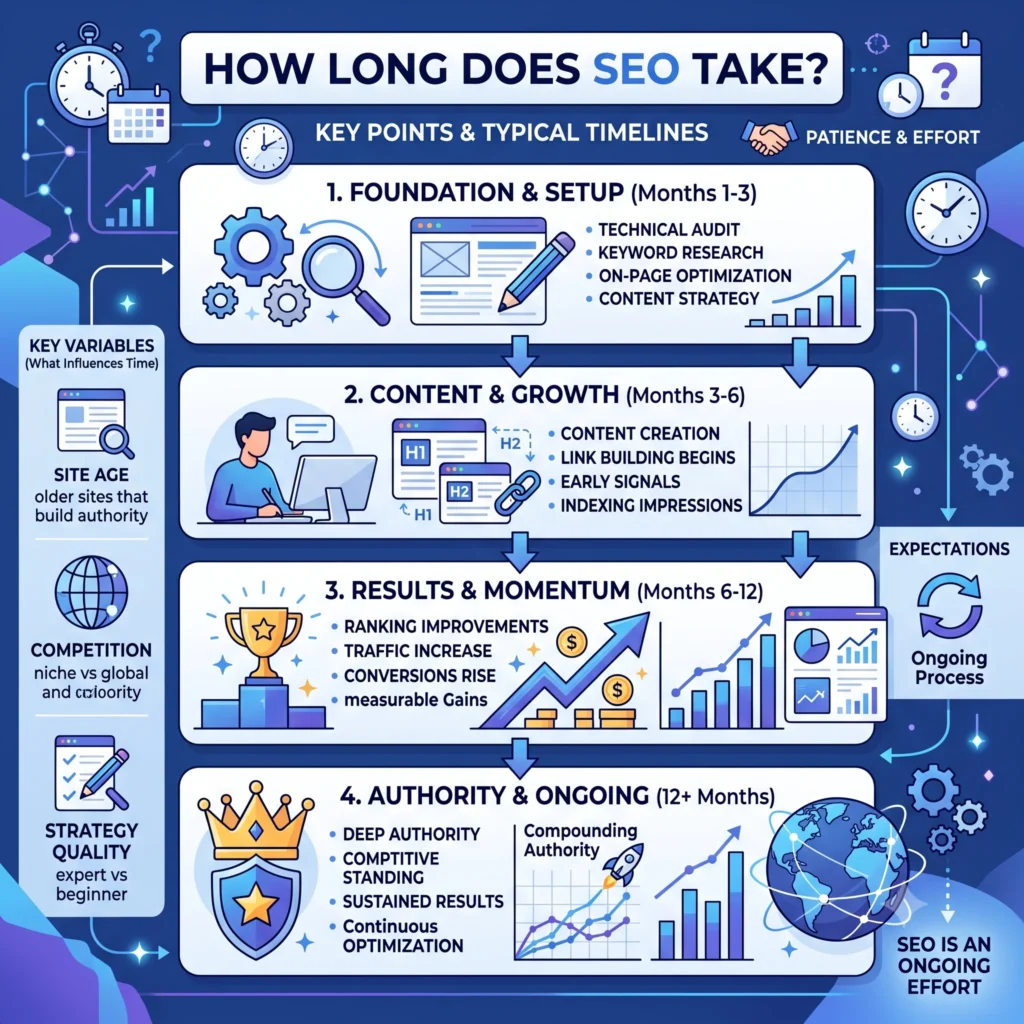
One of the most common questions beginners ask is how long SEO takes to show results. The honest answer: it varies, but most websites start seeing meaningful movement within 4 to 6 months, with more substantial results building over 6 to 12 months.
Factors that influence SEO timelines:
- Domain age and existing authority
- Level of competition for your target keywords
- Content quality and consistency
- Technical health of your website
- How actively you build backlinks and authority
Newer websites in competitive niches typically take longer, while local or niche-specific sites can see faster traction. Patience combined with consistent effort is the real formula for lasting SEO success.
Best SEO Tools for Beginners
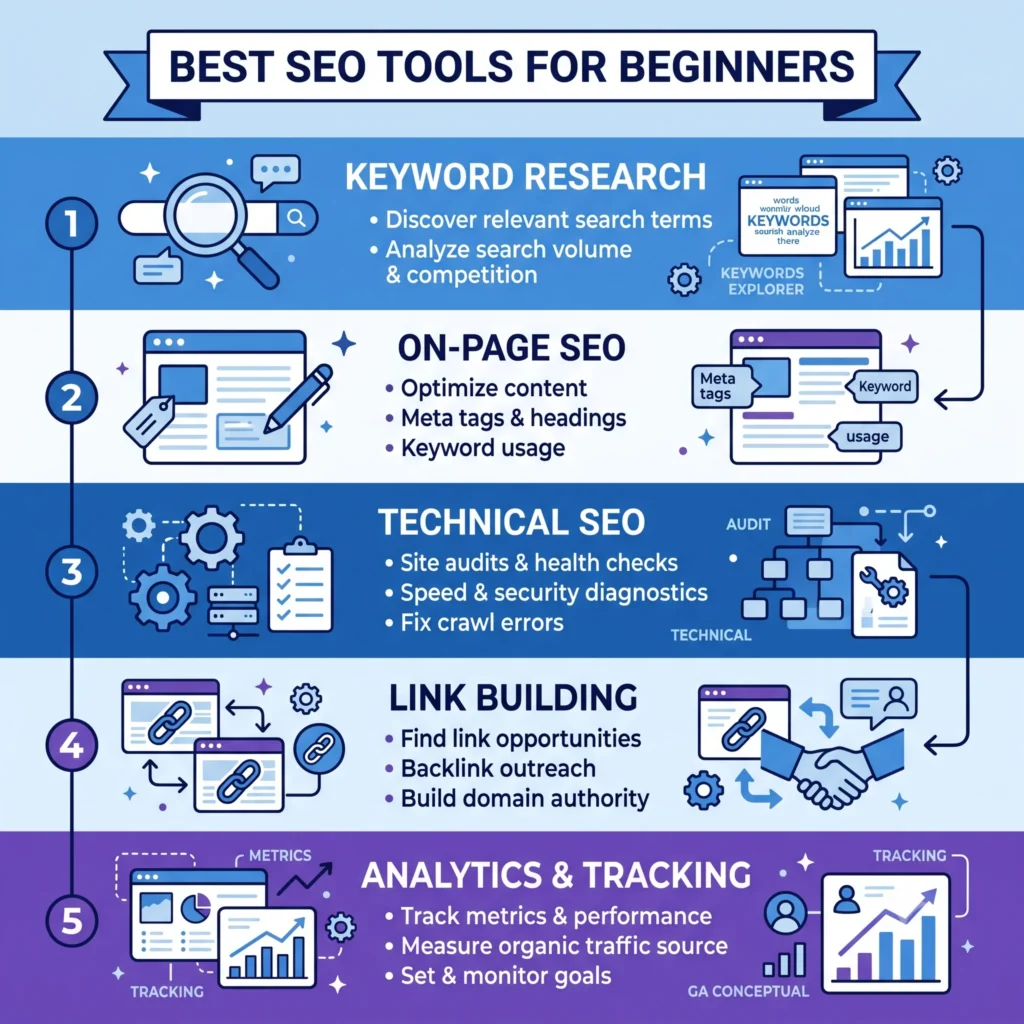
You don’t need an expensive toolkit to get started. If you’re unsure which platforms are worth using, our complete SEO tools guide compares the best free and paid SEO tools for keyword research, technical audits, backlink analysis, and rank tracking.Here are some reliable options across free and paid categories:
- Google Search Console – Free tool for monitoring indexing, crawl errors, and search performance.
- Google Keyword Planner – Free keyword research directly from Google’s own data.
- Ahrefs – A comprehensive platform offering Site Explorer, rank tracking, and Brand Radar for monitoring brand visibility.
- Yoast SEO or Rank Math – Popular SEO plugins for WordPress that guide on-page optimization as you write.
- Google Analytics – Web analytics for tracking traffic, behavior, and conversions.
- PageSpeed Insights – Free tool for checking Core Web Vitals and site speed.
If your website runs on WordPress, Shopify, Wix, or Webflow, most of these platforms offer built-in or plugin-based SEO features, making basic optimization accessible even without technical experience.
SEO Basics Checklist
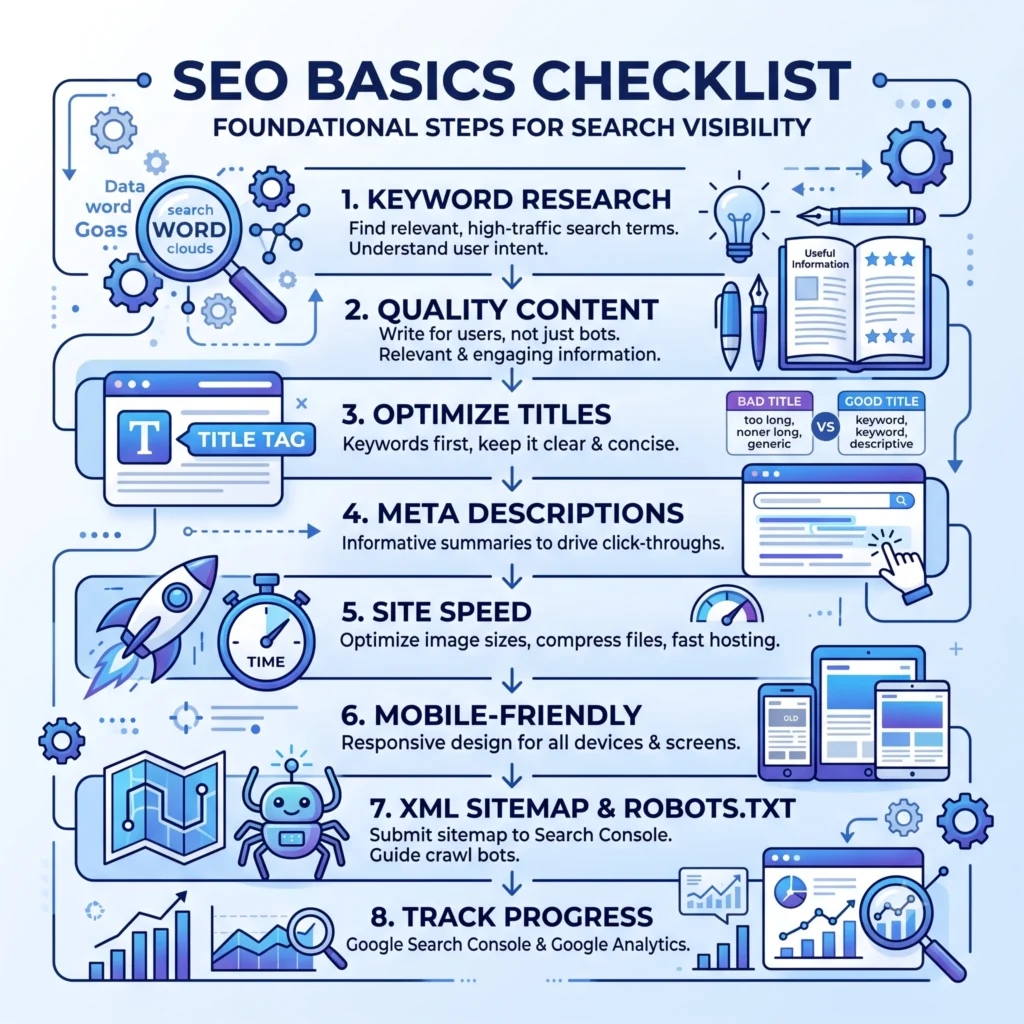
Use this quick checklist to apply what you’ve learned:
- Understand how Google crawls, indexes, and ranks pages
- Submit your XML sitemap via Google Search Console
- Check your robots.txt file for crawl blocks
- Do basic keyword research and map search intent
- Write helpful, original, well-structured content
- Optimize title tags, meta descriptions, and headings
- Use clean, descriptive URLs
- Add internal links with relevant anchor text
- Ensure HTTPS/SSL is active
- Improve website speed and Core Web Vitals
- Make sure your site is mobile-friendly
- Set up and optimize your Google Business Profile (if local)
- Earn backlinks through quality content and outreach
- Track rankings, traffic, and indexing monthly
Final Thoughts
Learning SEO basics doesn’t require a technical background or years of experience — it requires understanding how search engines work and consistently applying a few core principles: helpful content, a crawlable and fast website, solid keyword research, and genuine authority-building.
Whether you’re optimizing for Google Search, Bing Search, or the growing world of AI search through tools like ChatGPT, Gemini, and Perplexity, the fundamentals stay remarkably consistent. Start with this beginner SEO guide, work through the checklist, and revisit your progress regularly. SEO success is less about perfection and more about steady, informed improvement over time.
Frequently Asked Questions (FAQ)
What are the four pillars of SEO?
The four pillars of SEO are On-Page SEO, Off-Page SEO, Technical SEO, and Content SEO. Together, they improve your website’s visibility, user experience, and search engine rankings.
How do I start SEO as a beginner?
Start by learning the basics of keyword research, creating high-quality content, optimizing your pages for on-page SEO, and ensuring your website is technically sound. Use tools like Google Search Console and Google Analytics to monitor your progress.
What are the five most important concepts of SEO?
The five core SEO concepts are:
- Keyword Research
- Content Optimization
- On-Page SEO
- Technical SEO
- Link Building
Mastering these fundamentals provides a strong foundation for long-term SEO success.
Can ChatGPT help with SEO?
Yes. ChatGPT can assist with content creation, keyword brainstorming, meta descriptions, outlines, and SEO best practices. However, it should be used alongside professional SEO tools for technical audits, keyword tracking, and performance analysis.
Is AI replacing SEO?
No. AI is transforming SEO, not replacing it. Search engines and AI-powered platforms still rely on high-quality, authoritative, and well-optimized content. Adapting your SEO strategy to include AI optimization can improve visibility across both traditional search results and AI search experiences.
FluxSEO’s Team creates practical, beginner-friendly guides on SEO, blogging, keyword research and digital growth. Our goal is to simplify search engine optimization and help website owners improve visibility, rankings and organic traffic with clear, actionable advice.