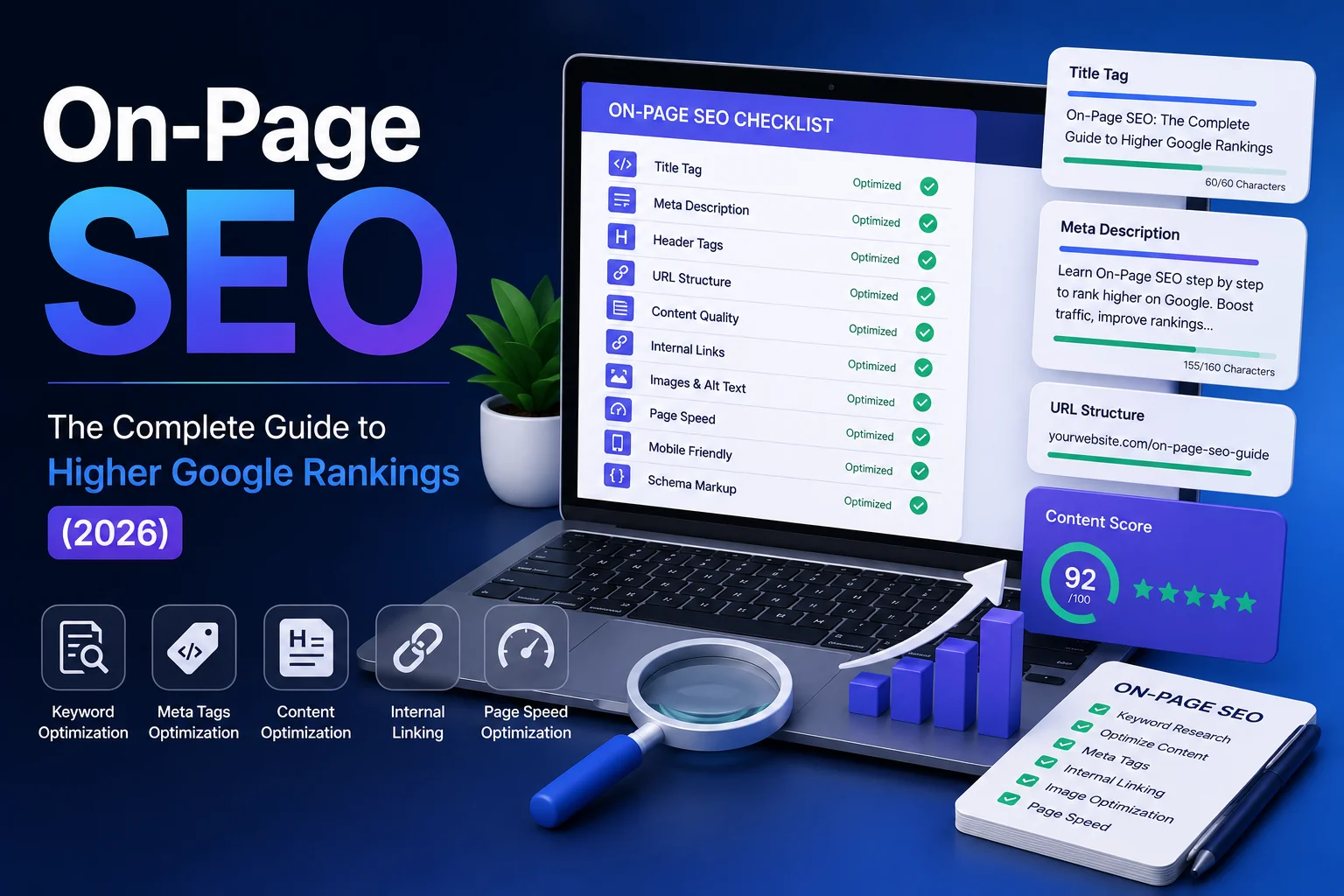
If you want your website to show up on Google, you need more than good writing. You need on-page SEO — the practice of optimizing individual web pages so search engines can understand them, trust them, and rank them.
This guide breaks on-page SEO down into simple, actionable steps. Whether you’re a blogger, small business owner, or marketer, you’ll learn exactly how to structure, write, and optimize a page so it ranks well on Google, appears in AI Overviews, and earns clicks from real people. If you’re just getting started, check out our SEO Basics: The Complete Beginner’s Guide before diving deeper into on-page optimization.
By the end, you’ll have a complete on-page SEO checklist you can use on every page you publish.
What Is On-Page SEO?
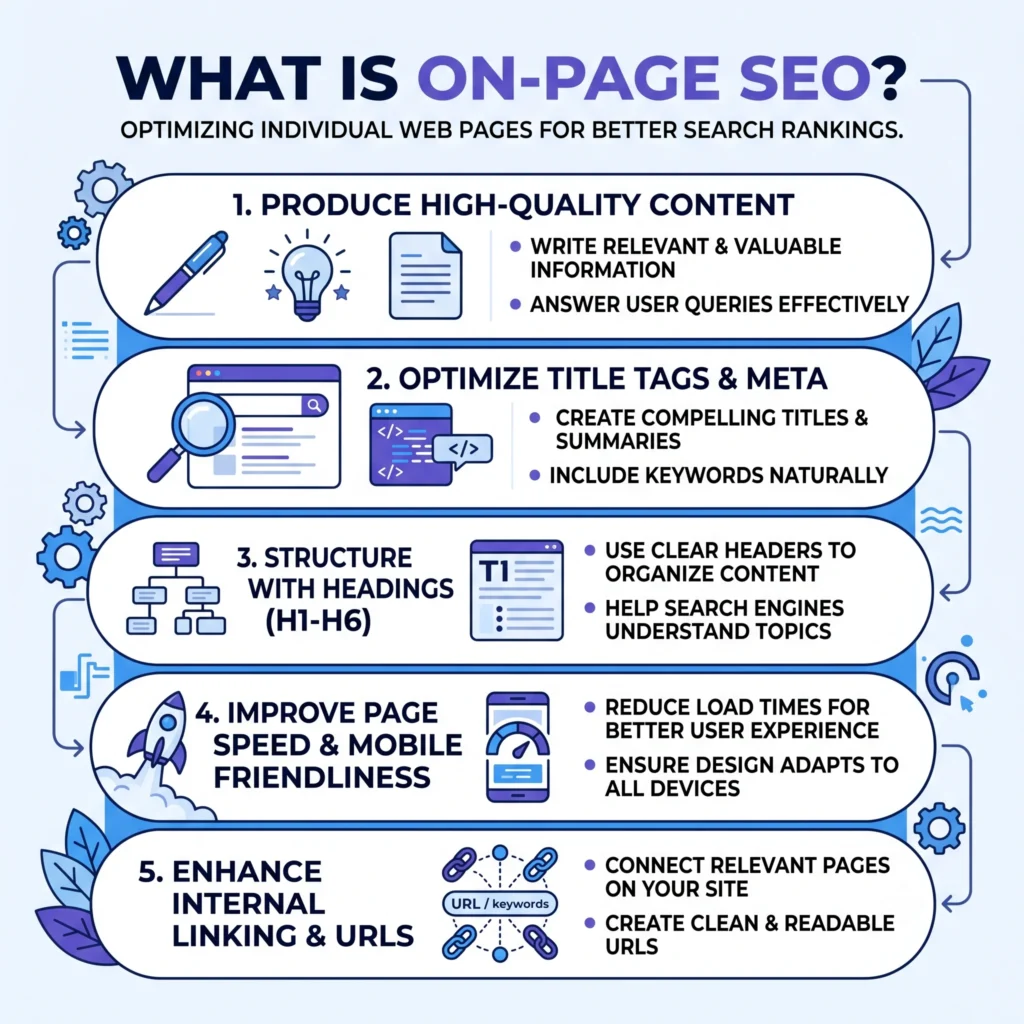
On-page SEO is one of the core pillars of search engine optimization, but it’s only one part of a successful SEO strategy. If you’re still learning the fundamentals, our SEO Basics Guide explains how search engines work, why SEO matters, and how all the different SEO disciplines fit together.
Unlike off-page SEO, which happens outside your website (backlinks, social signals, brand mentions), on-page SEO is entirely within your control. It covers everything from the words on the page to the code behind it.
In simple terms: on-page SEO answers the question, “Does this page clearly tell Google (and readers) what it’s about, and does it deliver real value?”
Search engines like Google use signals from your page — title tags, headings, content quality, keyword placement, and structured data — to decide what the page is about and how well it satisfies search intent. Get these signals right, and you give your content a real shot at ranking.
Why Is On-Page SEO Important?
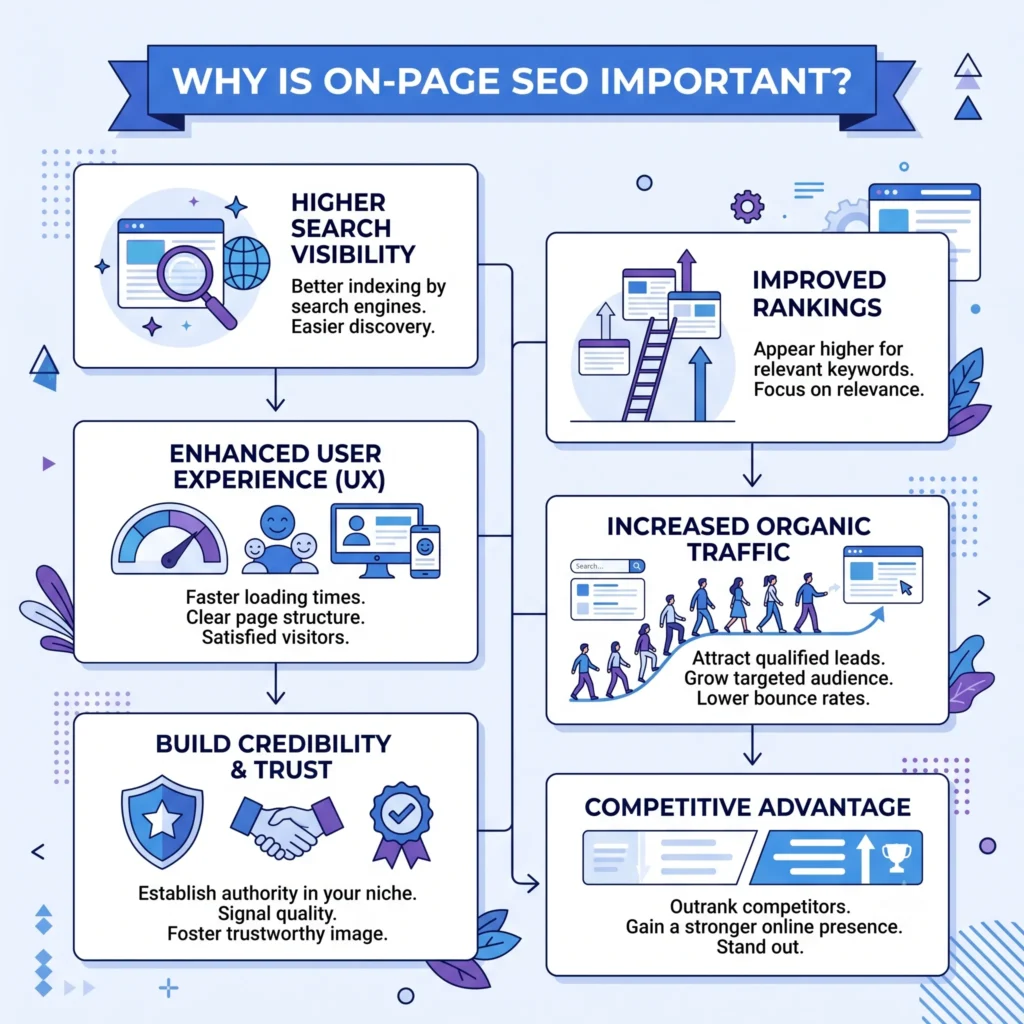
On-page SEO matters because it directly influences how Google interprets and ranks your content. Here’s why it deserves your attention:
- It drives organic traffic. Well-optimized pages are more likely to rank for relevant queries, bringing in visitors without paid ads.
- It improves search visibility. Clear titles, headings, and structured data help your pages appear in regular results, featured snippets, and rich results.
- It supports Google ranking factors. Content quality, keyword relevance, and page experience are all core inputs into how Google ranks pages.
- It enhances user experience. Fast-loading, well-structured, mobile-friendly pages keep visitors engaged rather than bouncing back to the search results.
- It builds topical authority. Consistent, well-optimized content around a subject signals to Google that your site is a credible source on that topic.
Simply put, on-page SEO is the foundation everything else is built on. Backlinks and technical fixes matter, but without solid on-page fundamentals, those efforts won’t reach their full potential.
On-Page SEO vs. Off-Page SEO vs. Technical SEO
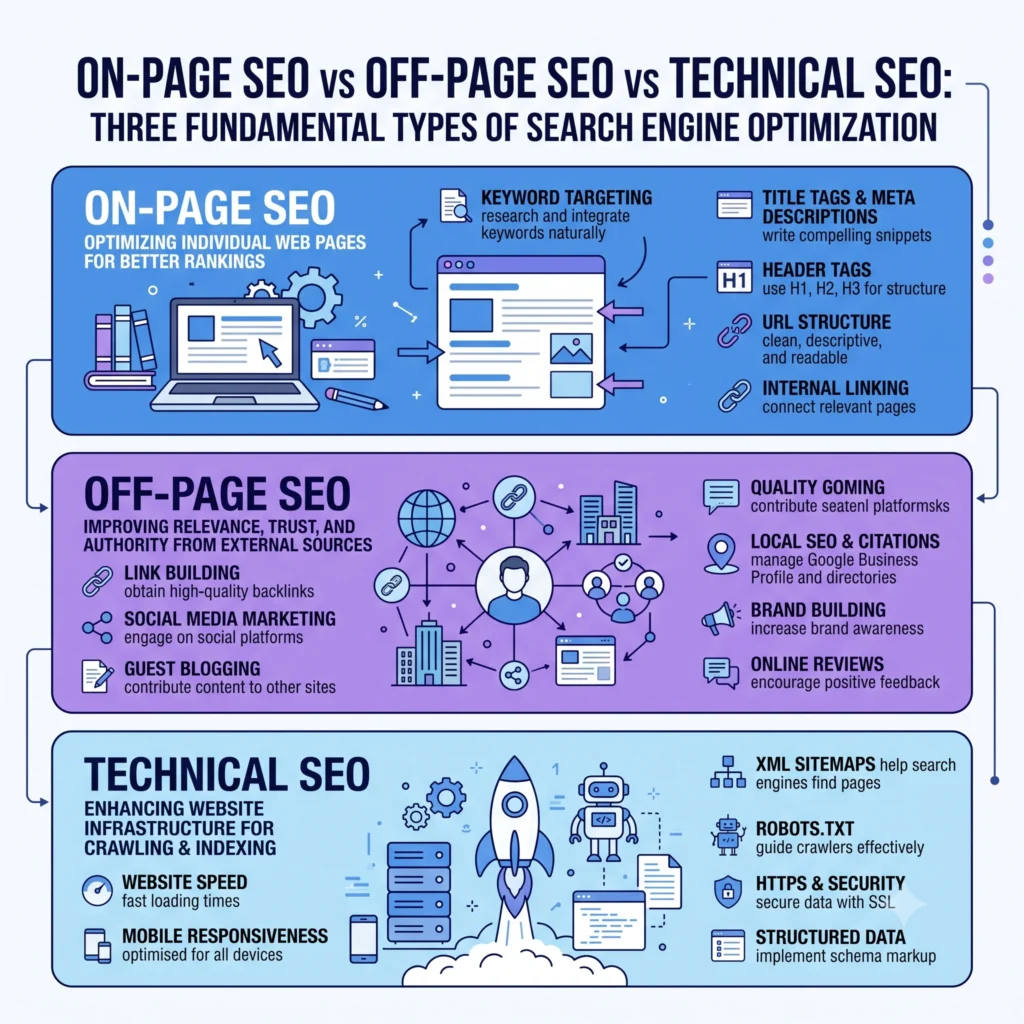
These three pillars of SEO often get confused, so here’s a clear breakdown:
| Type | What It Covers | Examples |
| On-Page SEO | Elements within a single page | Title tags, content, headings, internal links, images |
| Off-Page SEO | Signals from outside your website | Backlinks, brand mentions, social shares, digital PR |
| Technical SEO | Site-wide infrastructure and crawlability | XML sitemap, robots.txt, canonical tags, site speed |
Understanding the differences between on-page, off-page, and technical SEO is much easier when you have a strong foundation. Our Beginner’s Guide to SEO covers the essential concepts every website owner should know before diving into advanced optimization techniques.There’s overlap — for example, Core Web Vitals and page speed are sometimes classified under both on-page and technical SEO. The key takeaway is that all three work together. A page can have excellent content (on-page) but still fail to rank if the site has a poor crawl budget (technical) or no authoritative links pointing to it (off-page).
How Search Engines Understand and Rank Your Content
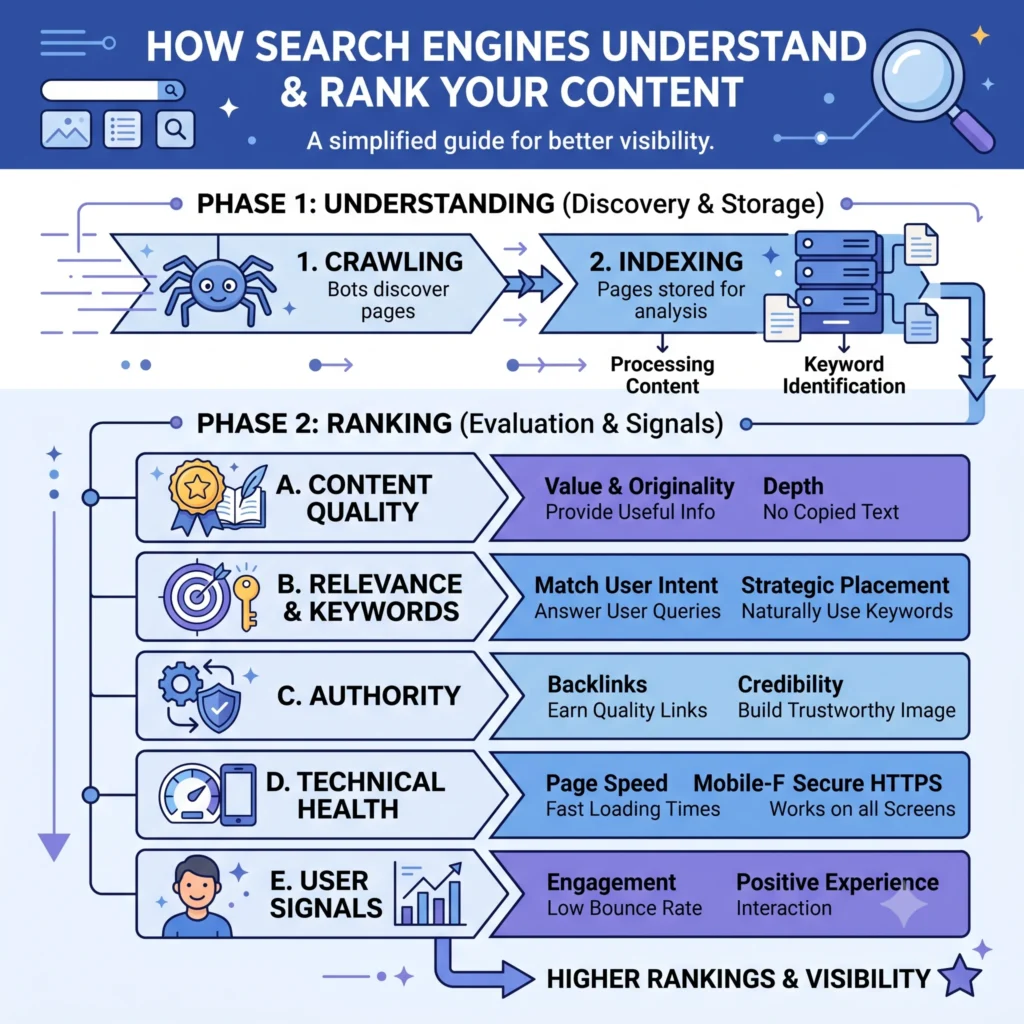
Before optimizing, it helps to understand how Google actually processes a page.
- Crawling — Googlebot discovers your page through links, sitemaps, or direct submission via Google Search Console.
- Indexing — Google analyzes and stores the page’s content, checking for indexability issues like duplicate content or noindex tags.
- Understanding — Using natural language processing (NLP) and semantic SEO analysis, Google identifies entities, topics, and search intent behind your content.
- Ranking — Google compares your page against others using hundreds of ranking factors, including relevance, authority, and page experience.
This is why semantic SEO and entity SEO matter so much today. Google doesn’t just match keywords anymore — it understands concepts, relationships between entities, and the overall topical relevance of your content. Writing naturally around a topic, and covering it thoroughly, tends to outperform pages that just repeat a keyword.
The Complete On-Page SEO Checklist
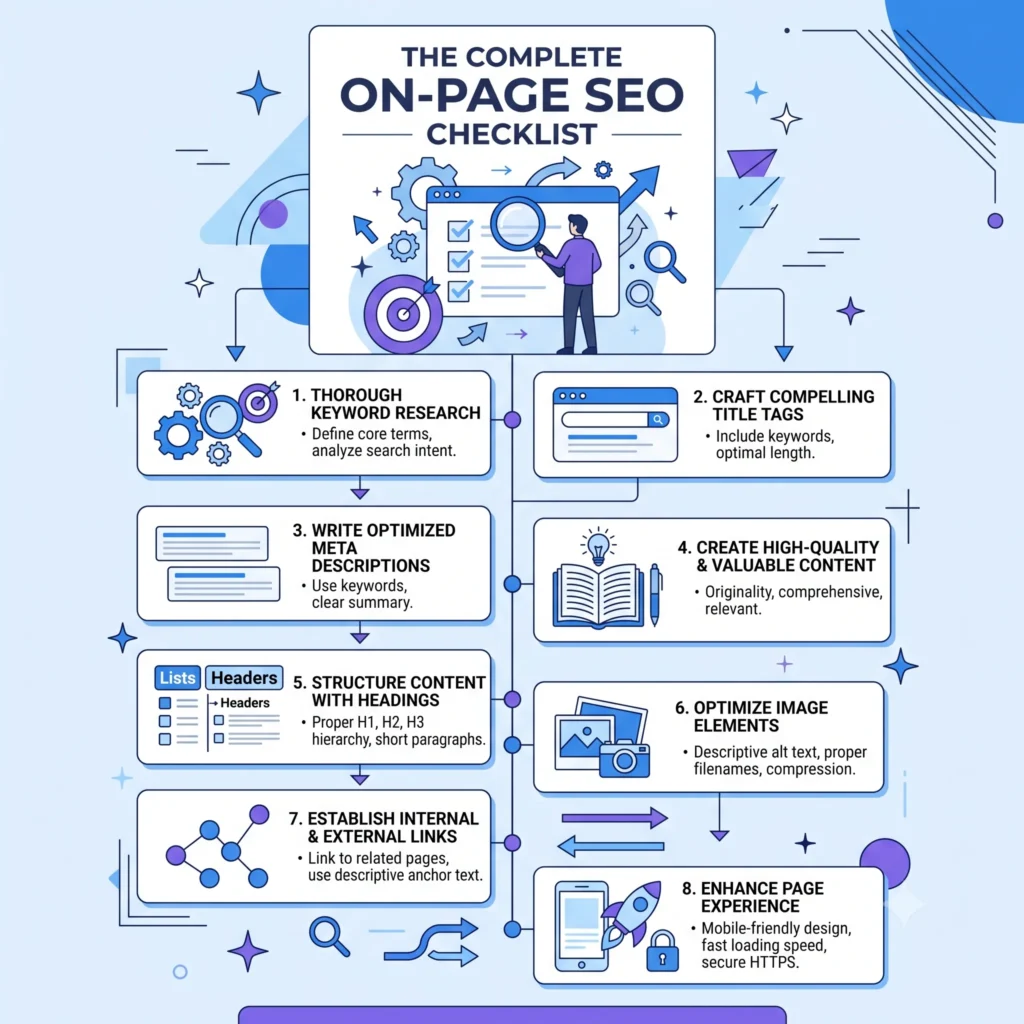
Here’s a quick-reference on-page SEO checklist covering the core on-page SEO factors:
- Target keyword in the title tag, H1, and URL
- Compelling meta description with a clear value proposition
- Short, descriptive URL structure
- Logical heading hierarchy (H1 → H2 → H3)
- Keyword placement in the first 100 words
- Natural keyword density (no stuffing)
- Content that fully matches search intent
- Internal links to relevant pages
- External links to authoritative sources
- Descriptive anchor text
- Optimized images with alt text and compressed file sizes
- Schema markup / structured data
- Mobile-friendly, responsive design
- Fast page speed and strong Core Web Vitals
- Original, high-quality, easy-to-read content
- Clear content structure for featured snippets and AI Overviews
We’ll walk through each of these in detail below.
How to Create SEO-Friendly Content That Ranks
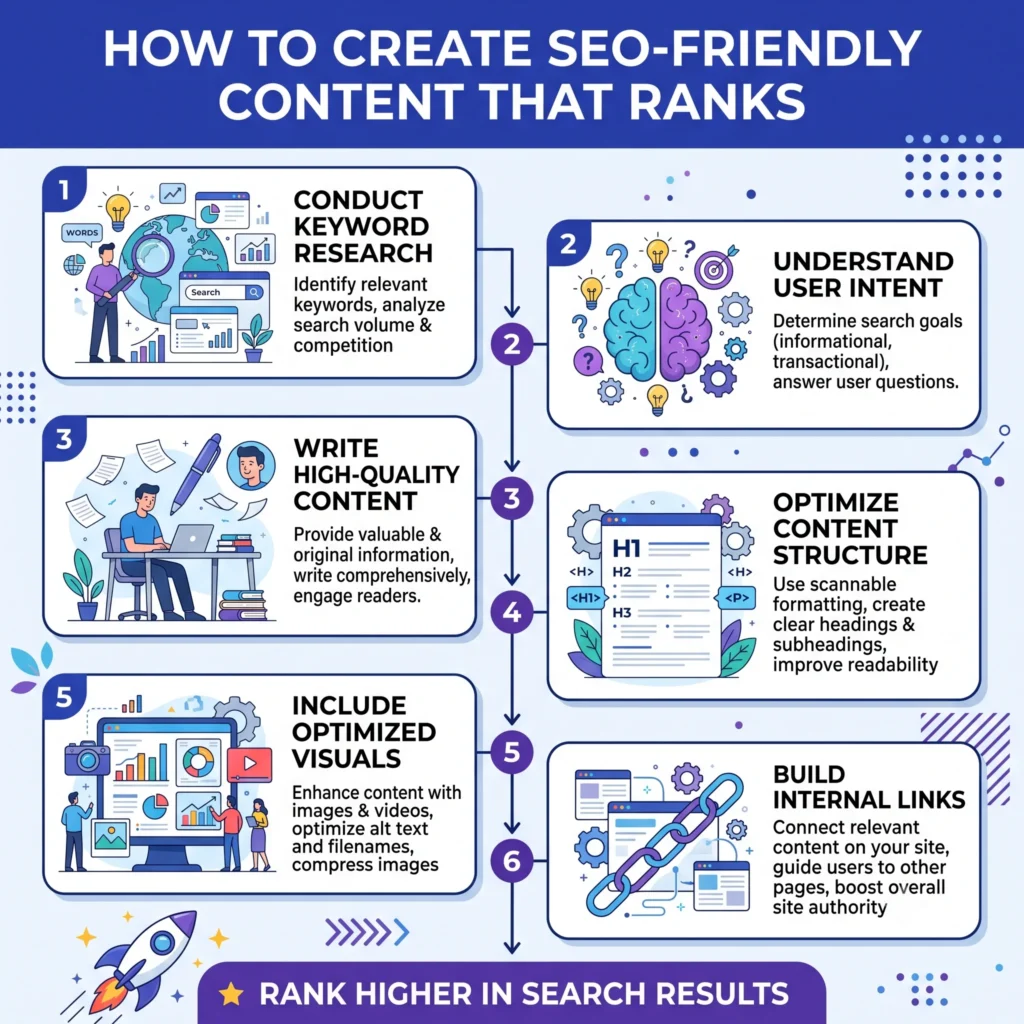
Content is still the heart of on-page SEO. Here’s how to approach content optimization the right way.
1. Start with search intent. Before writing a word, ask: what is the person searching for, and what result would satisfy them? Google groups intent into four types — informational, navigational, transactional, and commercial. Your content should match the dominant intent for your target keyword.
2. Write for humans first, search engines second. Content quality and readability matter more than exact-match keyword repetition. Use short paragraphs, simple language, and a logical flow.
3. Cover the topic comprehensively. Instead of obsessing over keyword density, think in terms of topical relevance. Address related questions, use relevant entities, and answer what a reader genuinely wants to know.
4. Avoid thin content and duplicate content. Pages with little original value, or content copied/spun from other sources, struggle to rank and can hurt the rest of your site’s credibility with Google.
5. Demonstrate EEAT. Google’s Experience, Expertise, Authoritativeness, and Trustworthiness (EEAT) guidelines reward content written by people with real knowledge or experience. Add author bios, cite credible sources, and share original insights or examples where possible.
Keyword Placement and Semantic SEO
Keyword placement still matters — just not in the old-school, stuff-it-everywhere sense. Aim to naturally include your primary focus keyword in:
- The H1
- The introduction (first 100 words)
- At least one H2 and one H3
- The meta title and meta description
- The URL
- The conclusion
- Naturally throughout the body content
Alongside your primary keyword, weave in secondary and long-tail keywords, plus related entities and synonyms. This is the essence of semantic SEO: helping search engines understand the full context of your topic rather than relying on one repeated phrase.
How to Optimize Title Tags, Meta Descriptions, and URLs
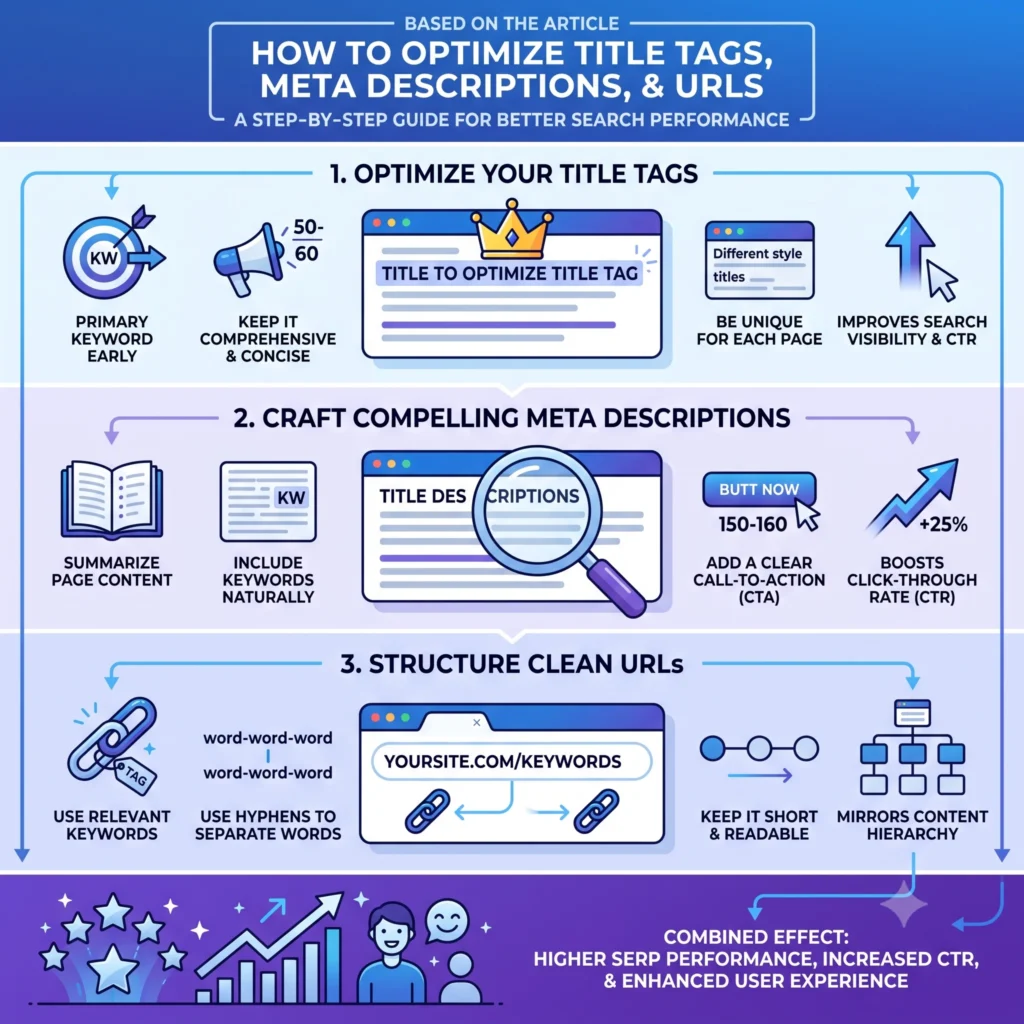
These three elements are often the first impression searchers get of your page — get them right and you improve both rankings and click-through rate (CTR).
Title Tag Optimization
- Keep titles under ~60 characters
- Place the primary keyword near the beginning
- Make it specific and benefit-driven, not generic
Meta Description
- Keep it under ~155–160 characters
- Include the focus keyword naturally
- Write it like ad copy — clear, compelling, and honest about what the page delivers
URL Structure
- Keep the URL slug short and descriptive
- Include the primary keyword
- Avoid stop words, dates, and unnecessary parameters
- Use hyphens to separate words
Example: instead of yoursite.com/blog/post?id=4821, use yoursite.com/on-page-seo-guide. Google’s own URL structure best practices documentation goes into more detail on avoiding overly complex, parameter-heavy URLs.
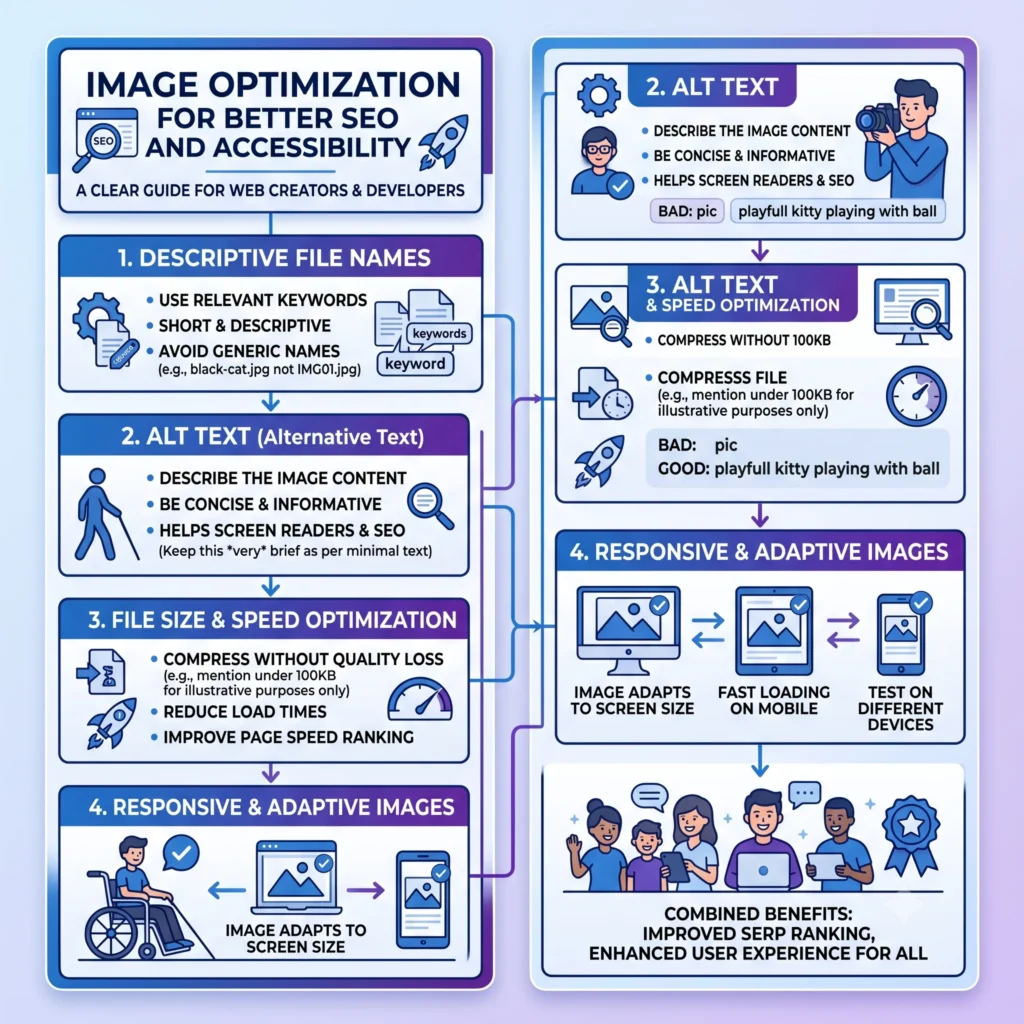
How to Use Headings, Keywords, and Internal Links Effectively
Header tags (H1, H2, H3) create a logical structure that helps both readers and search engines scan your content.
- Use exactly one H1 per page — it should contain your primary keyword.
- Use H2 headings to break down major sections (as in this guide).
- Use H3 subheadings for supporting points within a section.
- Keep headings descriptive rather than clever-but-vague.
Internal linking connects related pages on your site, distributing authority and helping Google understand your site’s structure.
- Link to relevant, related content using descriptive anchor text (avoid generic “click here” links)
- Prioritize linking to important pages you want to rank
- Don’t overdo it — a handful of relevant, natural links beats a wall of links
External linking to authoritative, trustworthy sources (like Google’s own documentation or reputable industry sites) can reinforce your content’s credibility and support EEAT.
Image Optimization for Better SEO and Accessibility
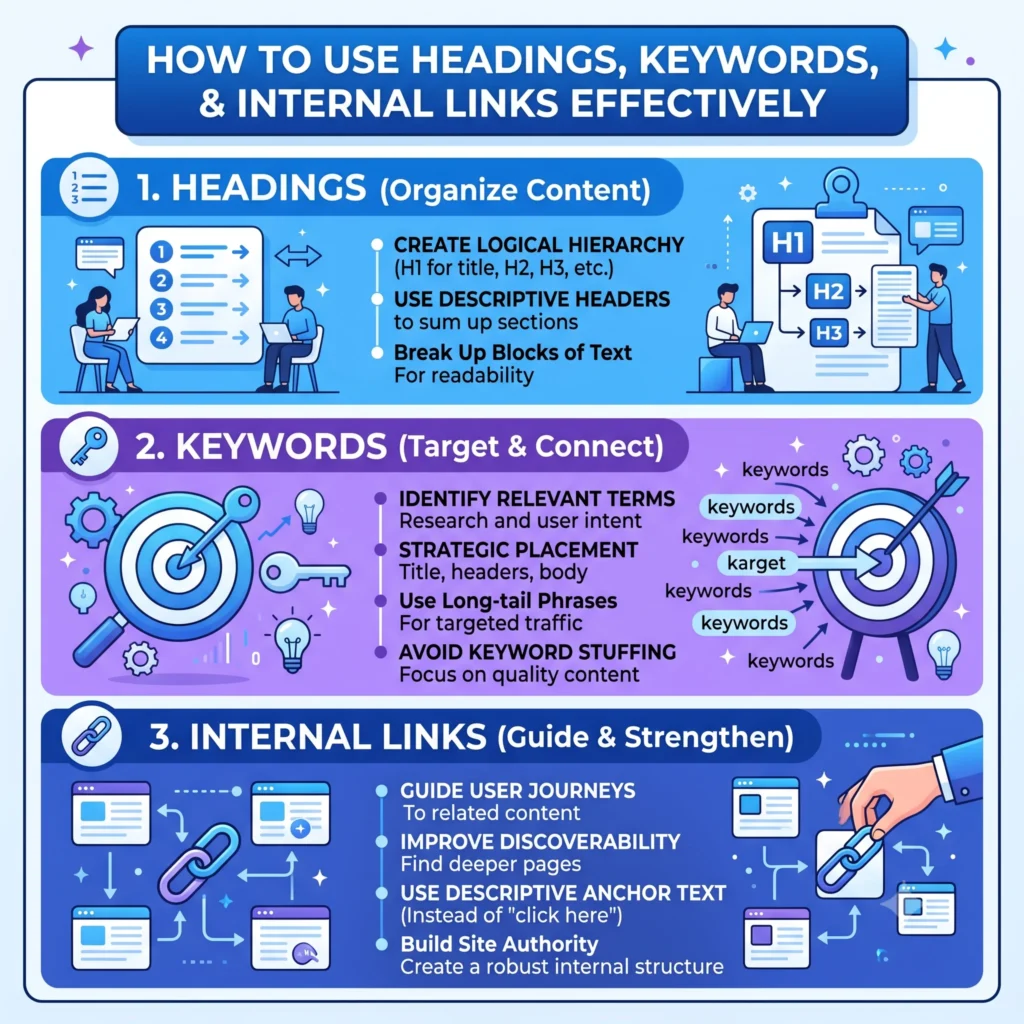
Images affect both user experience and SEO. Here’s how to optimize them:
- Image file names: Use descriptive, keyword-relevant file names (e.g., on-page-seo-checklist.jpg instead of IMG_2931.jpg)
- Image alt text: Write concise, descriptive alt text that describes the image — this helps accessibility and gives search engines more context
- Compression: Compress images to reduce file size without sacrificing quality, which improves page speed
- Responsive images: Use appropriately sized images for different devices to support a responsive design
- Modern formats: Consider WebP or AVIF for smaller file sizes with strong visual quality
Schema Markup and Rich Results Optimization
Schema markup (structured data, typically written in JSON-LD format based on Schema.org vocabulary) helps search engines understand your content at a deeper level and can unlock rich results in search — like star ratings, FAQs, breadcrumbs, or how-to steps.
Common schema types for on-page SEO include:
- Article schema for blog posts
- FAQ schema for question-and-answer sections
- HowTo schema for step-by-step guides
- Breadcrumb schema for navigation context
- Product/Review schema for e-commerce pages
You can implement schema manually using JSON-LD, or through plugins like Yoast SEO or Rank Math if you’re on WordPress. The Schema.org vocabulary reference is the canonical source for available schema types and properties. Once implemented, test it using Google’s Rich Results Test to confirm it’s valid and eligible for rich results.
Improve User Experience (UX) and Core Web Vitals
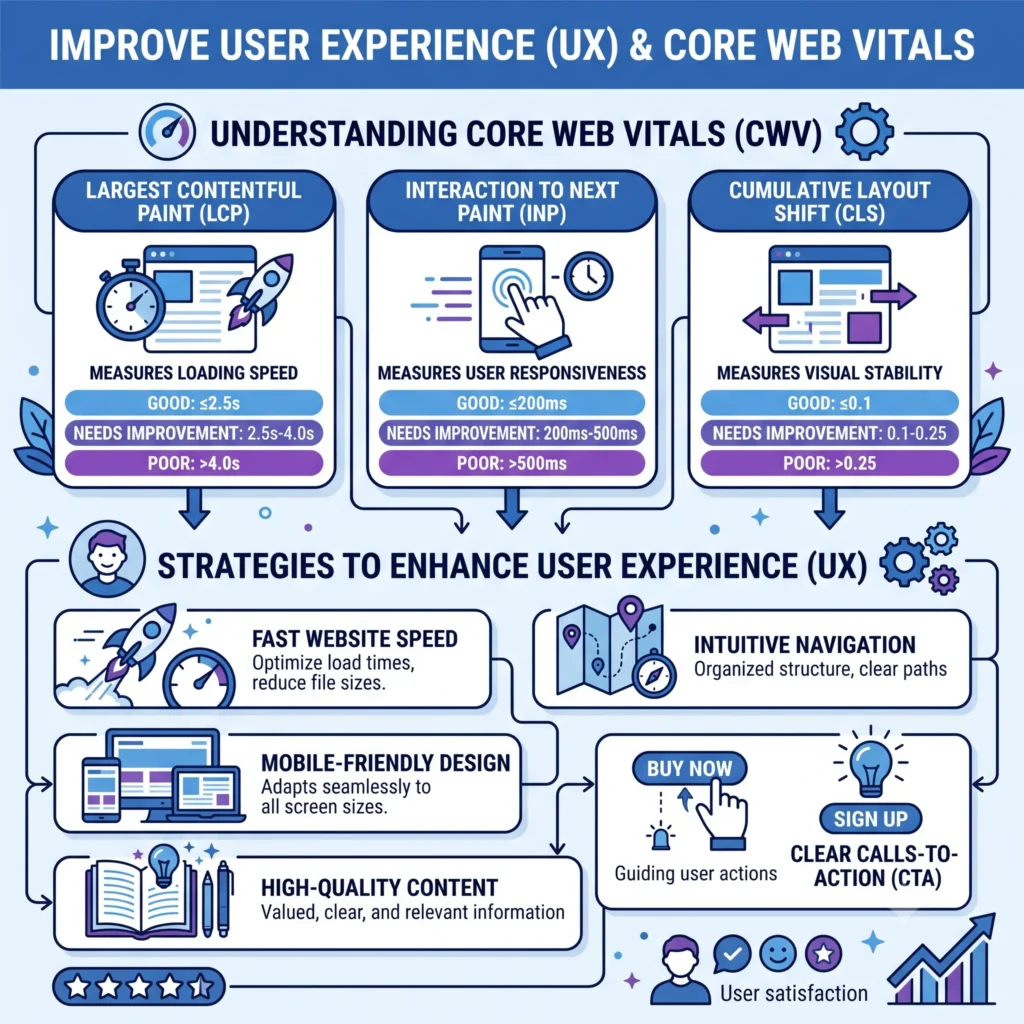
Google’s page experience signals are now a meaningful part of on-page SEO. The most important of these are Core Web Vitals:
- Largest Contentful Paint (LCP) — measures loading performance; aim for under 2.5 seconds
- Interaction to Next Paint (INP) — measures responsiveness to user interaction
- Cumulative Layout Shift (CLS) — measures visual stability; aim for a score under 0.1
To improve these metrics and overall page speed:
- Compress and lazy-load images
- Minimize unnecessary JavaScript and CSS
- Use a fast, reliable hosting provider or CDN
- Ensure your site uses a mobile-friendly, responsive design
- Test regularly with Google PageSpeed Insights or Google Lighthouse
Beyond the metrics, focus on genuine user experience: easy navigation, readable font sizes, minimal intrusive pop-ups, and clear calls to action.
How to Optimize for AI Search, Featured Snippets, and Zero-Click Results
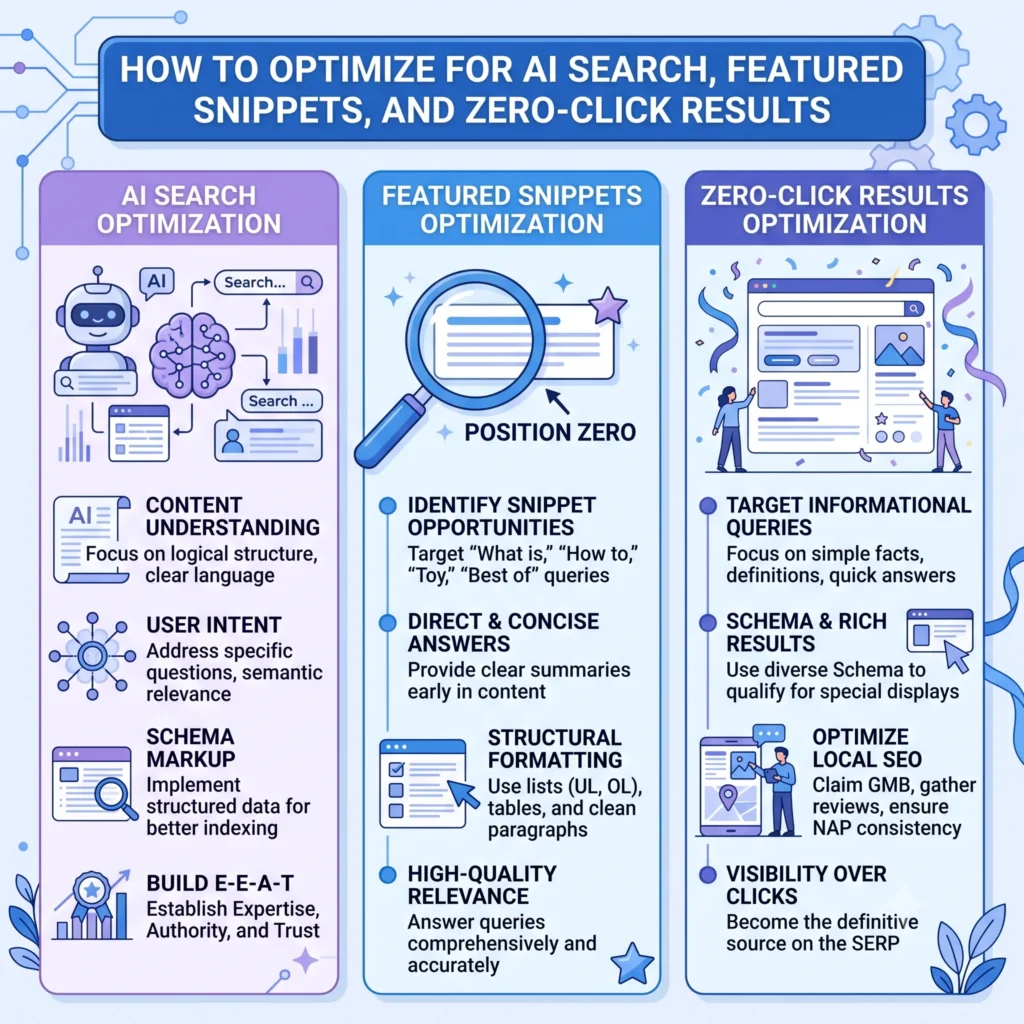
Search is evolving fast. Beyond traditional blue links, your content now needs to compete for visibility in AI Overviews, featured snippets, and answers surfaced by tools like ChatGPT, Gemini, and Perplexity.
Here’s how to optimize for AI search and zero-click search environments:
- Answer questions directly and early. Provide a clear, concise answer near the top of a section — AI systems and featured snippets favor extractable, well-structured answers.
- Use structured formatting. Bullet points, numbered lists, and tables are easier for both readers and AI tools to parse and quote.
- Add an FAQ section. Directly addressing common questions increases your chances of being pulled into AI Overviews and featured snippets.
- Strengthen EEAT signals. AI systems tend to favor content that demonstrates real expertise and trustworthiness, since they’re optimized to reduce misinformation.
- Use schema markup. Structured data helps AI crawlers and search engines understand your content’s structure and purpose more reliably.
- Focus on topical depth. Comprehensive, well-organized content is more likely to be referenced as a source, even in zero-click search results where the user never clicks through.
Even though zero-click search can reduce direct traffic for some queries, being cited as a source in AI Overviews still builds brand visibility and trust.
Advanced On-Page SEO Strategies
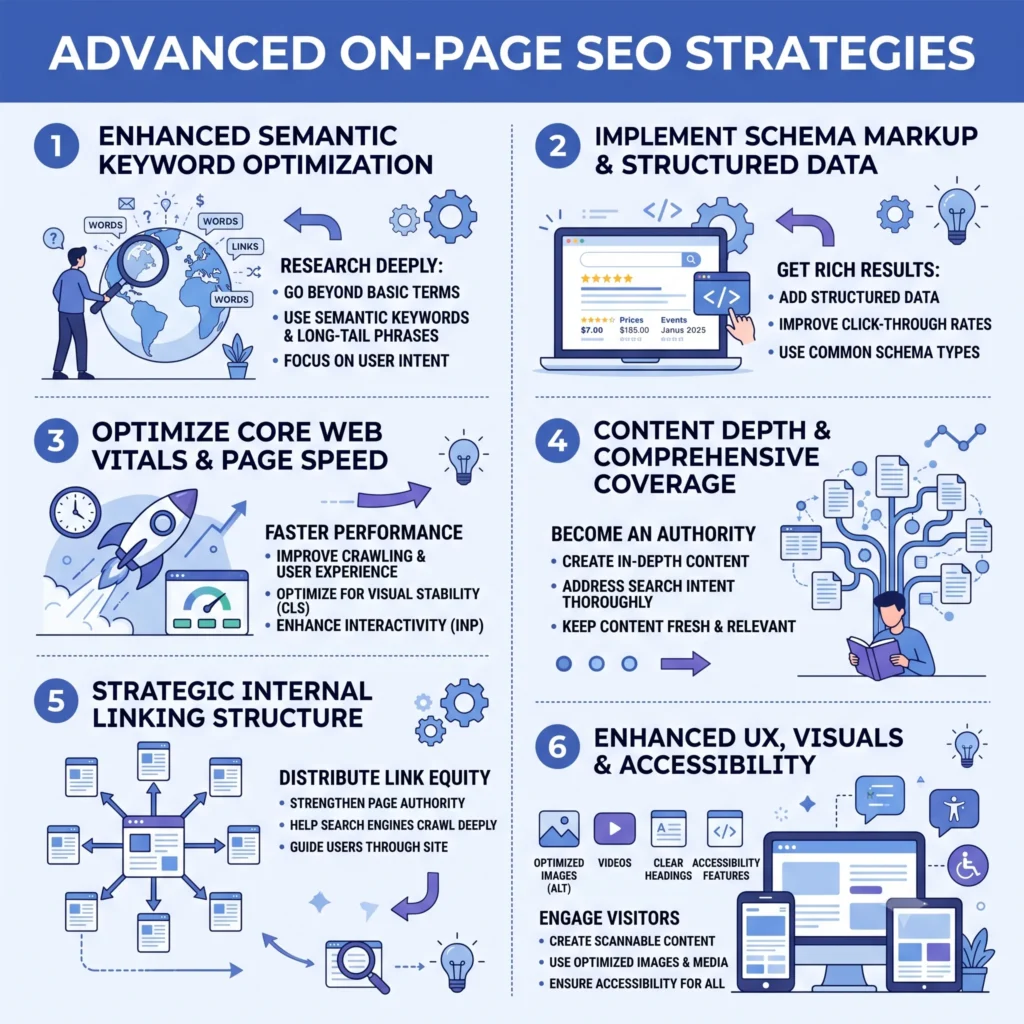
Once the fundamentals are solid, consider these advanced on-page SEO techniques:
- Topic clusters and pillar pages — Organize content around a central “pillar” page with supporting cluster content, all interlinked, to build topical authority.
- Content pruning and updates — Regularly refresh outdated content, update statistics, and merge or remove thin, underperforming pages.
- Entity optimization — Reference and link to well-known entities (people, brands, concepts) relevant to your topic to strengthen semantic SEO signals.
- Search intent segmentation — Create different content formats (guides, comparisons, product pages) tailored to different stages of the buyer journey.
- People-first content audits — Periodically evaluate whether your content genuinely helps readers, in line with Google’s Helpful Content system.
Common On-Page SEO Mistakes to Avoid
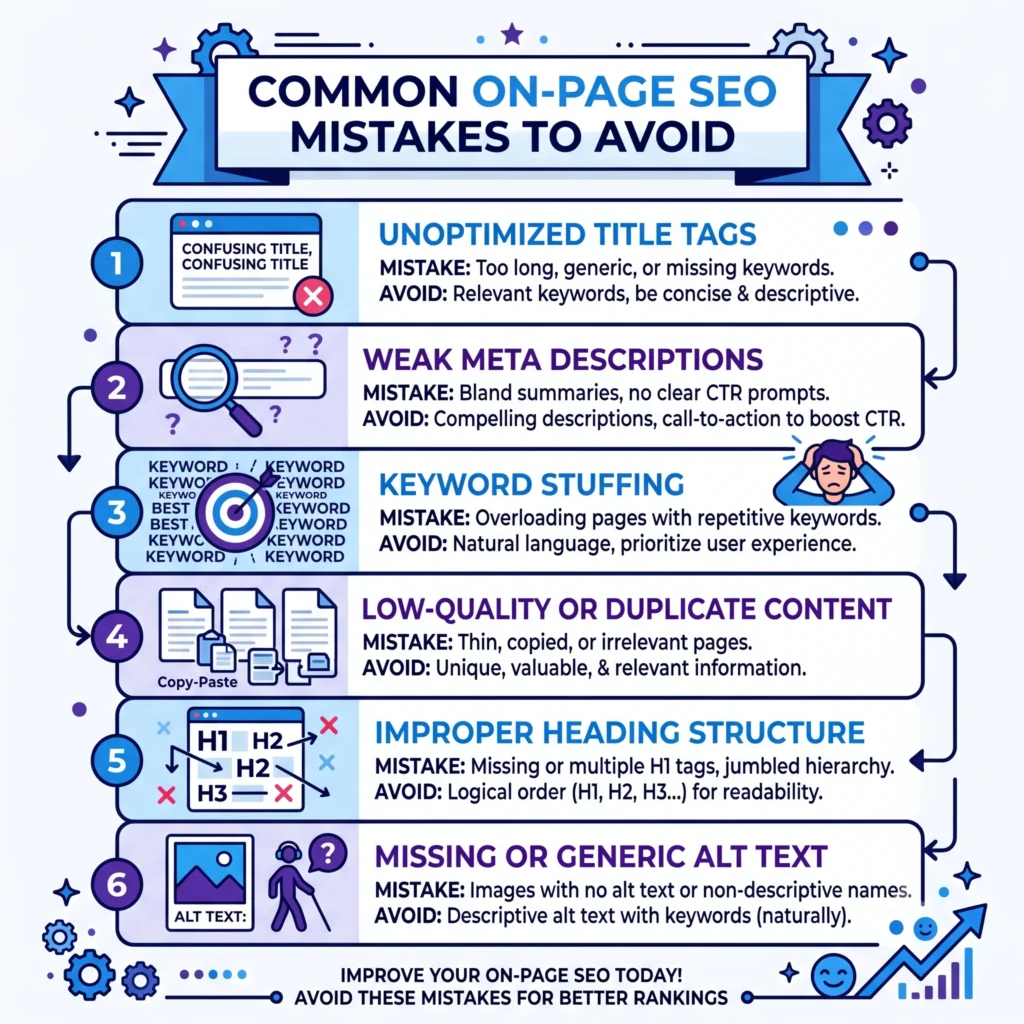
Even experienced site owners fall into these traps:
- Keyword stuffing — Overusing your focus keyword makes content unnatural and can hurt rankings.
- Duplicate content — Publishing near-identical content across multiple pages confuses search engines about which page to rank.
- Thin content — Pages with little substance rarely rank, no matter how well-optimized the tags are.
- Missing or generic meta descriptions — This hurts CTR even if your page ranks well.
- Ignoring mobile-friendliness — With mobile-first indexing, a poor mobile experience directly hurts rankings.
- Weak internal linking — Orphaned pages with no internal links are harder for Google to crawl and understand.
- Skipping alt text — This is a missed opportunity for both accessibility and image search visibility.
- Overlooking page speed — Slow pages frustrate users and can lower rankings, especially on mobile.
Best On-Page SEO Tools
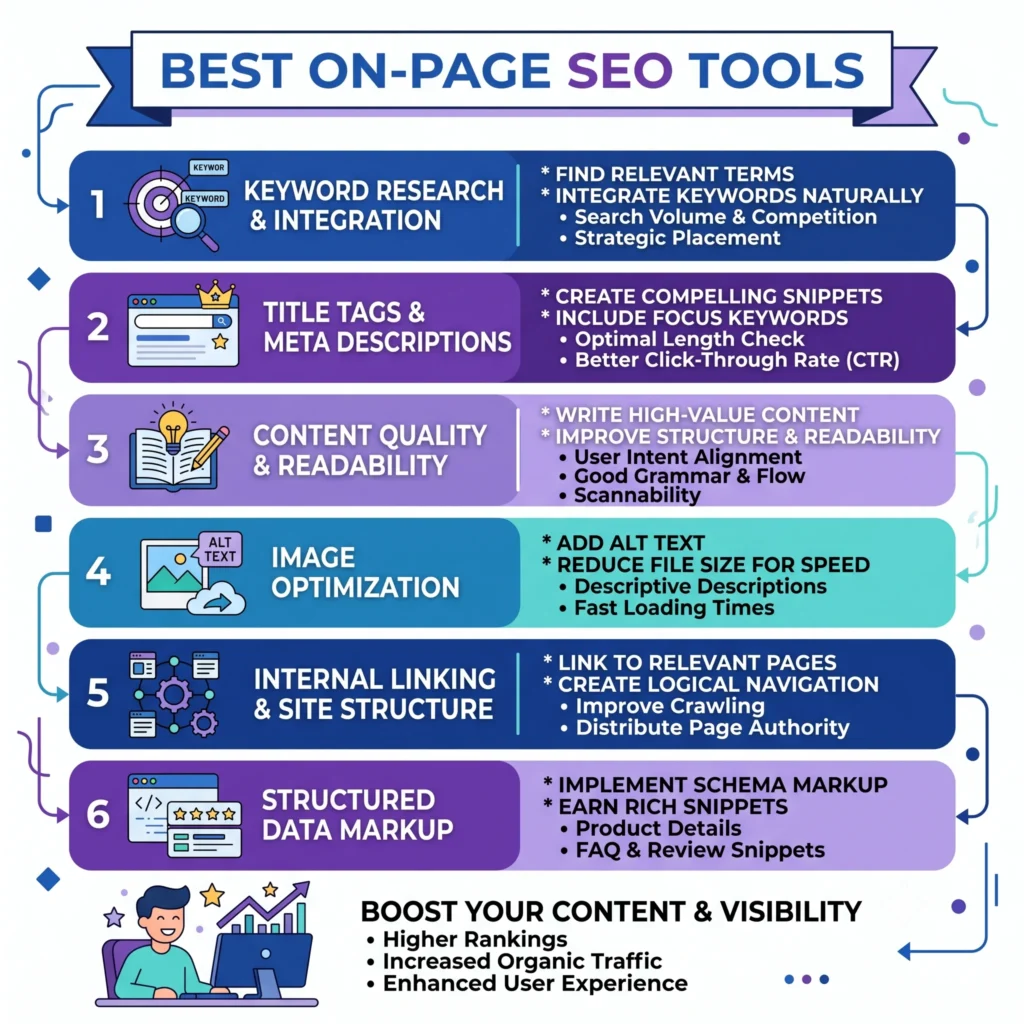
These tools can help you research, implement, and audit your on-page SEO:
- Google Search Console — Monitor indexing, search performance, and crawlability issues
- Google Analytics 4 — Track user behavior and organic traffic performance
- Google PageSpeed Insights and Google Lighthouse — Measure Core Web Vitals and page speed
- Google Rich Results Test — Validate your schema markup
- Google Keyword Planner — Research keyword ideas and search volume
- Semrush and Ahrefs — Comprehensive keyword research, competitor analysis, and site audits
- Screaming Frog — Crawl your site to find technical and on-page issues at scale
- Yoast SEO and Rank Math — WordPress plugins for on-page optimization and schema implementation
How to Measure On-Page SEO Success
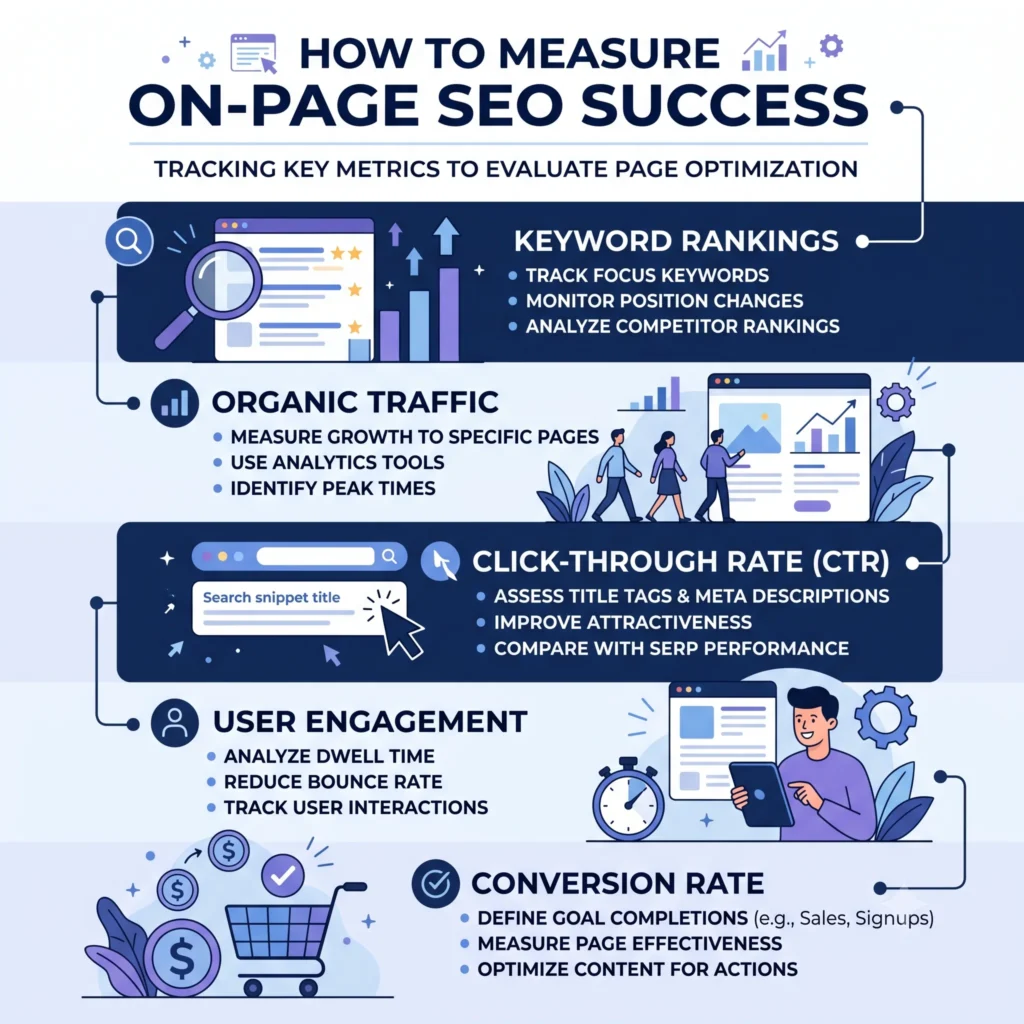
On-page SEO isn’t a one-time task — it requires ongoing measurement. Track these metrics:
- Organic traffic — Are your optimized pages attracting more visitors from search?
- Search engine rankings — Is your target keyword and its related long-tail keywords moving up in the SERP?
- Click-through rate (CTR) — Are people clicking your result when it appears in search?
- Core Web Vitals scores — Are LCP, INP, and CLS within recommended thresholds?
- Indexability and crawl status — Use Google Search Console to confirm pages are indexed without errors.
- Engagement metrics — Time on page, bounce rate, and scroll depth can hint at whether content matches search intent.
Review these metrics monthly, and treat on-page SEO as an ongoing cycle: optimize, measure, refine, repeat.
On-Page SEO Checklist (Quick Summary)
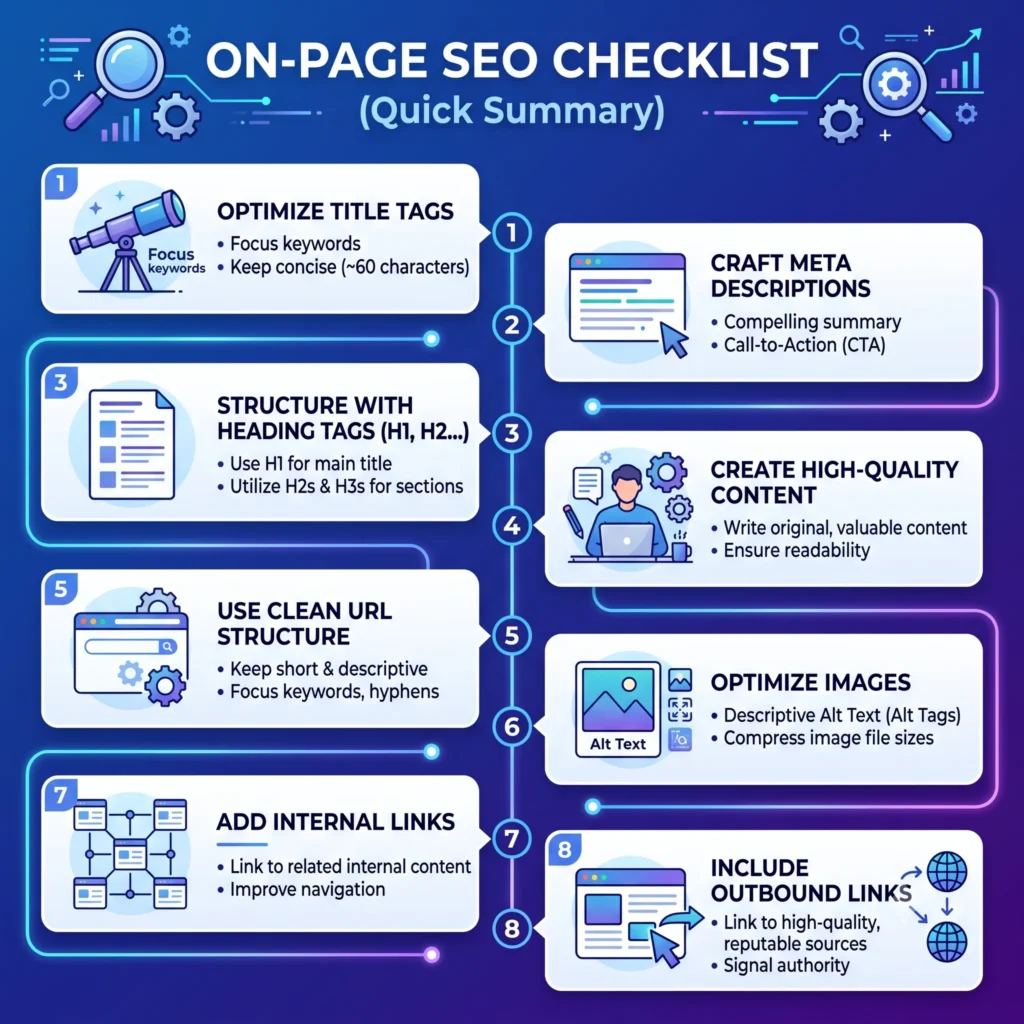
A fast recap of the essentials covered in this guide:
- Research search intent before writing
- Optimize the title tag, meta description, and URL
- Use one H1 and a logical H2/H3 structure
- Place your focus keyword naturally throughout
- Write original, comprehensive, easy-to-read content
- Add internal and external links with descriptive anchor text
- Optimize images (file names, alt text, compression)
- Implement schema markup for rich results
- Improve Core Web Vitals and overall page speed
- Ensure a mobile-friendly, responsive design
- Add an FAQ section to support AI Overviews and featured snippets
- Track rankings, traffic, and CTR to refine over time
Conclusion
On-page SEO is one of the most important parts of a successful SEO strategy, but it’s only one piece of the puzzle. To achieve long-term organic growth, it’s essential to understand how search engines work and how all SEO disciplines fit together. If you’re just getting started, read our SEO Basics: The Complete Beginner’s Guide to build a strong foundation before moving on to advanced optimization techniques.
Search is evolving toward AI-driven, zero-click experiences, but the fundamentals haven’t changed: create genuinely helpful content, structure it clearly, and make it easy for both search engines and readers to understand. Use the on-page SEO checklist in this guide as your starting point, and revisit it regularly as your site grows.
Frequently Asked Questions (FAQ)
What are the 4 types of SEO?
The four main types of SEO are On-Page SEO, Off-Page SEO, Technical SEO, and Local SEO. Together, they improve your website’s visibility, rankings, and overall search performance.
What is the difference between On-Page and Off-Page SEO?
On-Page SEO focuses on optimizing your website’s content, HTML, and user experience, while Off-Page SEO involves building authority through backlinks, brand mentions, and external signals.
What is the difference between Technical SEO and On-Page SEO?
Technical SEO improves your website’s infrastructure, such as page speed, indexing, and crawlability, whereas On-Page SEO optimizes content, keywords, titles, and other page elements.
How to do On-Page SEO step by step?
Start with keyword research, then optimize your title, meta description, URL, headings, and content. Finally, add internal links, optimize images, improve page speed, and implement schema markup.
Which tool is best for On-Page SEO?
Semrush is one of the best all-in-one tools for on-page SEO, while Google Search Console, Ahrefs, and Screaming Frog are also excellent for optimization and performance analysis.
FluxSEO’s Team creates practical, beginner-friendly guides on SEO, blogging, keyword research and digital growth. Our goal is to simplify search engine optimization and help website owners improve visibility, rankings and organic traffic with clear, actionable advice.