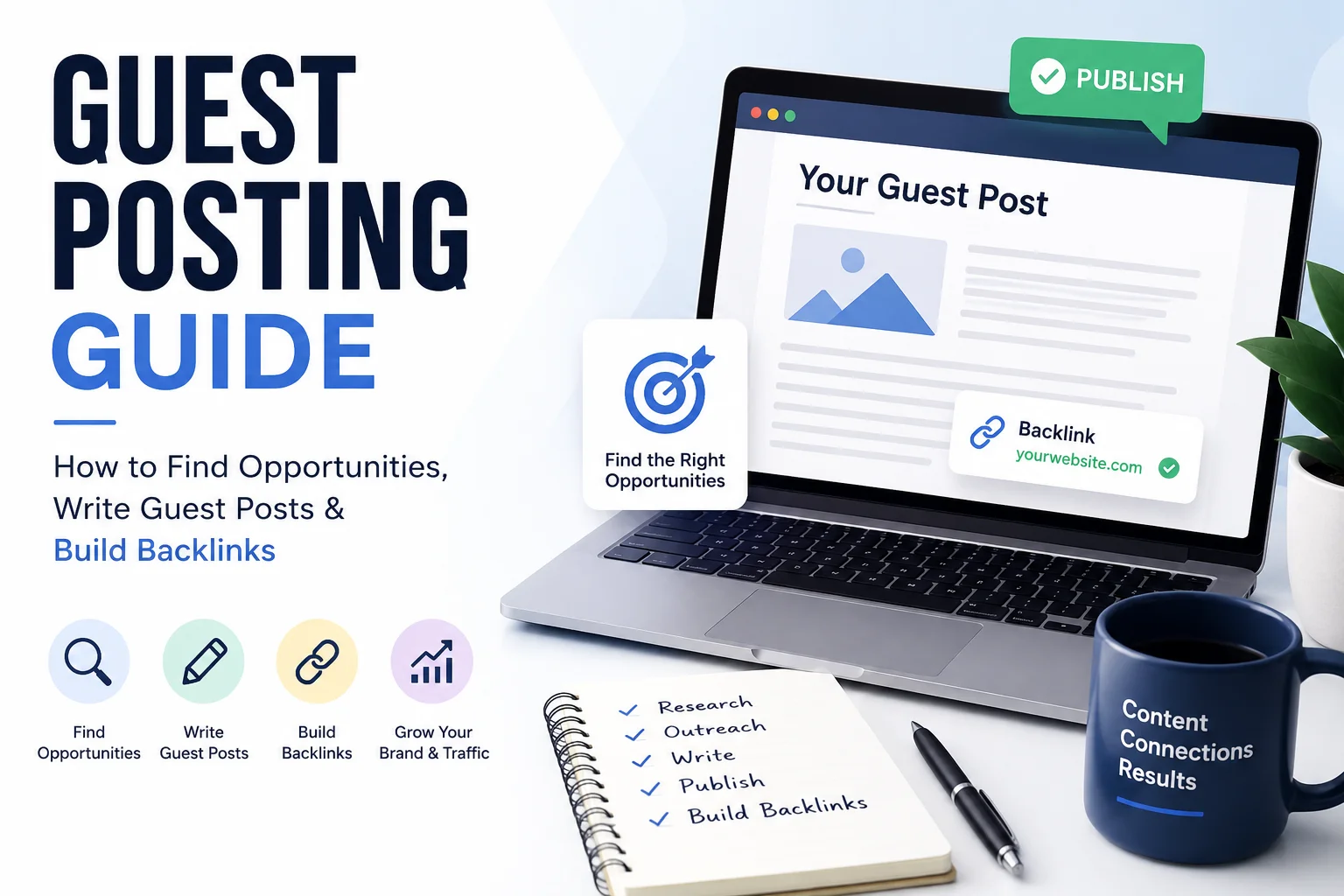
If you’ve ever wondered how established brands seem to show up on every industry blog you read, the answer is usually guest posting. This guest posting guide walks you through the entire process from finding guest posting opportunities to writing a guest post that gets accepted, pitching editors, and building backlinks that actually move the needle for your website authority. Guest posting is just one approach to earning links; our complete link building guide covers additional strategies for building high-quality backlinks.
Whether you’re a blogger, a business owner, or an SEO professional, this guest posting guide is written to be beginner-friendly while still covering the strategy that experienced marketers use to get published on authoritative websites.
What Is Guest Posting and How Does It Work?

Guest posting (also called guest blogging) is the practice of writing and publishing an article on someone else’s website, usually in exchange for a byline, an author bio, and a link back to your own site. In simple terms, you contribute content to another publication, and in return you get exposure to their existing audience plus a backlink that can support your SEO strategy.
Here’s how guest posting works in practice: a contributor identifies a relevant blog in their niche, pitches a topic idea to the site’s editorial team, writes an original article that follows the site’s guidelines, and submits it for review. Once approved, the article is published with a contributor bio that usually includes a link to the guest author’s website.
Guest posting sits at the intersection of content marketing and off-page SEO. It’s not just about backlinks — it’s about relationship building with publishers, editors, and other content creators in your industry, and about putting your expertise in front of a new, engaged audience. This guest posting guide breaks each stage of that process down into clear, actionable steps.
Why Is Guest Posting Important for SEO and Brand Growth?
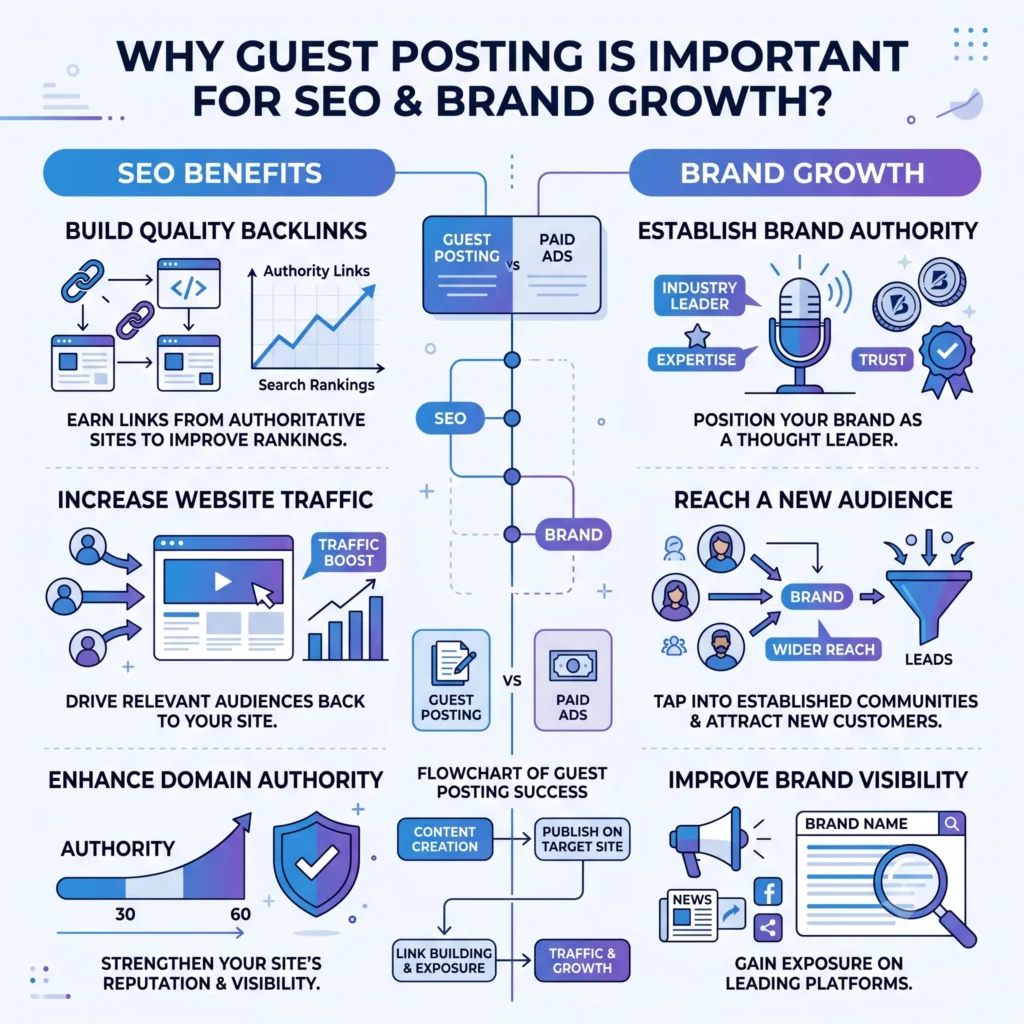
Guest posting remains one of the most reliable link building strategies because it delivers value on multiple fronts at once. It’s also important to understand how guest posting fits into the broader link building process and how different link acquisition strategies work together.
SEO benefits. High-quality backlinks from authoritative websites are still one of the strongest ranking signals in Google’s algorithm. Guest posting for SEO gives you contextual backlinks placed naturally within relevant content, which search engines tend to trust more than links from directories or low-effort sources.
Referral traffic. A well-placed guest post on a site with an engaged audience can send real readers to your website — not just link equity, but qualified, referral traffic that converts.
Website authority and brand visibility. Publishing on respected industry publications signals credibility. Over time, consistent guest blogging builds thought leadership, online authority, and brand recognition among your target audience.
Relationship building. Guest post outreach naturally builds publisher relationships. These connections often lead to future collaboration, more guest posting opportunities, and even business partnerships.
It’s worth noting that Google has repeatedly cautioned against large-scale, low-quality guest posting done purely to manipulate rankings, and has publicly urged site owners not to treat guest blogging as a shortcut for acquiring links. You can read Google’s official position in its spam policies documentation. The takeaway isn’t that guest posting is dead — it’s that guest posting for SEO only works long-term when it’s genuinely useful to the publishing site’s audience.
How to Find High-Quality Guest Posting Opportunities

Finding the right guest posting opportunities is often the hardest part of the process, and it’s where most beginners get stuck. Here are the proven methods this guest posting guide recommends for how to find guest posting sites in your niche:
- Search operators. Use Google search strings like “your niche” + “write for us”, “your niche” + “guest post guidelines”, or “your niche” + “contribute” to surface websites actively accepting guest posts.
- Competitor backlink analysis. Check where your competitors are getting backlinks using SEO tools. If a competitor has a guest post on a site, there’s a good chance that site accepts contributors.
- Industry directories and roundups. Many niches maintain curated lists of guest post submission sites and blogs open to contributors.
- Social media and communities. Editors and bloggers often post calls for contributors on LinkedIn, Twitter/X, and niche Facebook or Slack groups.
- Existing relationships. Reach out to sites you already read, comment on, or engage with. Familiarity makes blogger outreach far easier.
This kind of guest post outreach strategy takes time, but it builds a sustainable pipeline of guest blogging opportunities rather than a one-off list. For a deeper breakdown of outreach tactics, Ahrefs’ guide on guest blogging the right way is a useful reference to bookmark.
How to Evaluate Guest Posting Websites Before You Pitch
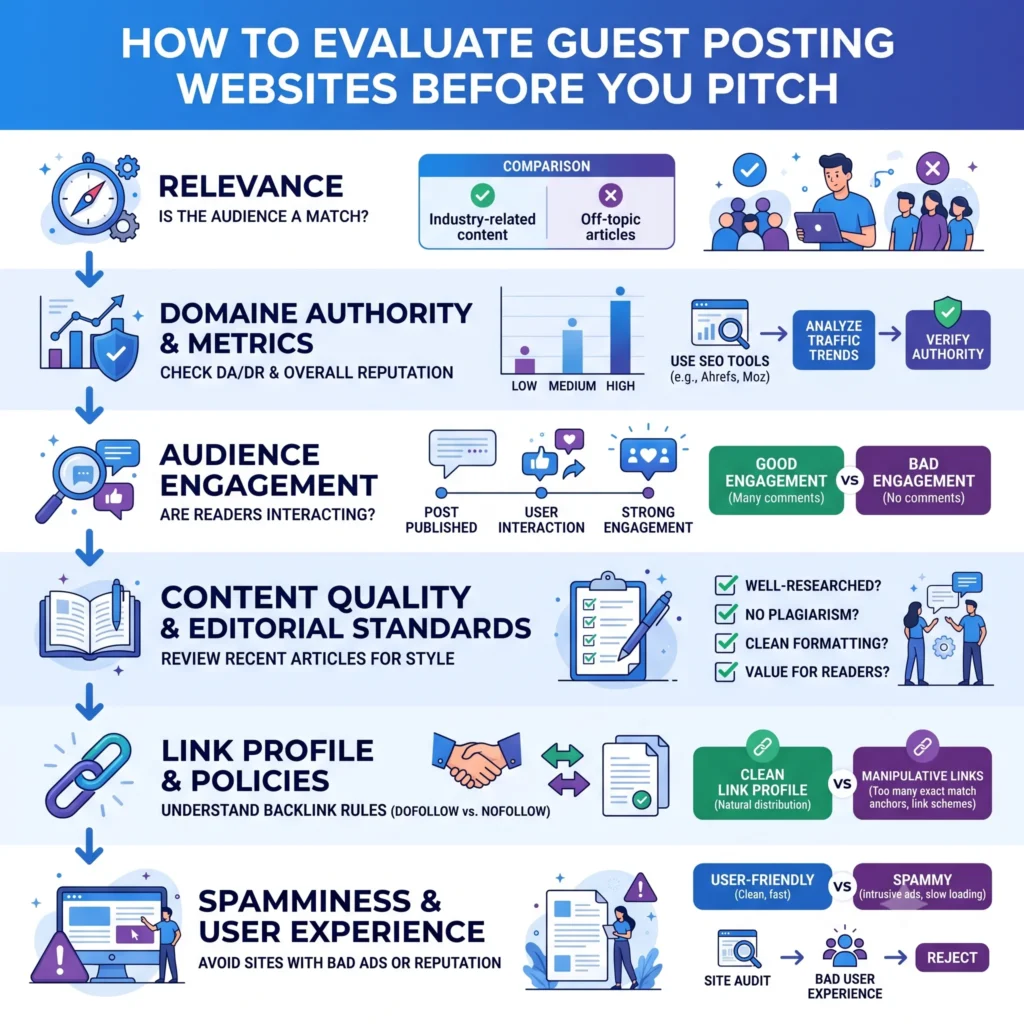
Not every guest posting site is worth your time, and skipping this step is one of the most common mistakes covered in this guest posting guide. Before pitching, evaluate potential guest posting websites on these criteria:
- Domain authority and domain rating. Higher authority sites pass more link equity and carry more credibility with readers.
- Topical relevance. A backlink from a site in your niche is worth far more than one from an unrelated industry. Domain relevance matters more than raw authority scores.
- Organic traffic. Check whether the site actually receives meaningful organic search traffic, not just inflated vanity metrics.
- Content quality. Read a few existing articles. Are they well-researched, original, and edited? Or thin and outdated?
- Editorial standards. Sites with clear contributor guidelines and an active editorial team tend to produce higher-quality guest posts — and Google views their links more favorably.
- Link practices. Avoid sites that openly sell links or accept any topic without review. This is a major red flag under Google’s link spam policies. Moz’s guide to guest blogging for SEO covers this evaluation process in more detail if you want a deeper dive.
How to Evaluate Guest Posting Websites Using Free Tools
You don’t need expensive software to vet a site. Google’s own site search (site:domain.com “guest post”), free backlink checkers, and simply browsing a site’s “Written by” archive can tell you a lot about whether a publication maintains real editorial standards or just publishes anything for a fee.
How to Find the Right Guest Post Topics
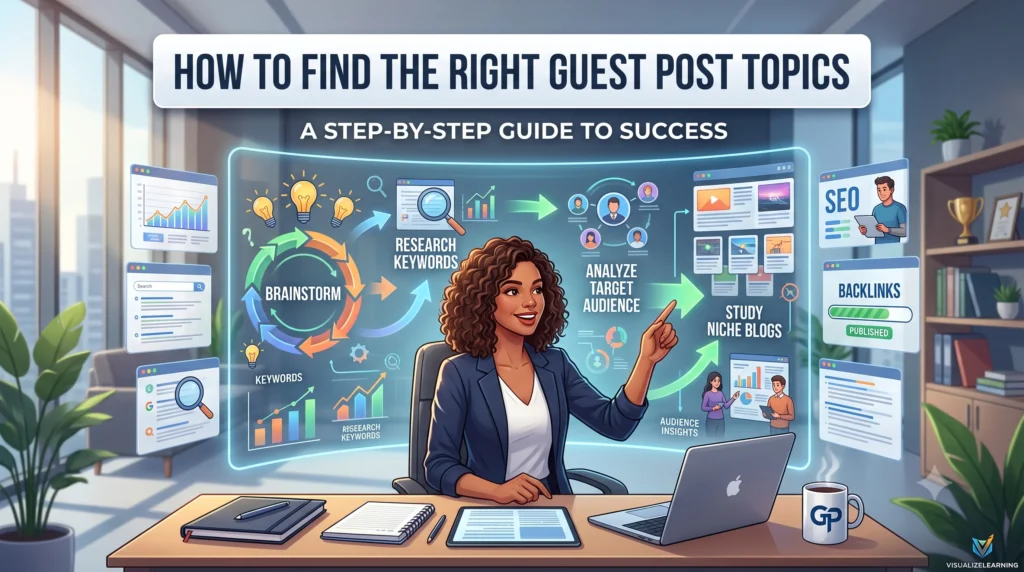
Even the best-written guest post won’t get accepted if the topic doesn’t fit. Here’s how to choose guest post topics editors actually want:
- Study the target publication. Look at their most shared or commented articles to understand what resonates with their audience.
- Identify content gaps. Find topics the site hasn’t covered yet, or angles they’ve only touched on briefly.
- Match search intent. Choose topics with genuine search demand, using keyword research tools to confirm interest.
- Bring original data or experience. Case studies, original research, and first-hand examples make a pitch stand out from generic advice.
- Check their content calendar. Some publications share upcoming themes; aligning your pitch with these increases acceptance odds.
How to Write a High-Quality Guest Post
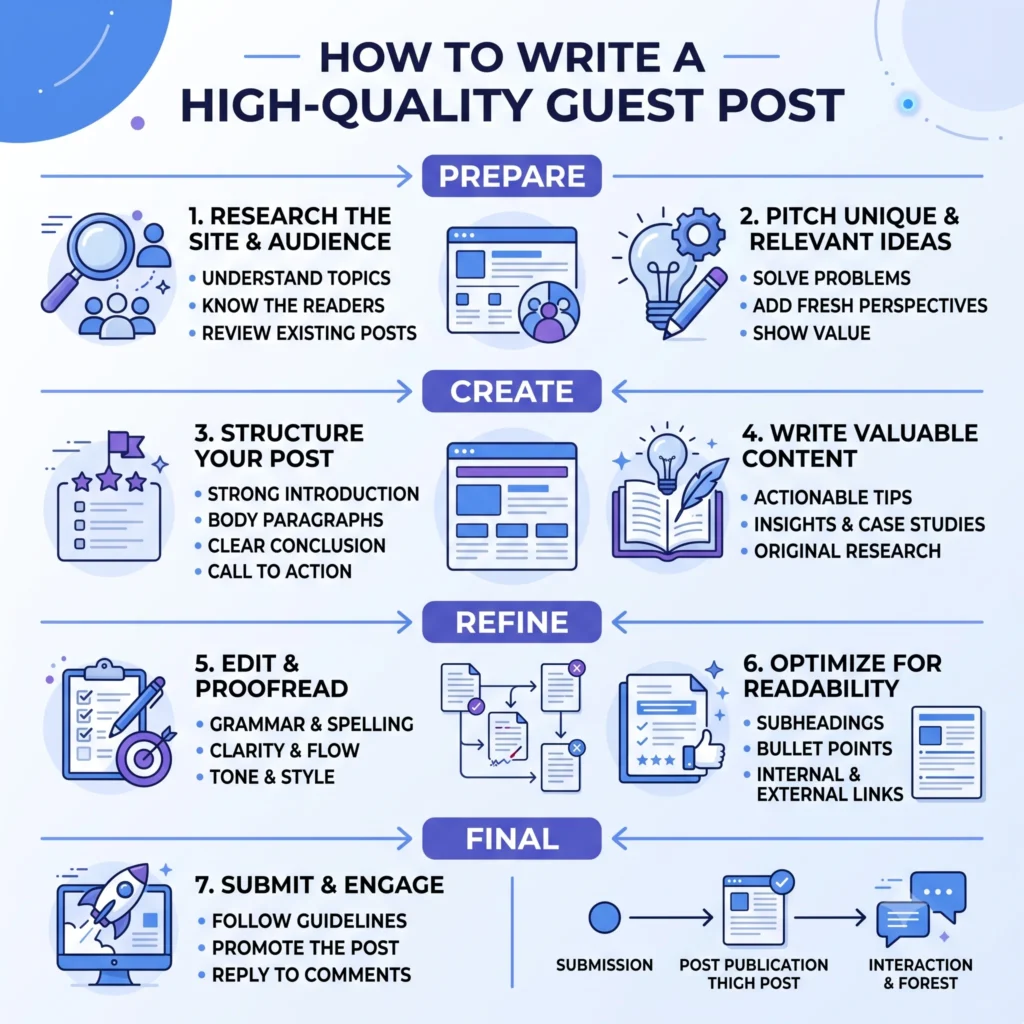
Once your topic is approved, focus on writing a guest post that meets professional editorial standards. This is the step where most of the advice in a typical guest posting guide really matters, since the quality of the article determines whether you’re invited back.
Follow the guidelines exactly. Every publication has its own guest post guidelines covering word count, formatting, and linking policy. Ignoring them is the fastest way to get rejected.
Write for their audience, not yours. A high-quality guest post speaks directly to the host site’s readers, using their tone and addressing their specific pain points.
Back up claims with data. Include statistics, examples, or original research where possible. Editors favor contributors who add real value rather than filler content.
Structure for readability. Use clear headings, short paragraphs, and bullet points. Add images, examples, or infographics where relevant to improve engagement.
Keep self-promotion minimal. One relevant, contextual link back to your site (usually in the bio or occasionally within the body, if permitted) is standard. Overtly promotional guest posts get rejected or stripped of links.
Proofread thoroughly. Typos and grammar mistakes damage your credibility and increase the odds of rejection during editorial review.
If you want additional examples of what strong contributor content looks like, HubSpot’s guide on how to do guest blogging the right way breaks down several real-world formatting and structuring tips.
This is the core of any solid guest blogging strategy: prioritize the reader and the host site first, and treat the backlink as a natural byproduct of genuinely useful content.
How to Write a Guest Post Pitch That Gets Accepted

Your guest post pitch is often more important than the article itself, since it determines whether an editor gives you a chance at all. Getting this step right is one of the most valuable takeaways from any guest posting guide.
A strong guest post pitch email should include:
- A personalized opening that references specific content from their site — proof you actually read it.
- A clear, specific topic idea (or two or three options) rather than a vague “I’d like to write for you.”
- A short explanation of why this topic fits their audience.
- Relevant credentials or writing samples that establish your expertise.
- A polite, concise closing with a clear call to action.
Keep the guest post pitch short — editors receive dozens of pitches weekly and don’t have time for long emails. Personalized outreach consistently outperforms generic, templated cold email blasts. Avoid attaching a fully written article unless the site specifically requests it; most editors prefer approving a topic before you invest time writing.
How to Build Backlinks With Guest Posting
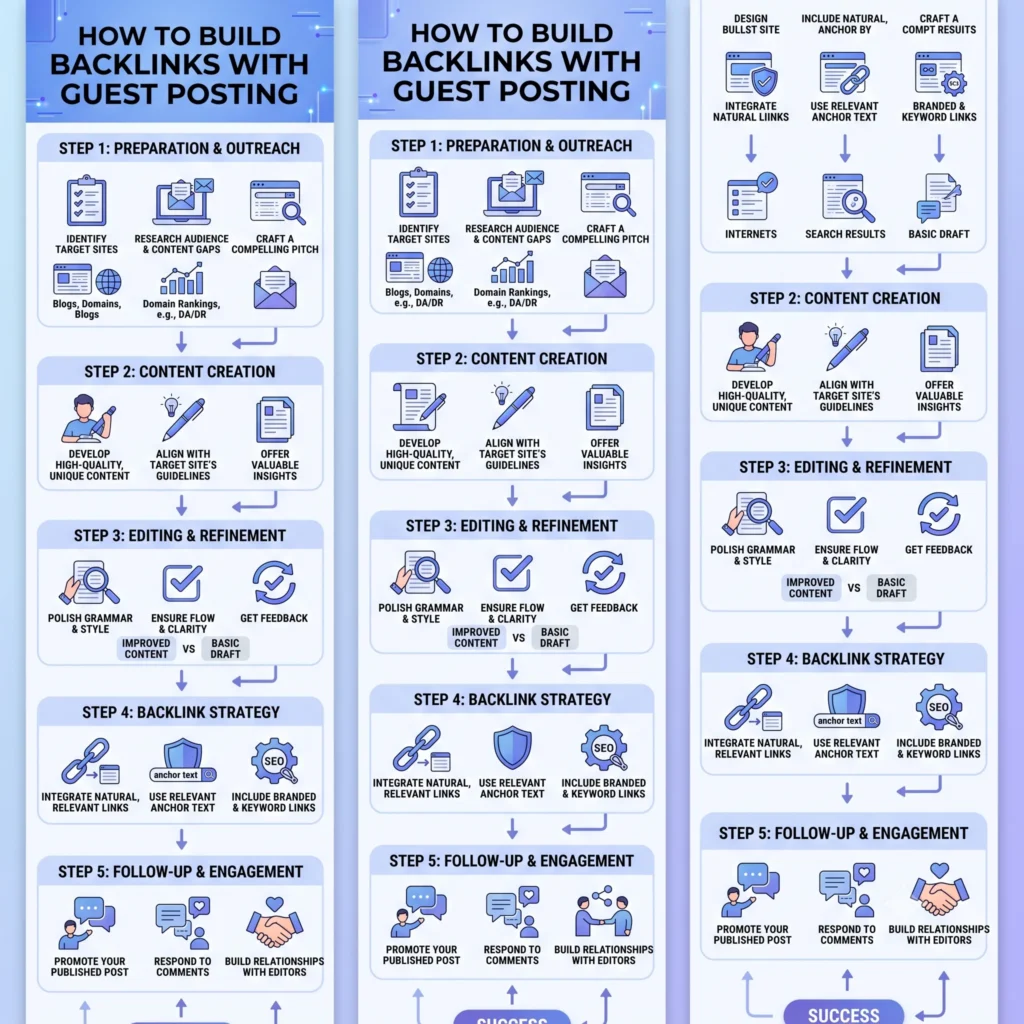
Guest posting remains one of the most effective ways to build backlinks, but doing it well requires a strategic approach — which is the whole point of following a structured guest posting guide instead of pitching blindly.
- Prioritize relevance over volume. A handful of contextual backlinks from authoritative, topically relevant sites outperforms dozens of links from low-quality guest post sites.
- Diversify anchor text. Avoid repeatedly using the exact same keyword-rich anchor text, which can look manipulative to search engines.
- Mix dofollow and nofollow naturally. Not every backlink needs to be dofollow — a natural link profile includes a mix, and many reputable publications now nofollow contributor links by default.
- Link internally within your own site to guide the referral traffic and link equity you earn toward key pages.
- Track your results. Monitor referring domains, search rankings, and referral traffic to see which guest posts are actually driving results.
According to Google’s official spam policies, the safest long-term approach is earning links through genuine value, original content, and real relationships rather than automated or large-scale link schemes, which are treated as manipulation. This is why guest posting for link building only works sustainably when quality and relevance come first.
How to Follow Up and Get Your Guest Post Published
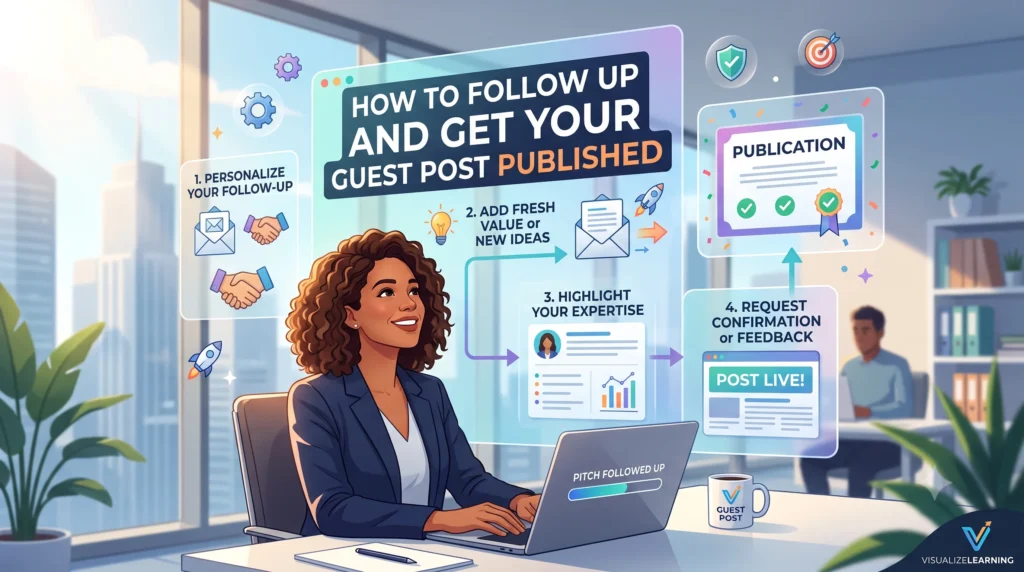
After submitting a pitch or draft, don’t assume silence means rejection. Editors are often juggling multiple responsibilities.
- Wait about a week before sending a polite follow-up email.
- Keep the follow-up brief — a short reminder with the original pitch attached is usually enough.
- Limit yourself to two follow-ups. If there’s still no response, move on respectfully; you can always pitch again later.
- Once accepted, respond quickly to edits requested by the editorial team, and confirm the publication date.
- Promote the published post on your own channels once live — this shows the editor your content adds value and often opens the door to future guest blogging opportunities.
Guest Posting Mistakes to Avoid
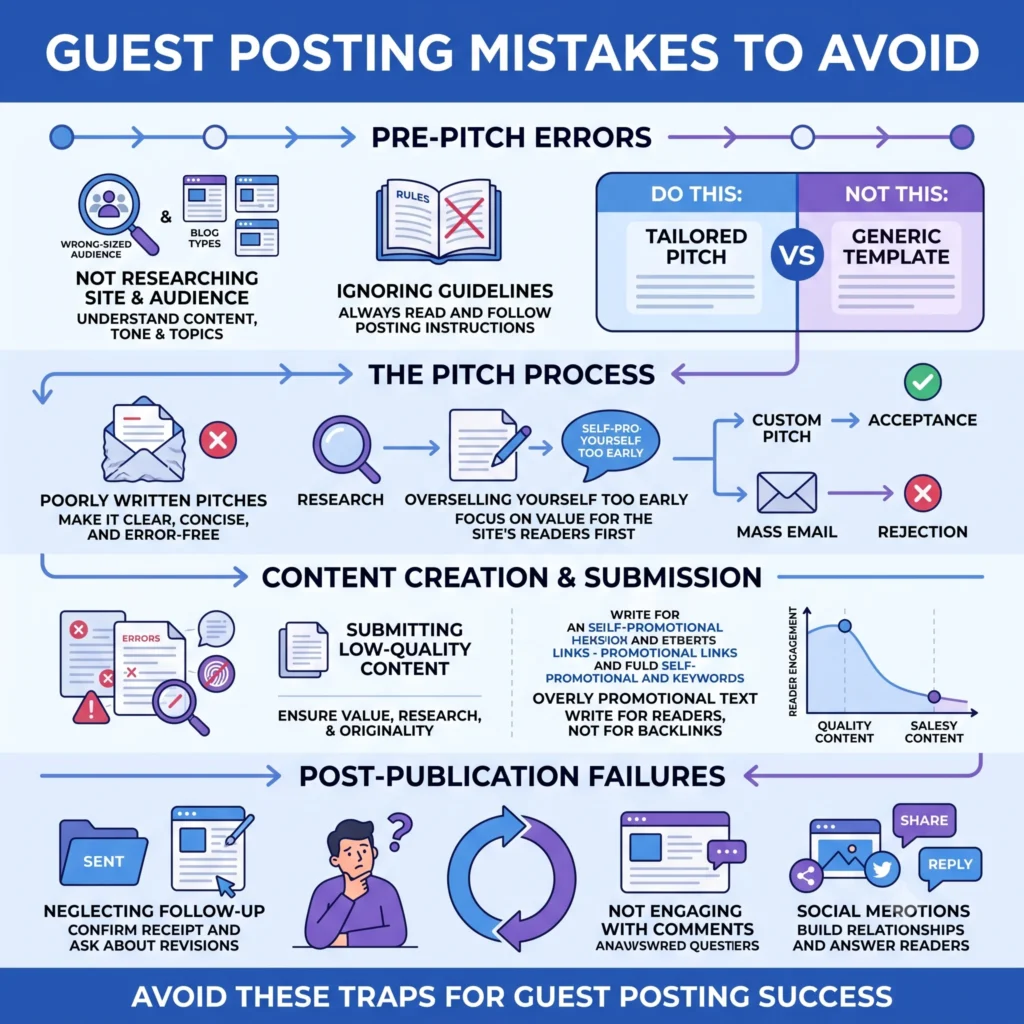
Even experienced marketers make guest posting mistakes that waste time or hurt credibility. This section of the guest posting guide covers the guest posting best practices violations to watch out for:
- Mass, generic pitches. Sending the same templated email to hundreds of sites rarely works and can damage your reputation.
- Ignoring guest post guidelines. Skipping submission requirements signals a lack of professionalism.
- Over-optimized anchor text. Stuffing exact-match keywords into your bio link raises red flags with search engines.
- Low-effort or duplicate content. Recycling the same article across multiple sites violates most editorial standards and Google’s policies on link spam.
- Focusing only on domain authority. A site with a high score but low relevance provides little real SEO or traffic value.
- Being purely self-promotional. Guest posts that read like advertisements get rejected or lose their links after publication.
- Paying for links without disclosure. Paid placements should be marked as sponsored or nofollow to stay compliant with search engine guidelines.
Avoiding these mistakes is just as important as knowing how to do guest posting correctly in the first place.
Conclusion
Guest posting is still one of the most effective ways to build backlinks, grow website authority, and reach a new, engaged audience as long as it’s done with quality and relevance in mind rather than volume alone. For more strategies beyond guest posting, explore our complete link building guide to learn how to build high-quality backlinks through different proven methods. This guest posting guide covered the full process: finding legitimate guest posting opportunities, evaluating sites before you pitch, choosing strong topics, writing high-quality guest posts, crafting a pitch that gets accepted, and following up professionally.
If you apply the strategies in this guest posting guide consistently — prioritizing real value over shortcuts — you’ll build a sustainable pipeline of high-quality backlinks, referral traffic, and industry relationships that support your SEO and content marketing goals for years to come.
Frequently Asked Questions
What is guest posting in SEO? Guest posting in SEO is the practice of writing content for another website in exchange for a backlink and author bio, helping build website authority, referral traffic, and search visibility.
Is guest posting still effective for SEO in 2026? Yes, but only when it’s done selectively and focused on relevance and quality. Large-scale, low-quality guest posting purely for links violates Google’s guidelines and can hurt rather than help your SEO. That’s why this guest posting guide emphasizes relevance and originality over volume.
How do I find guest posting opportunities? Use search operators like “write for us,” analyze competitor backlinks, browse industry directories, and build relationships through blogger outreach and social media.
How long does a guest post need to be? Most publications request 1,000–2,000 words, but always follow the specific guest post guidelines listed on the target website.
Do guest post backlinks need to be dofollow to help SEO? Not necessarily. A natural mix of dofollow and nofollow links, combined with genuine referral traffic and brand visibility, still provides real value even when a link is nofollow.
How many guest posts should I submit per month? There’s no fixed number. Focus on quality and relevance over quantity — a few well-placed guest posts on relevant, authoritative sites outperform dozens of low-value ones.

FluxSEO’s Team creates practical, beginner-friendly guides on SEO, blogging, keyword research and digital growth. Our goal is to simplify search engine optimization and help website owners improve visibility, rankings and organic traffic with clear, actionable advice.