
If you want your website to show up on Google, you need to speak the same language as the people searching for it. That’s exactly what keyword research helps you do. It’s the process of figuring out what your audience is actually typing into search engines, so you can create content that answers their questions and ranks for it.
In 2026, keyword research looks a little different than it did even two years ago. Search behavior has changed, AI Overviews are reshaping the search results page, and voice search keeps growing. But the core idea hasn’t changed at all: you can’t rank for what you don’t understand.
This guide walks you through everything — what keyword research is, why it matters, the types of keywords you should target, a step-by-step process, the best tools, common mistakes, and practical tips to help you rank better this year. Whether you’re a complete beginner or refreshing your SEO strategy, this is your one-stop resource.
What Is Keyword Research?

Keyword research is the process of discovering, analyzing, and prioritizing the words and phrases people use in search engines like Google, Bing, YouTube, and even Amazon, so you can create content around them.
At its core, keyword research answers three questions:
- What are people searching for? (keyword ideas and search queries)
- How many people are searching for it? (search volume and traffic potential)
- Why are they searching for it? (search intent, also called keyword intent)
When you combine these three data points, you get a clear picture of which topics are worth writing about and which ones won’t move the needle.This is the foundation of any solid content strategy, and it’s the starting point for on-page SEO, technical SEO, and even link building. If you’re new to search optimization, our SEO Basics guide explains how all of these elements work together to improve rankings.
Good keyword research isn’t just about finding a long list of terms. It’s about understanding search demand and user intent well enough that you can map keywords to the right pages on your site — a process known as keyword mapping.
Why Keyword Research Is Important for SEO
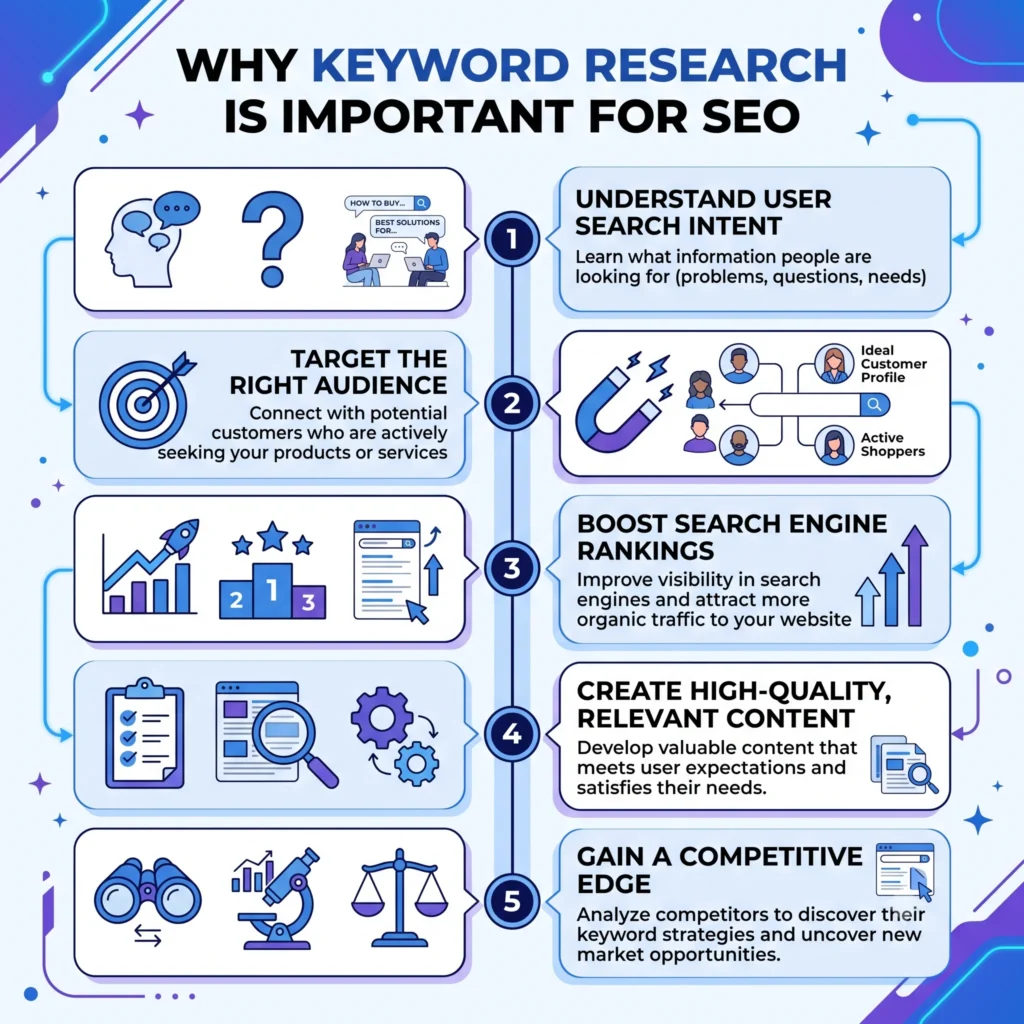
Some people skip keyword research and just write about whatever comes to mind. The problem is that without data, you’re guessing — and guessing rarely leads to organic traffic.
Here’s why keyword research matters so much for SEO:
- It reveals real search demand. Instead of assuming what your audience wants, you get actual data on search volume and monthly search volume trends.
- It improves ranking opportunities. By understanding keyword difficulty and keyword competition, you can target keywords you actually have a realistic chance of ranking for.
- It shapes your content calendar. Keyword research turns into a roadmap for content planning, helping you build topical authority over time instead of publishing random, disconnected posts.
- It aligns content with intent. Ranking isn’t just about using the right words — Google rewards pages that match search intent. Keyword research helps you understand whether someone wants to buy, learn, or compare.
- It uncovers content gaps. Competitor keyword research often shows you topics your competitors rank for that you haven’t covered yet — instant content gaps you can fill.
- It supports every other SEO effort. On-page SEO, internal linking, and technical SEO all become more effective when they’re built around the right target keywords. If you’re still learning these concepts, start with our Beginner’s Guide to SEO.
Industry publications like Search Engine Journal consistently rank keyword research among the most foundational SEO tasks, since it identifies the exact terms and phrases people use to find information, products, and services online. In short, keyword research is the backbone of a sustainable SEO strategy — not a one-time task, but an ongoing part of how you plan content.
Types of Keywords You Should Target
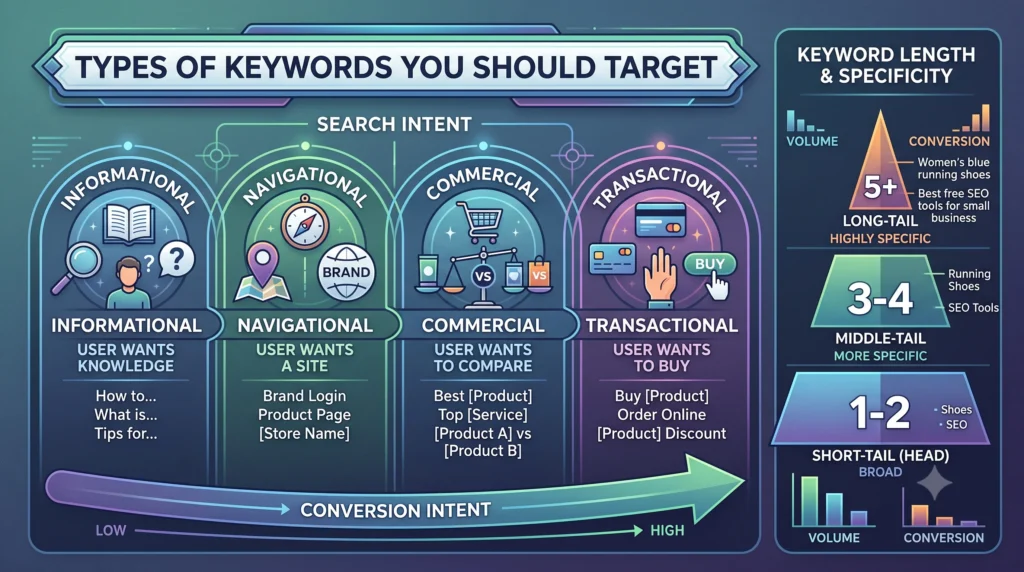
Not all keywords are created equal. To build a well-rounded keyword research strategy, you need a mix of different keyword types.
Short-Tail Keywords
These are broad, one-to-two-word phrases like “SEO” or “keyword research.” They tend to have high search volume but also high competition and vague intent, making them hard to rank for, especially for newer websites.
Long-Tail Keywords
Long-tail keywords are longer, more specific phrases like “how to do keyword research for SEO” or “best free keyword research tool.” They usually have lower search volume individually, but they convert better because they reflect clearer intent, and they’re often low competition keywords that are easier to rank for.
Informational Keywords
These target people looking to learn something, such as “what is keyword research” or “how does search intent work.” They’re perfect for blog posts and guides.
Commercial Keywords
These signal that someone is comparing options before buying, like “best keyword research tools” or “Ahrefs vs Semrush.”
Transactional / PPC Keywords
These show clear buying intent, such as “buy SEO keyword tool subscription.” They’re valuable for both organic content and PPC keywords in paid campaigns.
Navigational Keywords
People searching for a specific brand or website, like “Google Search Console login.”
Question Keywords
Phrases that start with who, what, why, or how, such as “how to find long-tail keywords.” These are great for FAQ sections and voice search keywords, since people often speak in full questions.
Local and Ecommerce Keywords
Local keywords include a location, like “SEO agency near me,” and matter a lot for local SEO. Ecommerce keywords target product-based searches, such as “buy running shoes online,” and are essential for online stores.
Understanding keyword intent behind each type helps with keyword clustering and keyword grouping later, so your content matches exactly what the searcher wants to see.
How to Do Keyword Research (Step-by-Step)

Here’s a practical, beginner-friendly process for how to do keyword research from scratch. Before diving in, it’s worth understanding the SEO fundamentals that make keyword research such an important part of search optimization.
Step 1: Start With Seed Keywords
Begin with broad seed keywords related to your niche. If you run a fitness blog, seed keywords might be “workout plans” or “weight loss.” These seeds become the foundation for keyword discovery.
Step 2: Expand Your List With Keyword Ideas
Use a keyword generator or Keywords Explorer tool to pull related keywords, keyword variations, and search suggestions based on your seed terms. Google’s autocomplete and the “People also ask” box are free ways to find keywords too.
Step 3: Analyze Search Volume and Keyword Metrics
Once you have a raw list, check each keyword’s monthly search volume, keyword difficulty (KD), and cost per click (CPC) if you’re also considering PPC keywords. This is where you separate high search volume keywords from low-value ones.
Step 4: Study Search Intent
For every keyword, ask: is the searcher looking to learn, compare, or buy? Google’s own results page is the best clue — check the SERP (Search Engine Results Page) and see what kind of content currently ranks.
Step 5: Do Competitor Keyword Research
Plug competitor URLs into a keyword tool to see their ranking keywords. This competitor analysis often reveals content gaps and keyword opportunities you hadn’t considered.
Step 6: Group Keywords Through Keyword Clustering
Organize your list by topic and intent. Keyword clustering groups similar keywords together so one page can target multiple related terms instead of creating duplicate content for every variation.
Step 7: Map Keywords to Pages
Assign each keyword cluster to a specific page — new or existing. This keyword mapping step keeps your site organized and prevents keyword cannibalization.
Step 8: Prioritize and Plan Content
Finally, rank your keyword list by a mix of traffic potential, keyword difficulty, and business relevance, then slot them into your content calendar.
How to Choose the Best Keywords for Your Website

Having a huge keyword list doesn’t help if you don’t know how to filter it. Here’s how to choose the best target keywords:
- Balance volume and difficulty. A keyword with massive search volume but sky-high keyword difficulty may take years to rank for. Look for a realistic middle ground.
- Prioritize relevance over volume. A lower-volume keyword that’s highly relevant to your niche keywords will often bring better, more qualified organic traffic than a broad, unrelated term.
- Match content type to intent. Don’t try to rank a product page for an informational keyword, or a blog post for a highly transactional one.
- Consider traffic potential, not just search volume. A single page often ranks for dozens of related keywords and keyword variations, so tools that estimate total traffic potential (not just the volume of one term) give a more accurate picture.
- Check the parent topic. Sometimes a slightly different keyword phrase is actually the head term that controls rankings for a whole cluster of related keywords — targeting that parent topic can be more efficient.
- Don’t ignore low competition keywords. Especially for newer sites, low competition keywords are a faster path to your first rankings and early wins.
- Think about semantic keywords. Modern search engines rely heavily on semantic keywords and related terms to understand a page’s topical relevance, so include natural variations rather than repeating the exact same phrase.
Best Keyword Research Tools
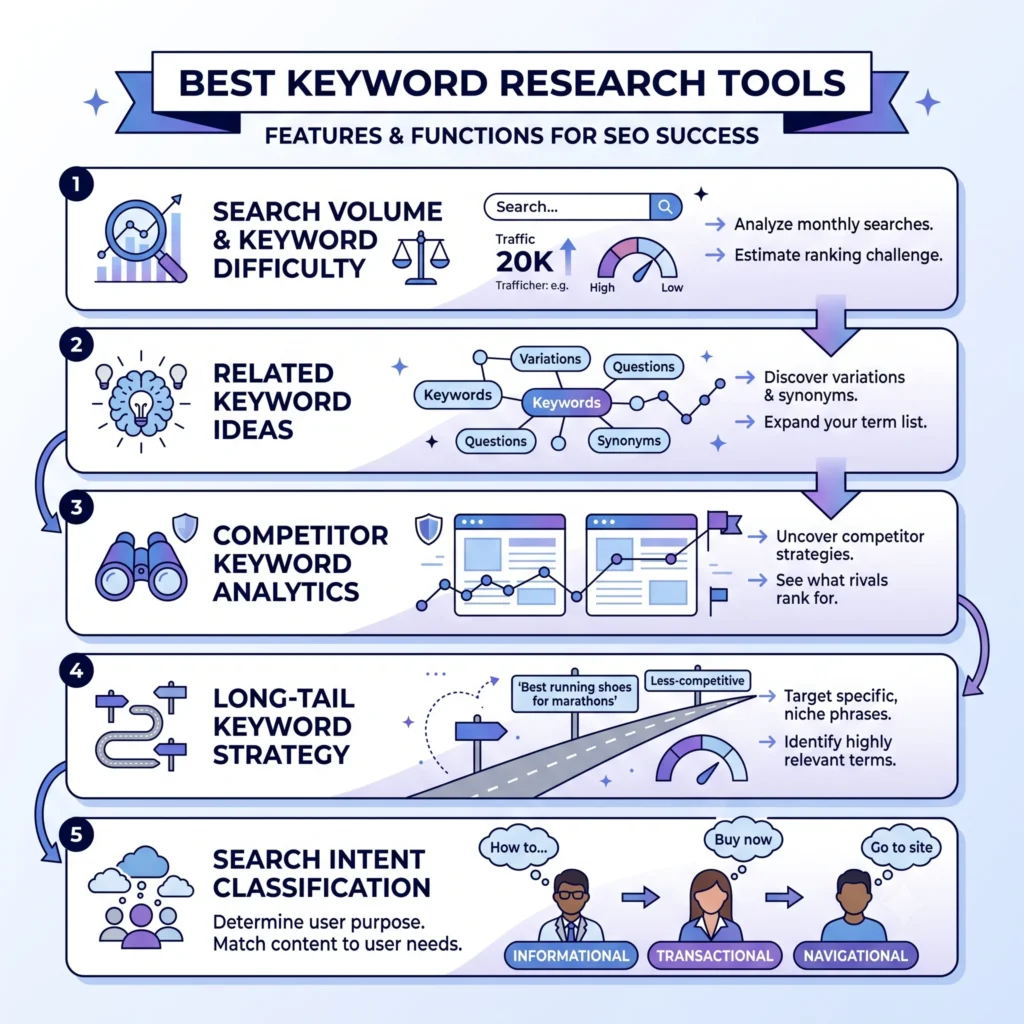
You don’t need dozens of tools — a few reliable ones cover almost everything.
- Google Keyword Planner – A free tool built for Google Ads, but widely used for basic search volume and keyword ideas.
- Google Search Console – Shows the actual queries your site already ranks for, which is gold for finding keyword opportunities you’re close to capturing.
- Google Trends – Great for spotting keyword trends and seasonal search behavior over time.
- Ahrefs – Known for its Keywords Explorer, clickstream-based data, and detailed keyword difficulty and CPC metrics.
- Semrush – Strong for competitor keyword research, SERP analysis, and content planning.
- Moz – Offers keyword suggestions along with a well-known Domain Authority metric.
- Ubersuggest – A budget-friendly option for beginners doing keyword research for blog posts.
- AnswerThePublic – Visualizes question keywords and search suggestions, ideal for informational and FAQ content.
Most of these tools offer free tiers or trials, so you can experiment before committing to a paid plan. For a deeper technical breakdown of how ranking factors and organic search work, Google’s Search Central documentation explains how Google Search works, from crawling and indexing to ranking, which is worth reading if you want to understand the mechanics behind why keyword research matters in the first place.
Common Keyword Research Mistakes to Avoid
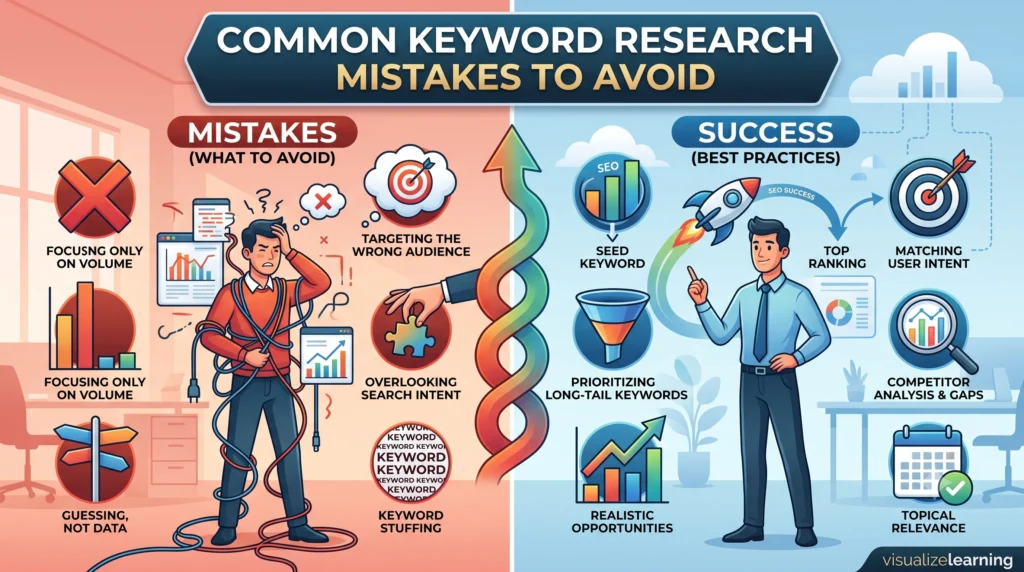
Even experienced marketers fall into these traps:
- Chasing high search volume keywords only. Big numbers look appealing, but if the keyword difficulty is too high for your site’s authority, you’ll never rank.
- Ignoring search intent. Ranking a listicle for a keyword that wants a single definitive answer (or vice versa) is a common reason content underperforms.
- Keyword stuffing. Repeating your focus keyword unnaturally hurts readability and can trigger spam signals. Google’s algorithms are built to reward natural, helpful writing, not repetition.
- Skipping competitor research. Not checking what’s already ranking wastes time on content that can’t realistically compete.
- Forgetting long-tail keywords. Many beginners only target short-tail keywords and miss dozens of easier, more specific keyword opportunities.
- No keyword mapping. Without mapping, multiple pages end up competing for the same keyword, which confuses search engines and splits your ranking potential.
- Treating keyword research as a one-time task. Search behavior shifts constantly. Keyword trends need to be revisited regularly, not just at the start of a project.
- Ignoring AI-driven search. With AI Overviews and zero-click searches on the rise, some keywords now return answers directly on the results page, which can affect your traffic potential even if you rank #1.
Keyword Research Tips for Better Rankings in 2026
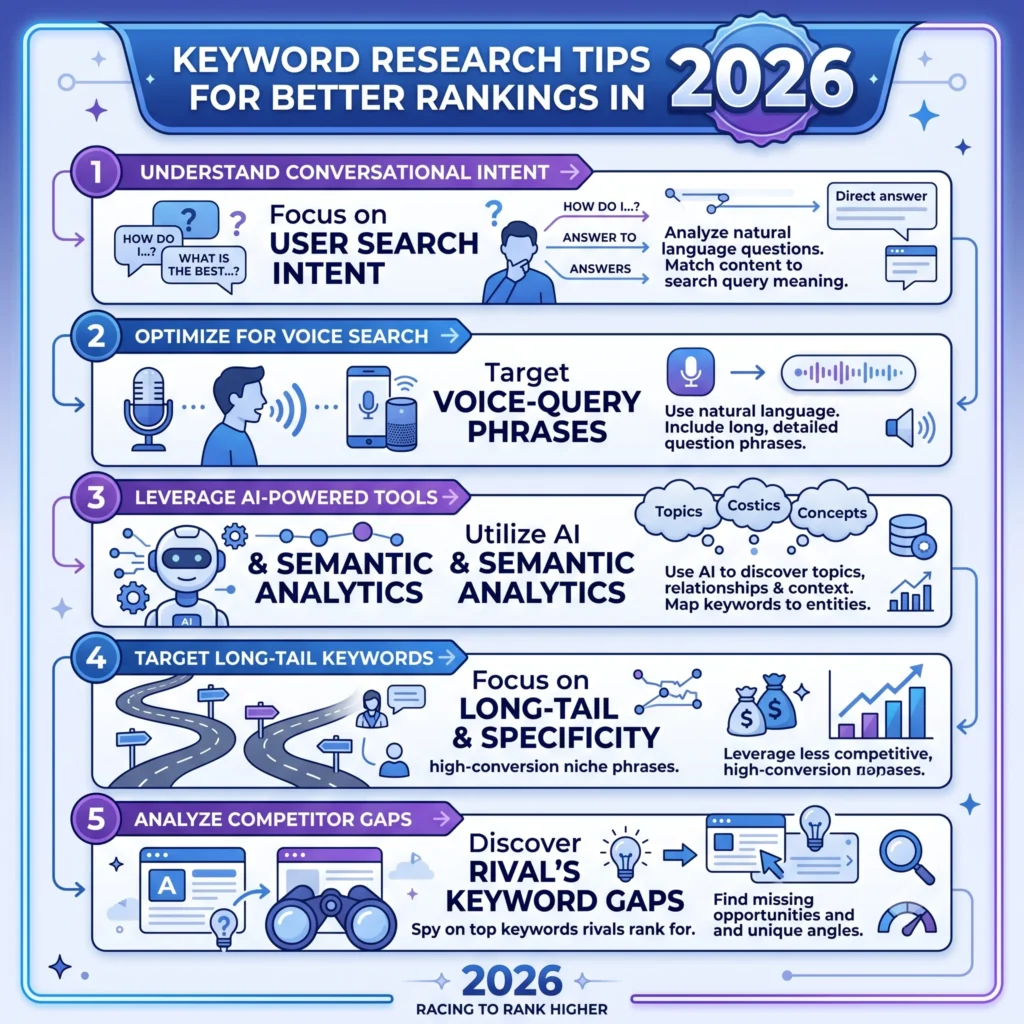
Search is evolving, and your keyword research strategy should evolve with it.
- Optimize for AI Overviews and AI search tools. ChatGPT, Gemini, and Perplexity increasingly pull from well-structured, clearly written content. Write in a natural, conversational tone and answer questions directly.
- Target question keywords for voice search. Voice search keywords tend to be longer and more conversational, so include natural-language phrases in your content.
- Build topical authority, not just isolated pages. Google increasingly rewards sites that cover a topic comprehensively through topic clusters rather than single, disconnected posts.
- Watch for zero-click searches. Some queries get fully answered on the SERP itself. For these, focus on keywords more likely to drive an actual site visit, like comparison or commercial keywords.
- Refresh your keyword list quarterly. Keyword trends shift, and new keyword opportunities appear as your niche evolves.
- Use clickstream data where available. Tools that incorporate clickstream data (like Ahrefs) offer more accurate search volume estimates than click-through-rate models alone.
- Don’t neglect on-page SEO basics. Even the best target keywords won’t help if your title tags, headers, and meta descriptions don’t reflect them naturally. Learn more in our SEO Basics guide.
- Balance informational and commercial content. A healthy content strategy mixes informational keywords for top-of-funnel traffic with commercial and transactional keywords for conversions.
Conclusion
Keyword research isn’t just a checkbox on your SEO to-do list — it’s the strategic foundation that determines whether your content gets found or gets ignored. By understanding search volume, keyword difficulty, and search intent, and by mixing short-tail and long-tail keywords into a well-organized content strategy, you set yourself up for sustainable organic traffic growth.
As search continues to evolve in 2026 with AI Overviews, voice search, and zero-click results, the fundamentals of keyword research remain your best guide. For a broader understanding of how keyword research fits into a successful search strategy, read our complete SEO guide. Start with seed keywords, dig into the data, understand intent, and map everything back to your content calendar. Do that consistently, and you’ll build the kind of topical authority that keeps paying off in rankings for years to come.
Frequently Asked Questions (FAQ)
What is keyword research?
Keyword research is the process of finding the words and phrases people search for so you can create content that ranks higher in search engines.
How to do keyword research for free?
Use free tools like Google Keyword Planner, Google Search Console, Google Trends, and Ahrefs Free Keyword Generator to discover relevant keywords.
Which tool is best for keyword research?
Ahrefs and Semrush are among the best keyword research tools, while Google Keyword Planner is a great free option.
What are the 4 types of keywords?
The four main types are informational, navigational, commercial, and transactional keywords, based on user search intent.
What are basic keywords?
Basic keywords are broad, high-level search terms that describe a topic, such as “keyword research,” “SEO,” or “digital marketing.”

FluxSEO’s Team creates practical, beginner-friendly guides on SEO, blogging, keyword research and digital growth. Our goal is to simplify search engine optimization and help website owners improve visibility, rankings and organic traffic with clear, actionable advice.