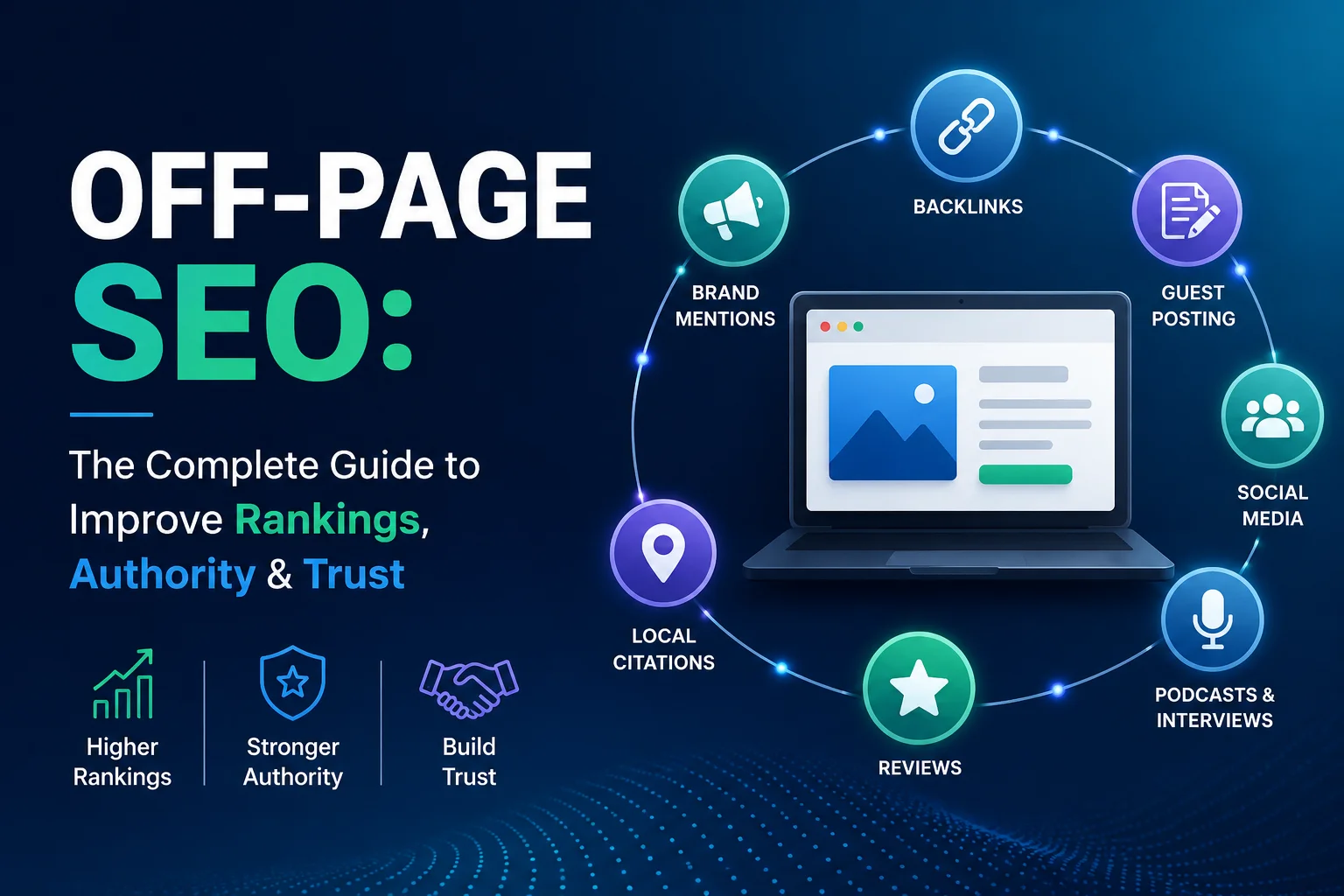
If you’ve ever optimized every heading, image, and meta tag on your website and still can’t crack the first page of Google, the missing piece is probably off-page SEO. On-page work tells search engines what your page is about. If you’re new to search optimization, start with SEO basics before diving into off-page strategies.
In this guide, you’ll learn what off-page SEO really means, why it matters more than ever in 2026, and exactly how to build backlinks, brand mentions, and trust signals the right way — without shortcuts that can get your site penalized.
What Is Off-Page SEO?
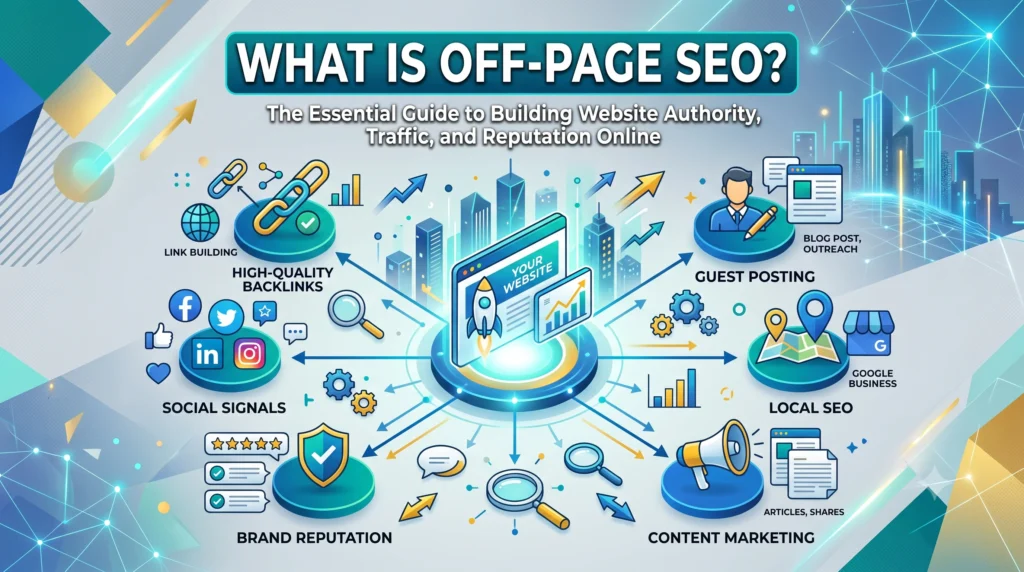
Off-page SEO refers to all the actions you take outside your own website to improve how search engines and users perceive your site’s authority, relevance, and trustworthiness. It’s the opposite of on-page SEO. If you’re just getting started, learn SEO first to understand how all SEO components work together., which focuses on elements you control directly, like content, title tags, and internal links.
Off-page SEO includes things like:
- Earning backlinks from other websites
- Getting brand mentions in the press or online conversations
- Building a presence on social media
- Managing customer reviews and online reputation
- Local citations and Google Business Profile optimization
- Digital PR and influencer collaborations
In simple terms, off-page SEO is what other people and websites say about you — and how much Google trusts that “word of mouth.”
Why Is Off-Page SEO Important?
Search engines can’t just take your word for it that your website is high-quality. They need external validation. That’s where off-page SEO comes in.
Here’s why it matters:
- It builds trust and credibility. When authoritative sites link to or mention your content, it signals to Google that your site is a reliable source of information.
- It improves rankings. Backlinks remain one of the strongest ranking factors in Google’s algorithm, especially for competitive keywords.
- It supports E-E-A-T. Google’s quality guidelines emphasize Experience, Expertise, Authoritativeness, and Trustworthiness, and off-page signals like brand mentions and reviews feed directly into how search quality raters assess whether a site demonstrates strong E-E-A-T, according to Google Search Central’s guidance on creating helpful, reliable, people-first content.
- It drives referral traffic. A well-placed backlink or mention on a popular site doesn’t just help rankings — it sends real visitors to your site.
- It increases brand visibility. Consistent digital PR and social proof grow branded search demand, which is itself a ranking signal.
If you’re still building your foundation, our SEO guide explains the core principles before moving into advanced off-page tactics. to outrank competitors with stronger authority profiles.
On-Page SEO vs. Off-Page SEO
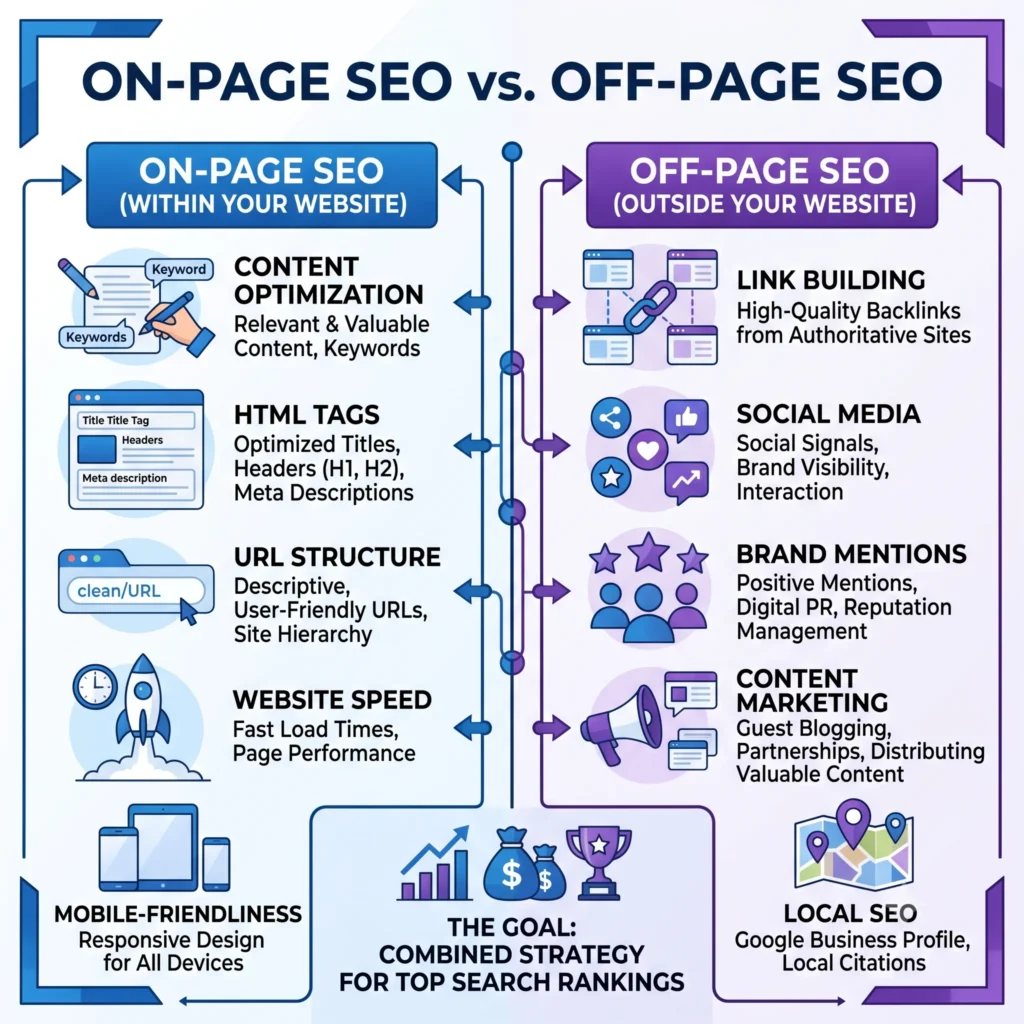
It helps to think of these as two halves of the same strategy:
| Off-Page SEO | On-Page SEO |
| Backlinks and referring domains | Title tags and meta descriptions |
| Brand mentions and digital PR | Header structure (H1, H2, H3) |
| Social media engagement | Keyword usage and content quality |
| Online reviews and reputation | Internal linking |
| Influencer marketing | Image alt text and page speed |
| Local citations (NAP consistency) | URL structure and schema markup |
Before comparing these strategies in depth, it’s helpful to understand the SEO fundamentals that connect on-page, off-page, and technical SEO.
How Search Engines Evaluate Off-Page SEO
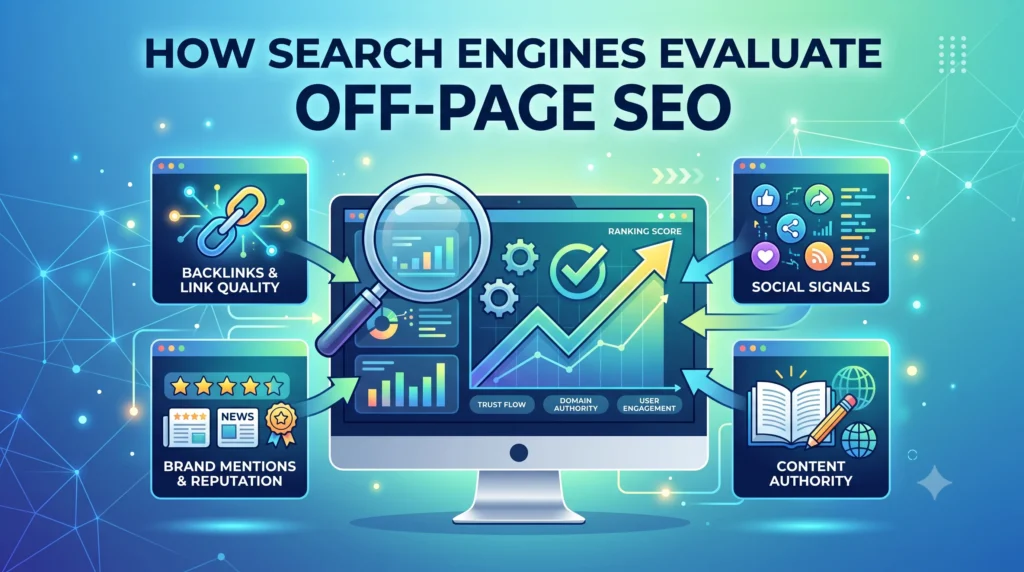
Google’s ranking systems don’t just count links — they evaluate context, quality, and intent. Some of the core evaluation methods include:
- Link quality analysis: Google assesses the authority, relevance, and trustworthiness of the linking domain, not just the number of backlinks.
- Anchor text relevance: The words used in a link matter, but over-optimized anchor text can trigger spam filters.
- Content-link relevance: A backlink from a site in your industry carries more weight than one from an unrelated niche.
- Brand signal analysis: Google’s systems also consider unlinked brand mentions, search volume for your brand name, and overall online reputation.
- User engagement signals: Click-through rate from search, direct traffic, and repeat visits can reinforce trust signals over time.
Google has been explicit that meeting technical and quality best practices — not manipulating rankings — is what its systems are designed to reward, as outlined in Google’s Search Essentials documentation.
The Most Important Off-Page SEO Ranking Factors
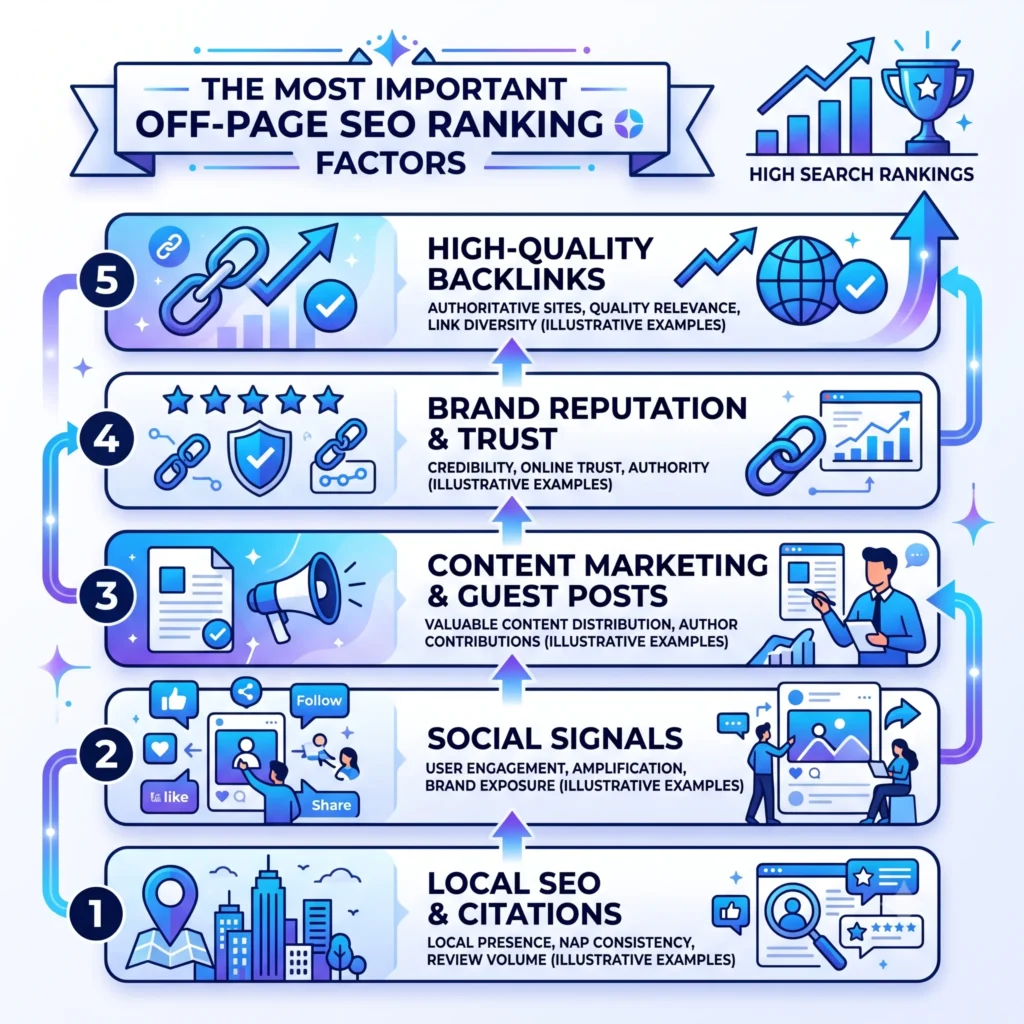
While Google uses hundreds of signals, these off-page factors consistently have the biggest impact:
- Backlink quality and quantity — Referring domains from authoritative, relevant websites.
- Referring IP diversity — Links from different hosting networks look more natural than a cluster from the same IP range.
- Domain Authority and Page Authority — Third-party metrics that estimate ranking potential based on backlink profiles.
- Brand mentions (linked and unlinked) — Google can associate your brand name with your website even without a hyperlink.
- Social signals — While not a direct ranking factor, social shares increase content visibility and the likelihood of earning links.
- Online reviews and ratings — Especially critical for local SEO and E-E-A-T.
- Content freshness and syndication — Actively shared, updated, and referenced content tends to earn more organic backlinks over time.
How to Build High-Quality Backlinks
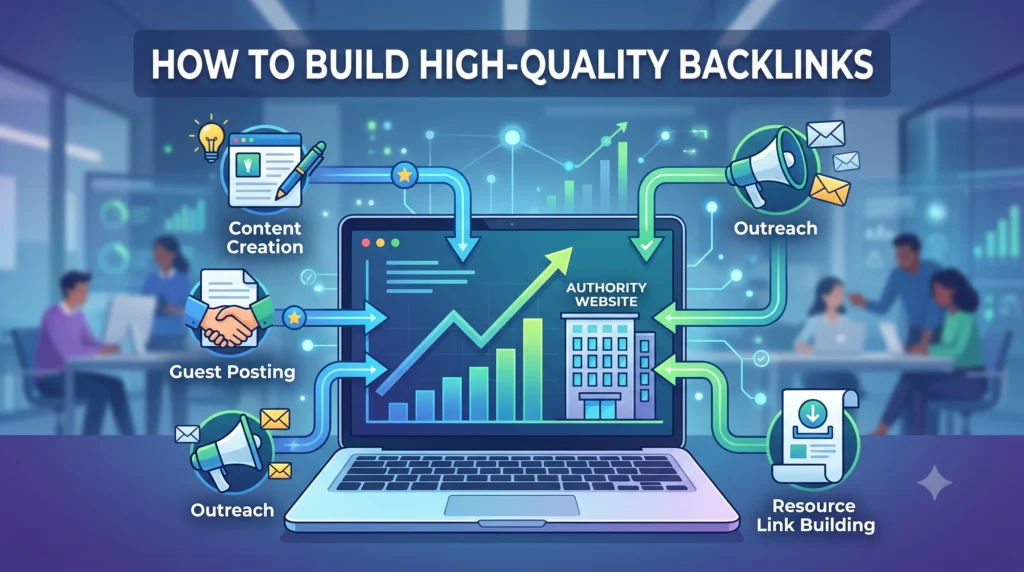
Link building is the backbone of off-page SEO, but quality always beats quantity. Here are proven, sustainable methods:
1. Create Linkable Assets
Original research, data studies, free tools, and in-depth guides naturally attract backlinks because other writers cite them as sources.
2. Guest Posting and Guest Blogging
Write high-quality articles for reputable, relevant websites in your niche. Focus on providing genuine value rather than stuffing links — one contextual backlink from a respected site is worth far more than ten from low-quality blogs.
3. Broken Link Building
Find broken links on relevant websites, then suggest your own content as a replacement. This strategy helps webmasters fix their site while earning you a natural backlink.
4. Digital PR and Journalist Outreach
Pitch data, expert commentary, or original insights to journalists and reporters. Platforms like HARO (Help a Reporter Out) connect sources with journalists looking for expert quotes, which can result in high-authority media backlinks.
5. Skyscraper Technique
Find top-ranking content in your niche, create something more comprehensive or up-to-date, then reach out to sites linking to the original piece.
6. Resource Page Link Building
Many websites maintain curated resource or “useful links” pages. If your content fits, a polite outreach email can earn you a placement.
Content Marketing for Off-Page SEO
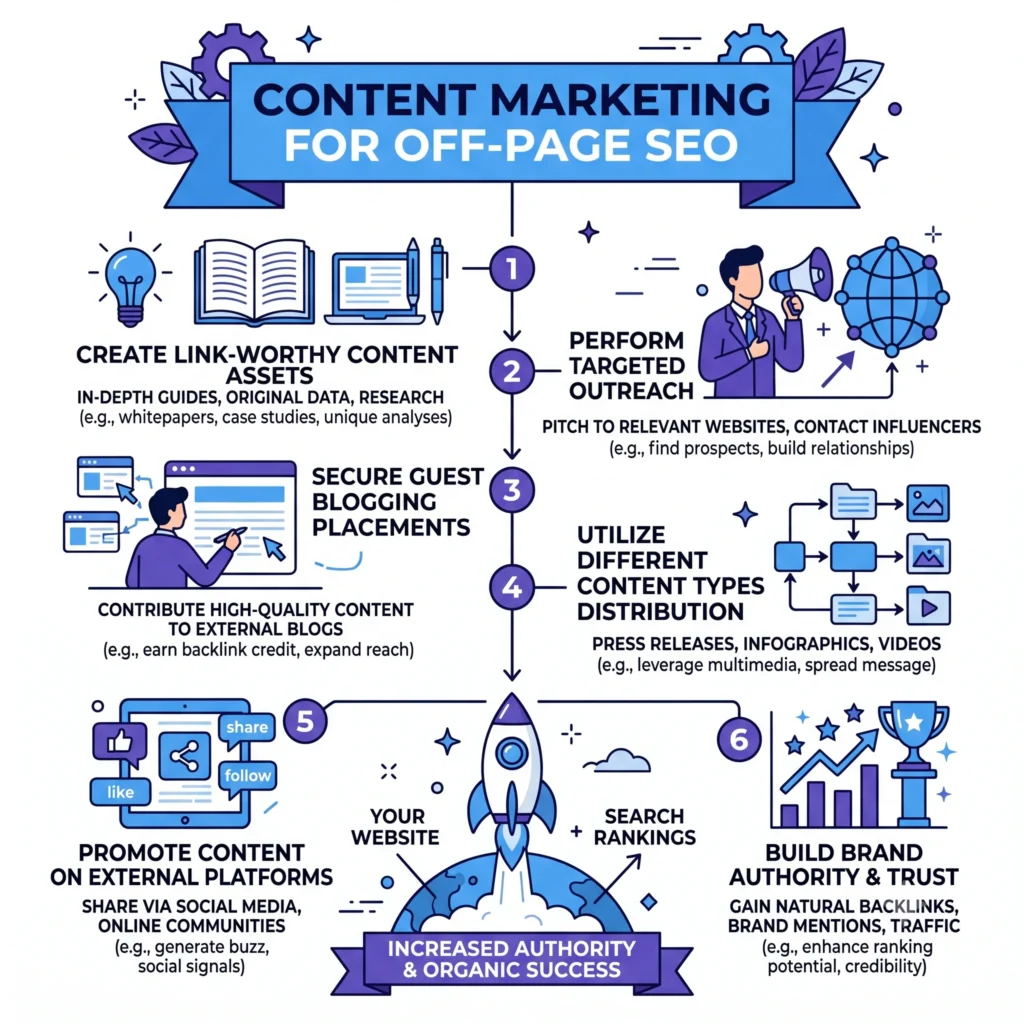
Content marketing and off-page SEO go hand in hand. The more valuable and shareable your content is, the more natural backlinks, mentions, and social shares it attracts. Effective tactics include:
- Content syndication on platforms like Medium or LinkedIn to expand reach (with proper canonical tags to avoid duplicate content issues)
- Podcast marketing — appearing as a guest to build authority and earn backlinks from show notes
- Webinar marketing to generate industry partnerships and co-promotion links
- Repurposing long-form content into infographics, videos, and social posts to widen your link-earning potential
The goal is to consistently produce content worth referencing — because no outreach strategy works well if the underlying content isn’t genuinely useful.
Brand Mentions, Digital PR & E-E-A-T
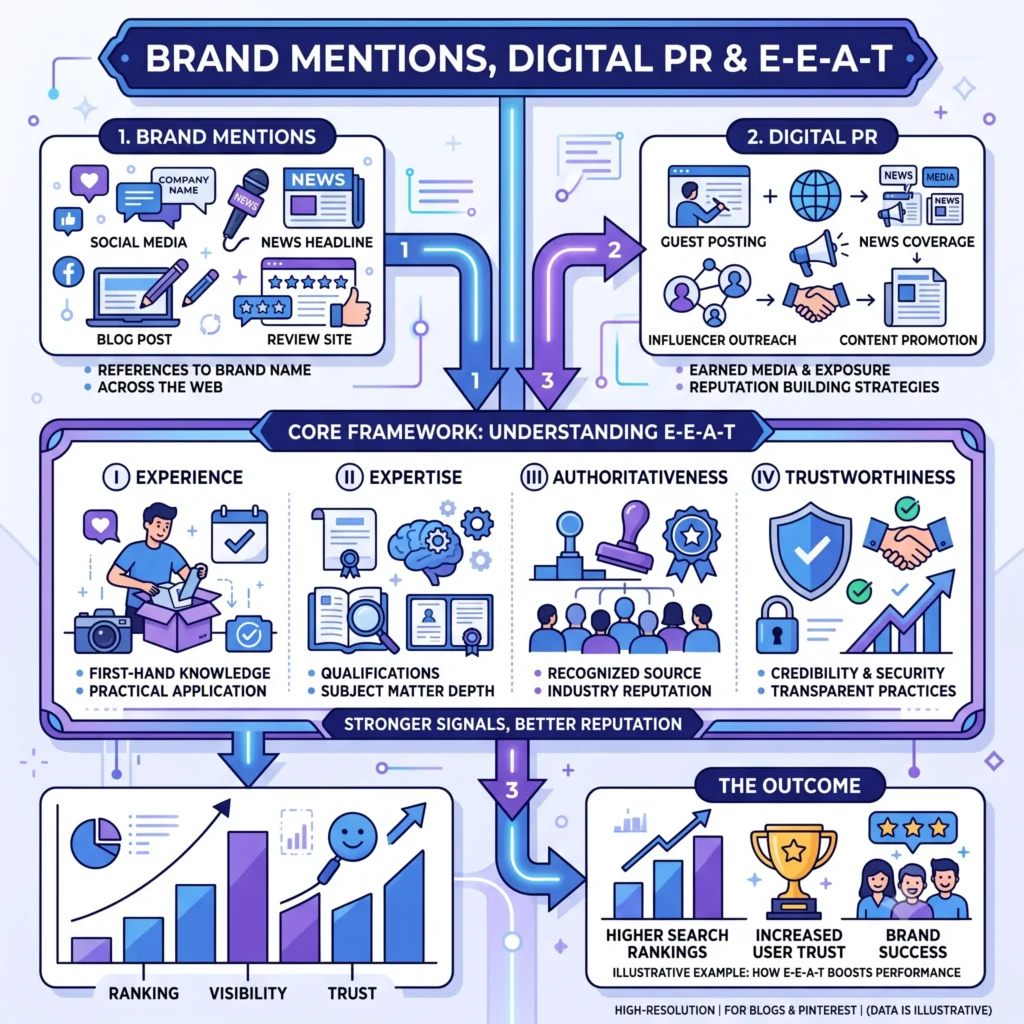
Not every mention of your brand includes a link, but Google’s systems can still recognize and value unlinked brand mentions as a trust signal. This is where digital PR becomes essential.
Strategies to build brand authority include:
- Getting quoted in industry news and trade publications
- Publishing original research that press outlets cite
- Building relationships with niche bloggers and journalists
- Monitoring brand mentions and requesting a link where appropriate (a tactic known as “unlinked mention reclamation”)
Since trustworthiness is described as the most critical component of E-E-A-T, consistent, positive brand visibility across the web strengthens how both users and search engines perceive your site’s credibility.
Social Media and Influencer Marketing
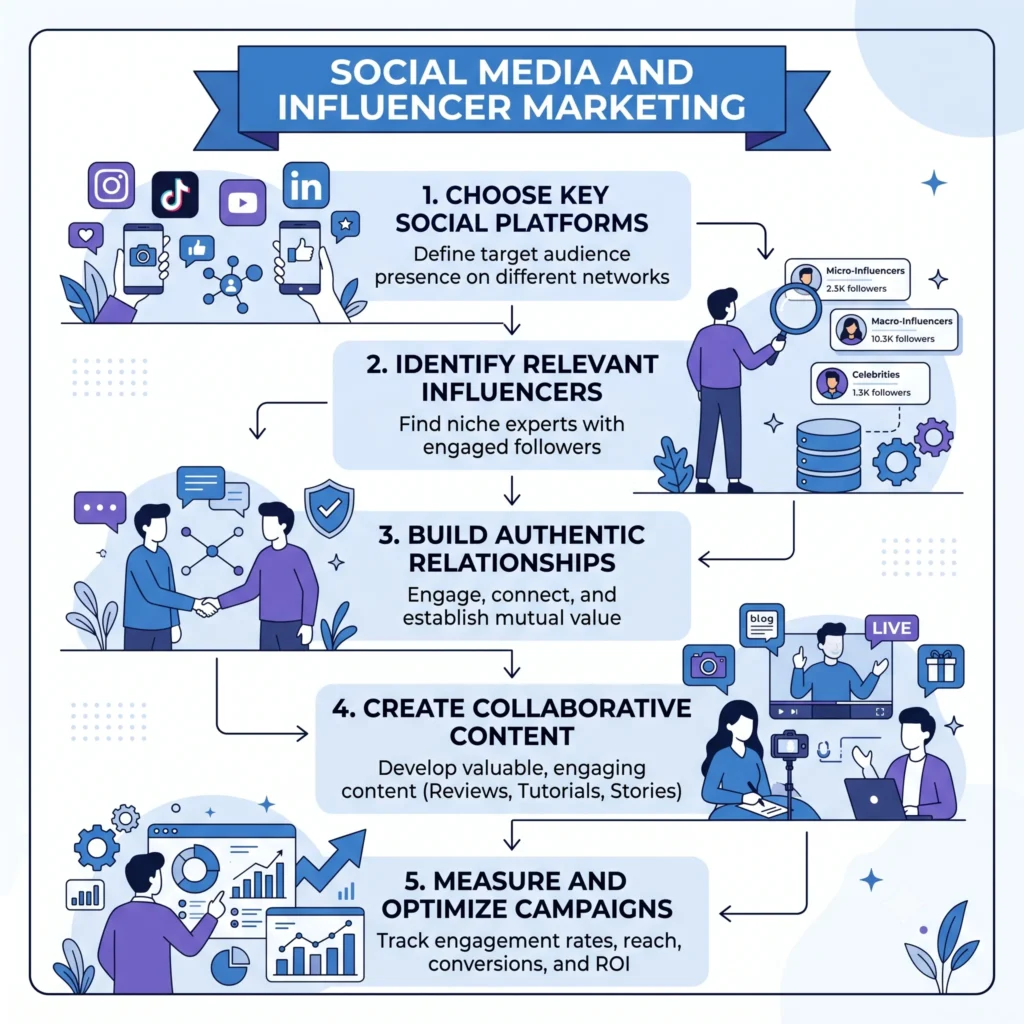
Social media doesn’t directly boost rankings the way backlinks do, but it plays a powerful supporting role in off-page SEO:
- Increased content visibility leads to more opportunities for organic backlinks
- Influencer partnerships can introduce your brand to new, relevant audiences
- Forum marketing on platforms like Reddit and Quora builds community trust and can drive referral traffic when done authentically (never through spammy self-promotion)
- Branded search growth from social exposure is itself a positive ranking signal
The key is authenticity. Communities like Reddit and Quora are quick to penalize (socially, if not algorithmically) accounts that only post promotional links.
Local Off-Page SEO (Reviews, Citations & Google Business Profile)
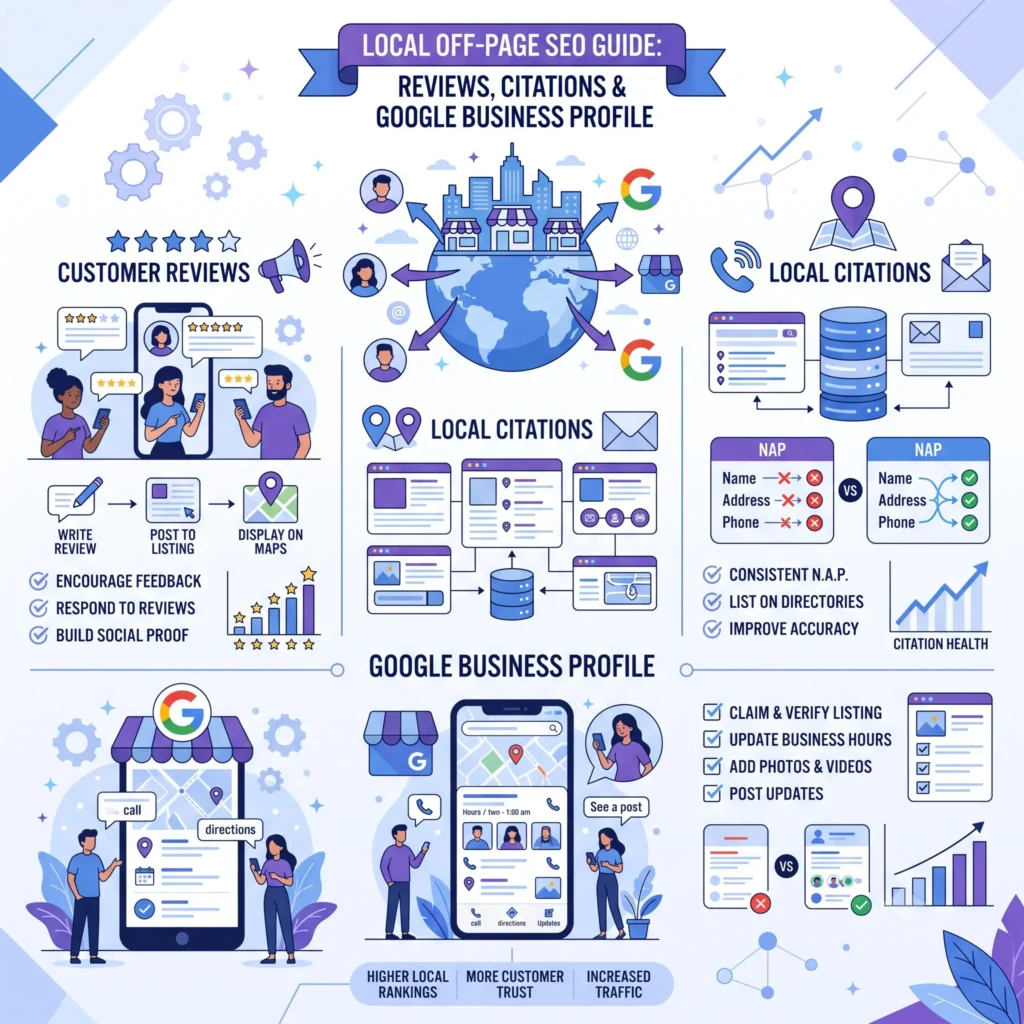
If you run a local business, off-page SEO takes on a few extra dimensions:
Google Business Profile Optimization
Keep your Google Business Profile complete, accurate, and active with posts, photos, and updated hours. This is one of the strongest local ranking factors for Google Maps SEO.
NAP Consistency
Your business Name, Address, and Phone number (NAP) should be identical across every directory, citation, and platform. Inconsistent NAP data confuses search engines and can hurt local rankings.
Local Citations and Business Directories
List your business on reputable directories relevant to your industry and location. Quality matters more than quantity here.
Online Reviews
Actively encourage satisfied customers to leave reviews on Google and other relevant platforms. Reviews influence both local rankings and consumer trust — and responding to reviews (positive and negative) shows engagement that strengthens your online reputation.
Advanced Off-Page SEO Techniques
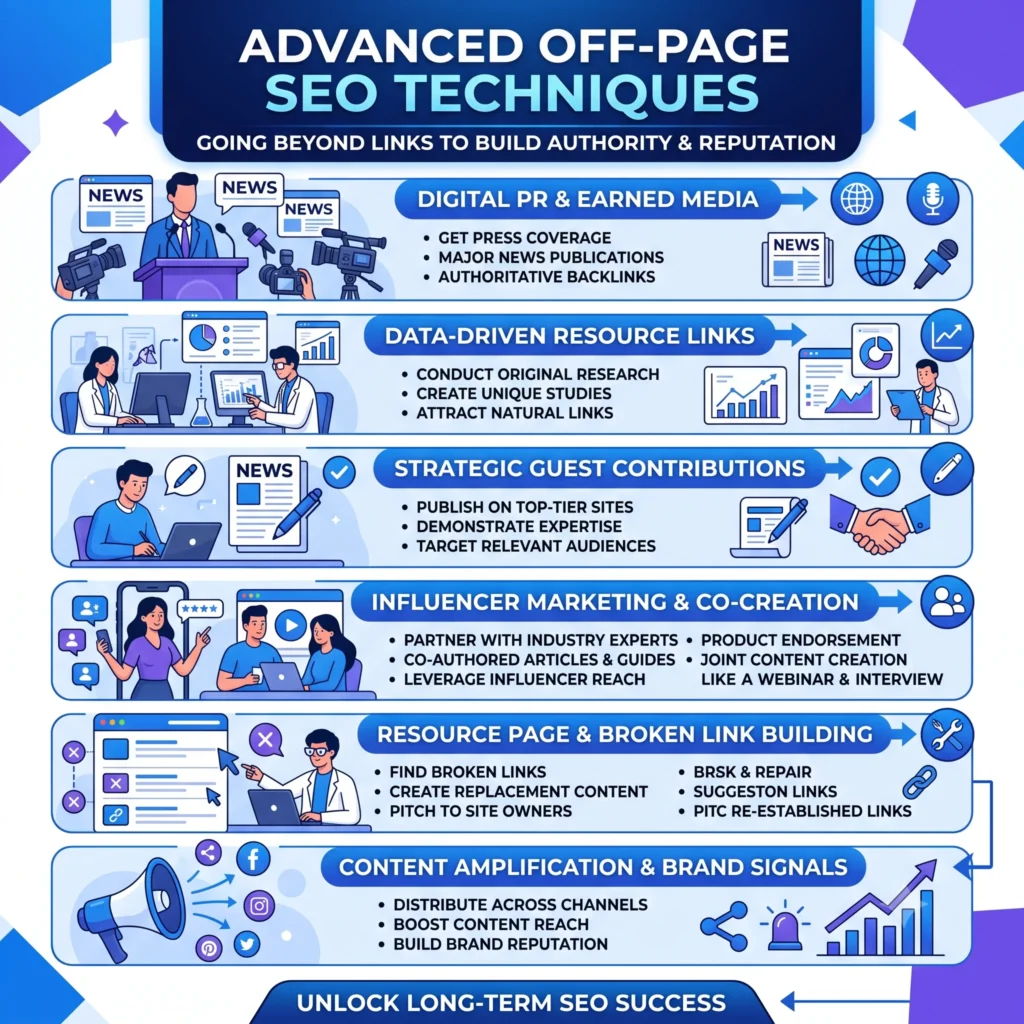
Once you’ve covered the fundamentals, consider these advanced tactics:
- HARO and Connectively-style journalist outreach for consistent digital PR wins
- Co-marketing partnerships with complementary (non-competing) brands
- Expert roundup contributions to earn niche authority backlinks
- Strategic content syndication through platforms like Outbrain, Taboola, or Business 2 Community
- Experiential marketing — sponsoring or participating in real-world events that generate press coverage and backlinks
- Reclaiming lost backlinks by monitoring for removed or broken links pointing to your site and reaching out to restore them
Common Off-Page SEO Mistakes to Avoid
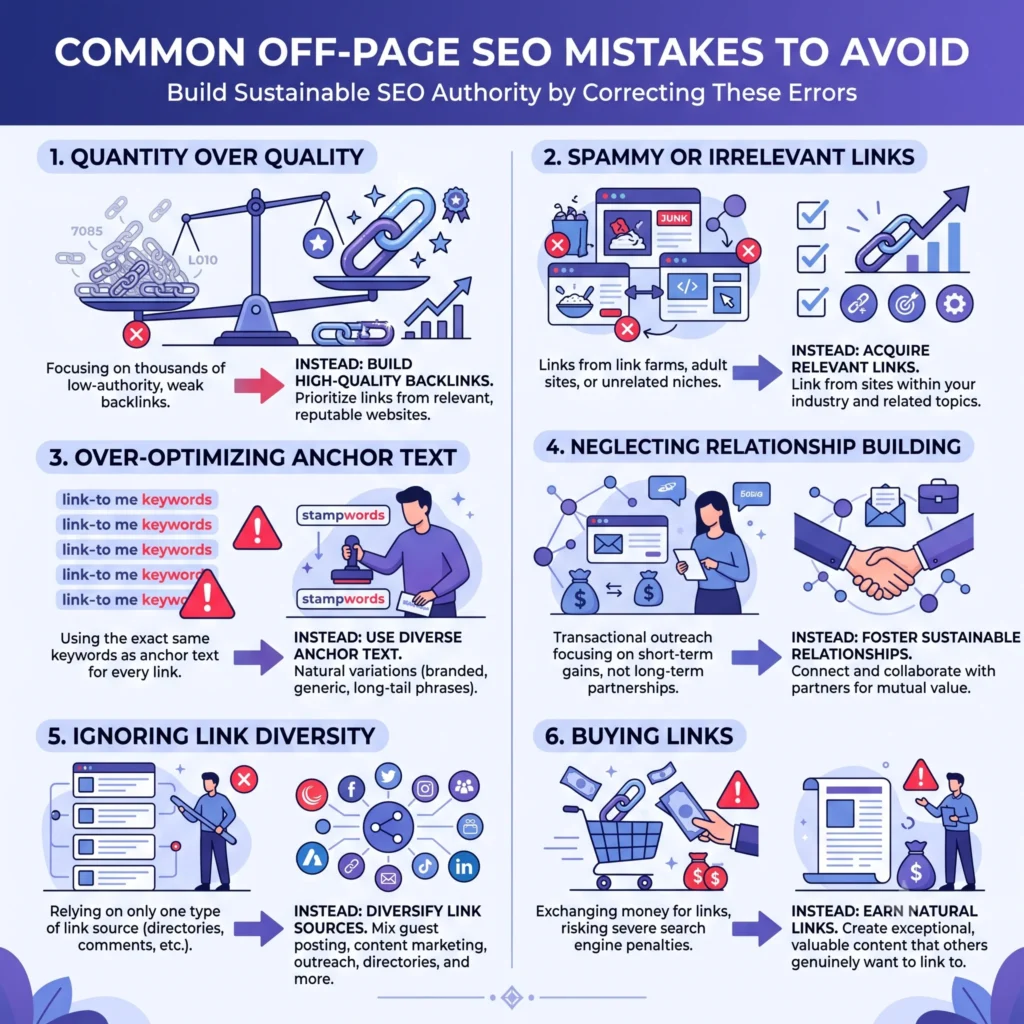
Even experienced marketers fall into these traps:
- Buying links in bulk from link farms or private blog networks — this violates Google’s spam policies and risks penalties.
- Over-optimized anchor text that looks unnatural or manipulative.
- Ignoring relevance — a backlink from an unrelated industry provides little SEO value.
- Inconsistent NAP data across local citations.
- Neglecting brand monitoring and missing opportunities for unlinked mention reclamation.
- Focusing only on quantity instead of the authority and relevance of referring domains.
- Treating social media as a direct ranking factor rather than a traffic and visibility tool.
How to Measure Off-Page SEO Success
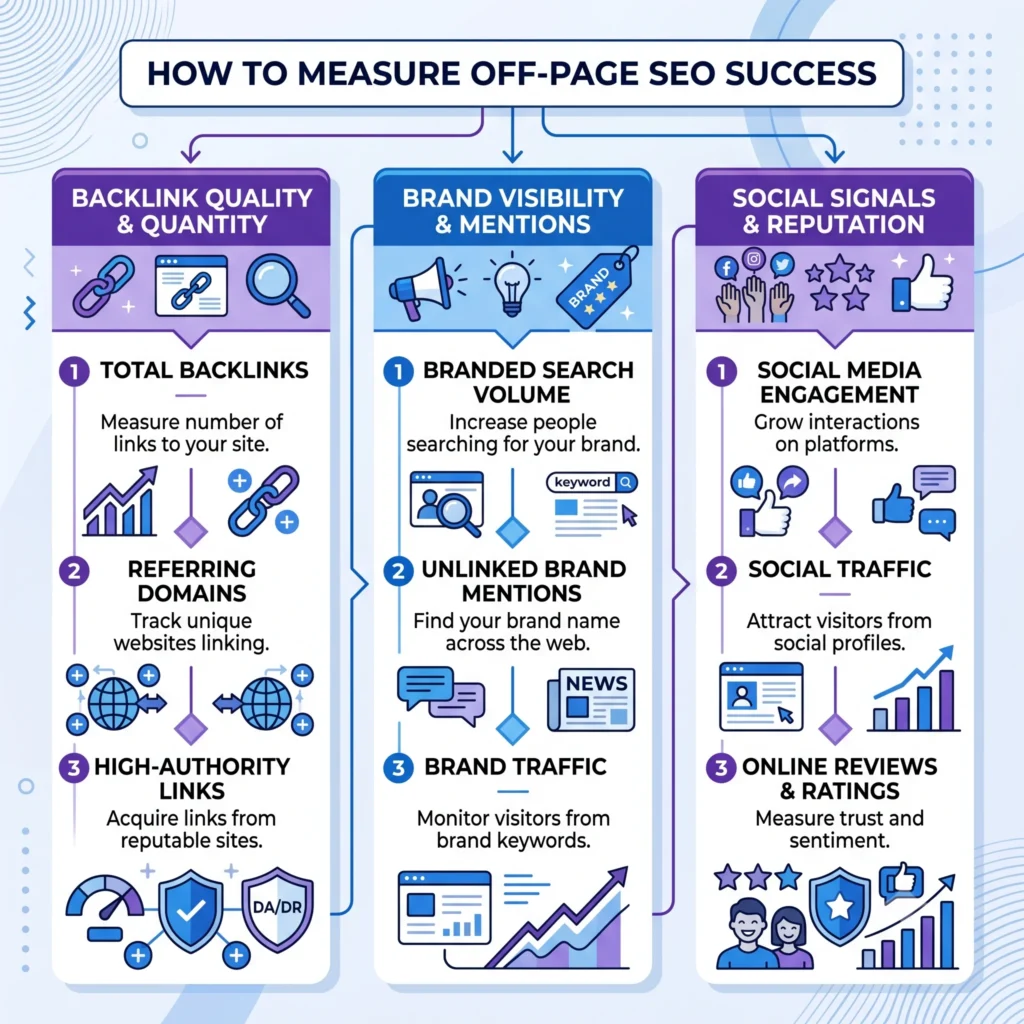
Track these metrics to evaluate your off-page SEO progress:
- Referring domains and referring IPs — growth over time indicates a healthier backlink profile
- Domain Authority / Page Authority (or equivalent third-party authority scores)
- Organic traffic and search visibility in tools like Google Search Console
- Branded search volume — a strong indicator of growing brand awareness
- Referral traffic from backlinks and social platforms
- Online review volume and average rating
- Keyword rankings for target terms over time
Set a baseline before starting any campaign, then review these metrics monthly or quarterly to spot trends.
Best Off-Page SEO Tools
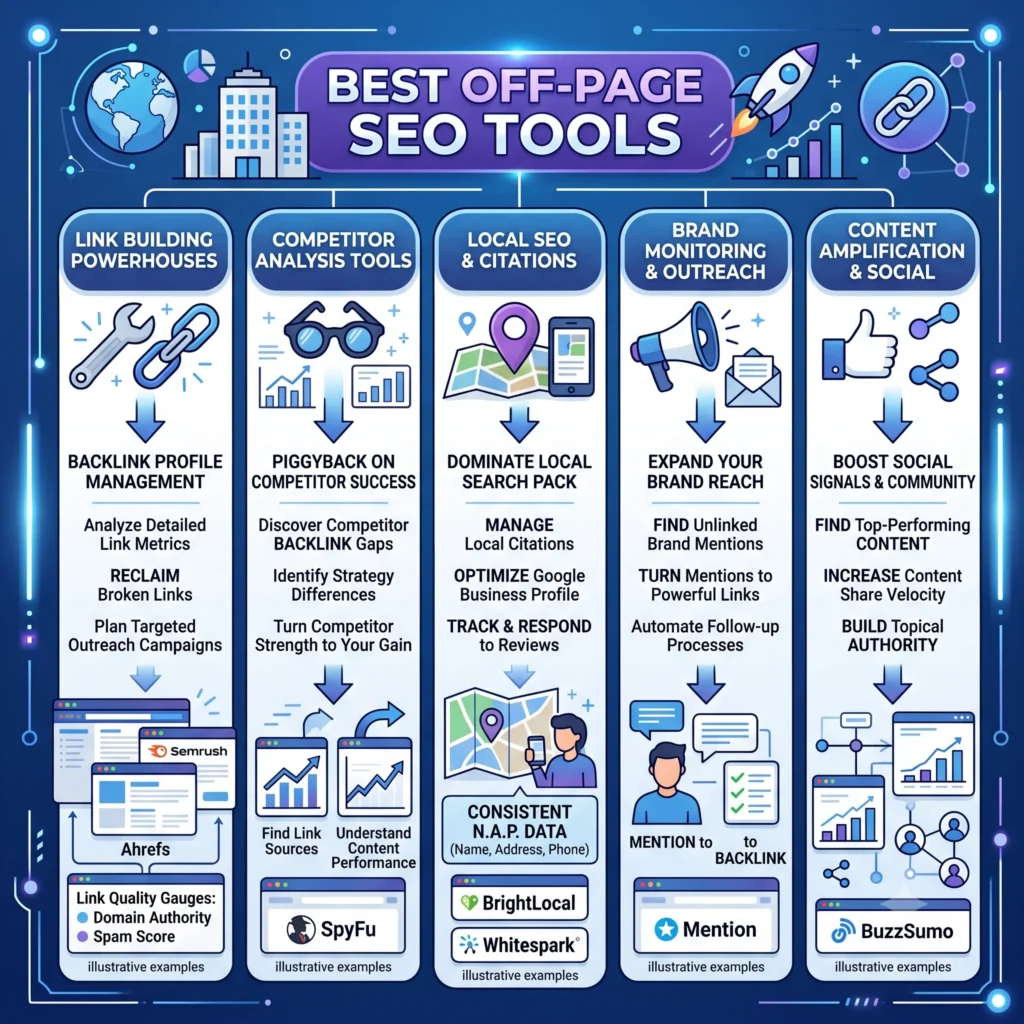
- Ahrefs — backlink analysis, referring domains, and content research
- Moz — Domain Authority and Page Authority tracking
- Semrush — backlink audits, brand monitoring, and PR outreach tools
- Google Search Console — free performance and indexing data straight from Google
- BuzzSumo — content research and influencer discovery
- HARO / Connectively-style platforms — journalist and digital PR outreach
- Google Alerts — free brand mention monitoring
Conclusion: Build Authority Beyond Your Website
Off-page SEO isn’t a one-time task — it’s an ongoing effort to build genuine authority, trust, and visibility across the web. From earning high-quality backlinks and brand mentions to managing local citations and online reviews, every off-page signal adds up to tell search engines (and real people) that your website is worth trusting. If you’re starting your SEO journey, our beginner’s guide covers the essential concepts before you move on to advanced optimization strategies like off-page SEO.
Start with the fundamentals: create content worth linking to, build relationships through digital PR, keep your local listings consistent, and monitor your brand’s reputation. Do this consistently, and your off-page SEO efforts will compound into stronger rankings, more referral traffic, and lasting brand authority.
Frequently Asked Questions (FAQ)
What are the 4 types of SEO?
The four main types of SEO are On-Page SEO, Off-Page SEO, Technical SEO, and Local SEO. Together, they help improve your website’s visibility, rankings, and user experience.
What is an example of off-site SEO?
A common example of off-site SEO is earning backlinks from reputable websites. Other examples include guest posting, brand mentions, and social media promotion.
What is the basic difference between on-page and off-page SEO?
On-page SEO focuses on optimizing elements within your website, such as content, headings, and meta tags. Off-page SEO improves your site’s authority through backlinks, brand mentions, and external signals.
What does “off-page” mean?
Off-page refers to all SEO activities that happen outside your website to improve its authority, trust, and search engine rankings. These include link building, digital PR, and online reviews.
Is off-page SEO harder than on-page?
Yes, off-page SEO is generally more challenging because it relies on earning trust, backlinks, and mentions from other websites. Unlike on-page SEO, you have less direct control over the results.
FluxSEO’s Team creates practical, beginner-friendly guides on SEO, blogging, keyword research and digital growth. Our goal is to simplify search engine optimization and help website owners improve visibility, rankings and organic traffic with clear, actionable advice.