If you’ve spent any time researching SEO, you’ve probably run into the term “backlink” more times than you can count. But what are backlinks, exactly, and why does nearly every SEO guide treat them like a big deal?
In simple terms, a backlink is a link from one website that points to another website. Think of it as one site vouching for another. When Site A links to Site B, that link is a backlink for Site B. Search engines like Google Search treat these links as a signal of trust, relevance, and authority — which is why backlinks remain one of the most influential Google ranking factors even in 2026.
In this guide, you’ll learn exactly what backlinks are, why they matter, the different types of backlinks, how to build them the right way, and how to check and audit your backlink profile without falling into common traps. Backlinks are one of the most important parts of off-page SEO, which focuses on improving your website’s authority and reputation outside your own site. This is a beginner-friendly walkthrough, so no prior SEO experience is required.
Why Are Backlinks Important for SEO?
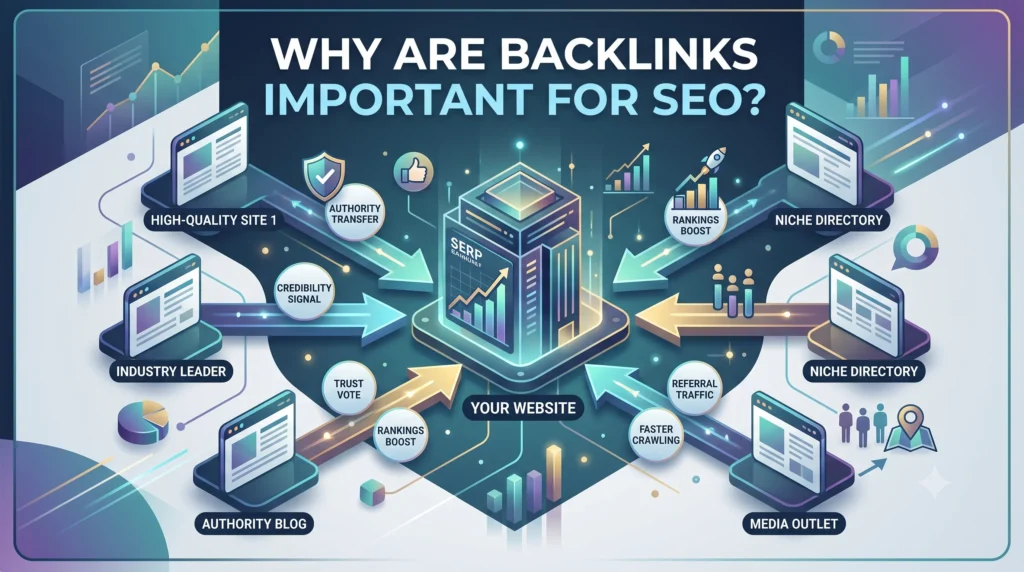
Backlinks matter because they act as a vote of confidence between websites. This makes link building a core strategy in off-page SEO, helping websites earn trust signals and improve their search visibility. When a reputable website links to your content, it tells search engines: “This page is worth referencing.” The more relevant, trustworthy sites that link to you, the more search engines tend to trust your content too.
This concept traces back to Google’s original PageRank algorithm, which evaluated web pages partly based on the quantity and quality of links pointing to them. While Google’s ranking system has evolved dramatically since then, link equity (often called “link juice”) is still part of how pages accumulate authority and rank in search engine rankings.
Here’s why backlinks continue to matter:
- They influence search engine rankings. Pages with strong, relevant backlink profiles tend to rank higher in the SERPs (Search Engine Results Pages).
- They build domain authority and page authority. Metrics from tools like Moz and Ahrefs use backlinks as a core input for scoring a site’s overall authority.
- They drive referral traffic. A backlink isn’t just an SEO signal — real users click those links and land on your site.
- They help with crawlability and indexability. Search engine bots discover new pages by following links, so backlinks can help Google find and index your content faster.
- They establish trust signals. Editorial backlinks from respected publications support your site’s E-E-A-T (Experience, Expertise, Authoritativeness, Trustworthiness), which Google explicitly considers when evaluating content quality.
According to Google’s own Search Central documentation, links remain part of how Search understands relationships between content across the web, even as the company continues to refine how much weight individual links carry (Google Search Central).
Types of Backlinks Explained
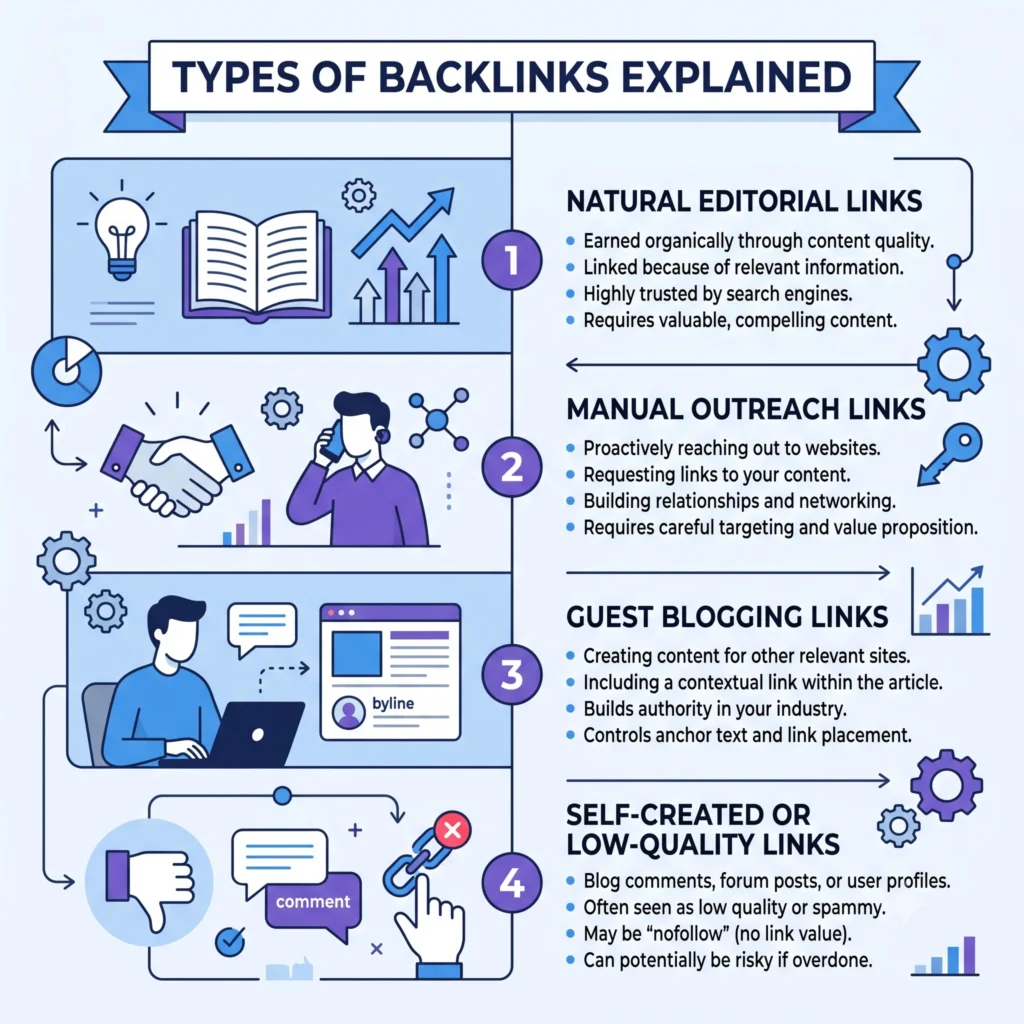
Not all backlinks are created equal. To really understand backlinks meaning in an SEO context, it helps to break them down by type.
Dofollow vs Nofollow Backlinks
This is one of the most important distinctions in link building.
- Dofollow backlinks pass link equity from the linking site to the linked site. By default, links on the web are dofollow unless marked otherwise. These are the backlinks most valuable for SEO.
- Nofollow backlinks include a rel=”nofollow” attribute, which tells search engines not to pass ranking credit through that link. Google also recognizes related attributes like rel=”ugc” (for user-generated content, such as blog comments) and rel=”sponsored” (for paid or advertising links).
Even though nofollow backlinks don’t directly pass link equity, they still offer value: referral traffic, brand visibility, and a more natural-looking backlink profile.
Editorial vs Natural Backlinks
Editorial backlinks are earned when another site links to your content because it’s genuinely useful — no outreach, payment, or request involved. Natural backlinks fall into this same category; they occur organically because your content deserves the citation. These are the gold standard of quality backlinks because search engines view them as authentic endorsements.
External Backlinks vs Internal Links
External backlinks (also called inbound links or incoming links) come from a different domain than your own. These are what people typically mean when they say “website backlinks.” This is different from internal links, which connect pages within the same website (more on that distinction later in this guide).
Other Common Backlink Sources
- Guest posting links — links earned through contributing articles to other websites
- Resource page links — links from curated pages that list helpful tools or content
- Digital PR links — links earned through press coverage, expert commentary, or data studies
- Broken link building — replacing dead links on other sites with links to your own working content
- Directory and citation links — links from business directories, which carry a mix of dofollow and nofollow attributes
What Makes a High-Quality Backlink?
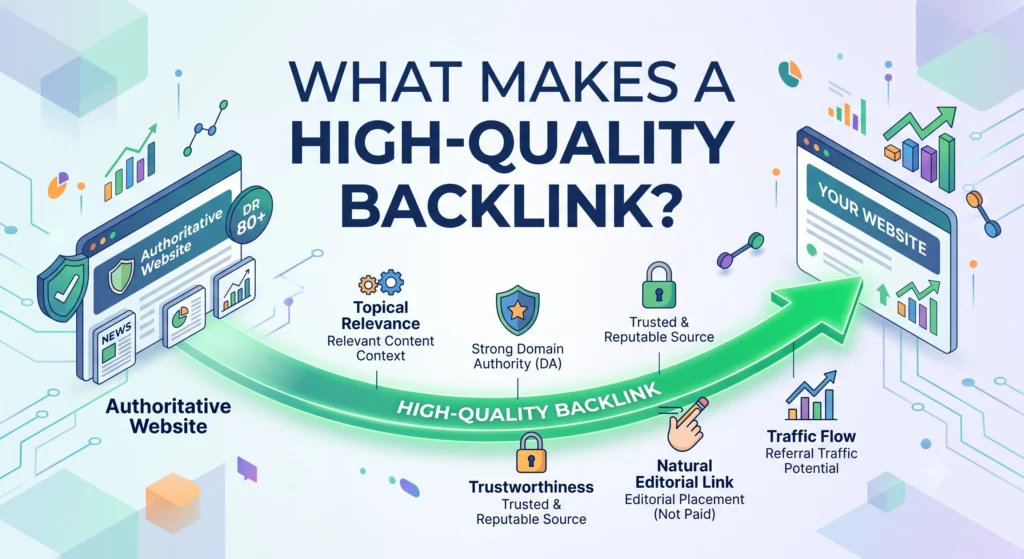
Not every backlink helps your rankings — some can even hurt them. So what separates high-quality backlinks from low-value or even toxic backlinks?
1. Relevance. A backlink from a site in your niche or a topically related industry carries more weight than a random, unrelated site. Topical relevance tells search engines the link makes contextual sense.
2. Authority of the linking domain. Links from websites with strong domain authority and page authority typically pass more trust and value.
3. Anchor text. The clickable text of a link (the anchor text) gives search engines context about what the linked page is about. Natural, varied anchor text is far better than repetitive, over-optimized phrasing.
4. Link placement. A link placed within the main body content of a page, surrounded by relevant text, is more valuable than a link buried in a footer, sidebar, or comment section.
5. Referring domains diversity. Getting backlinks from many unique referring domains is generally more valuable than getting dozens of links from the same site.
6. Dofollow attribute. As mentioned earlier, dofollow backlinks pass link equity, making them more impactful for rankings than nofollow links.
7. Traffic and trust. Links from sites that actually receive real organic traffic and have a clean reputation tend to be safer and more beneficial than links from spammy, low-traffic domains.
Ahrefs’ backlink guide echoes many of these same quality signals, emphasizing that relevance and authority together matter more than raw link volume (Ahrefs).
How to Get High-Quality Backlinks
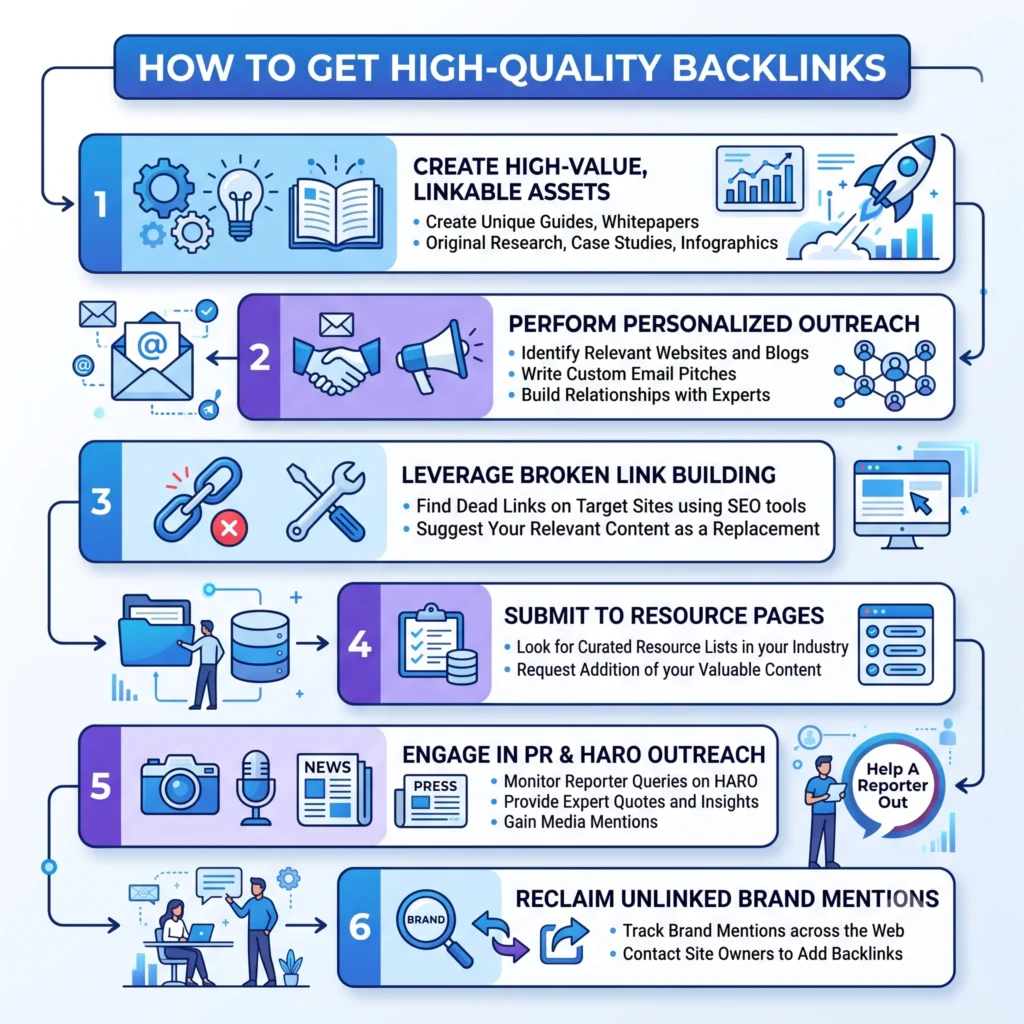
Now that you understand what makes a backlink valuable, let’s talk about how to get backlinks — and how to build backlinks sustainably, without risking a penalty.
1. Create Link-Worthy Content
This is the foundation of any real backlink strategy. Creating valuable content is just one part of a larger off-page SEO strategy that includes link building, brand mentions, and authority building. Original research, in-depth guides, free tools, and unique data are far more likely to earn organic, natural backlinks than generic content. Content marketing and backlink building go hand in hand — you can’t build durable links to weak content.
2. Try Guest Posting (the Right Way)
Guest posting is still an effective link building tactic when done properly. Contribute genuinely useful articles to relevant, reputable publications instead of mass-producing low-value guest posts purely for links.
3. Use Broken Link Building
Find broken (dead) links on other websites in your niche, then reach out and suggest your relevant content as a replacement. This tactic benefits both parties: the site owner fixes a broken link, and you earn a backlink.
4. Get Listed on Resource Pages
Many websites maintain curated resource pages listing helpful tools, guides, or services. If your content fits naturally, a polite outreach email can earn you a valuable placement.
5. Leverage Digital PR
Digital PR involves creating newsworthy content — original studies, surveys, or expert commentary — that journalists and bloggers want to cite. This is one of the most scalable ways to build high-quality backlinks from authoritative publications.
6. Analyze Competitor Backlinks
Competitor backlink analysis lets you see where your competitors are earning links, so you can pursue similar (or better) opportunities. This is one of the fastest ways to build a realistic, prioritized link building strategy.
7. Reclaim Unlinked Brand Mentions
Sometimes other sites mention your brand or content without linking to it. A quick outreach message asking them to add a link can convert these unlinked mentions into real backlinks.
Moz’s guide to link building notes that earning backlinks through genuinely useful content and relationship-based outreach consistently outperforms shortcut tactics over the long term (Moz).
How to Check Your Backlinks
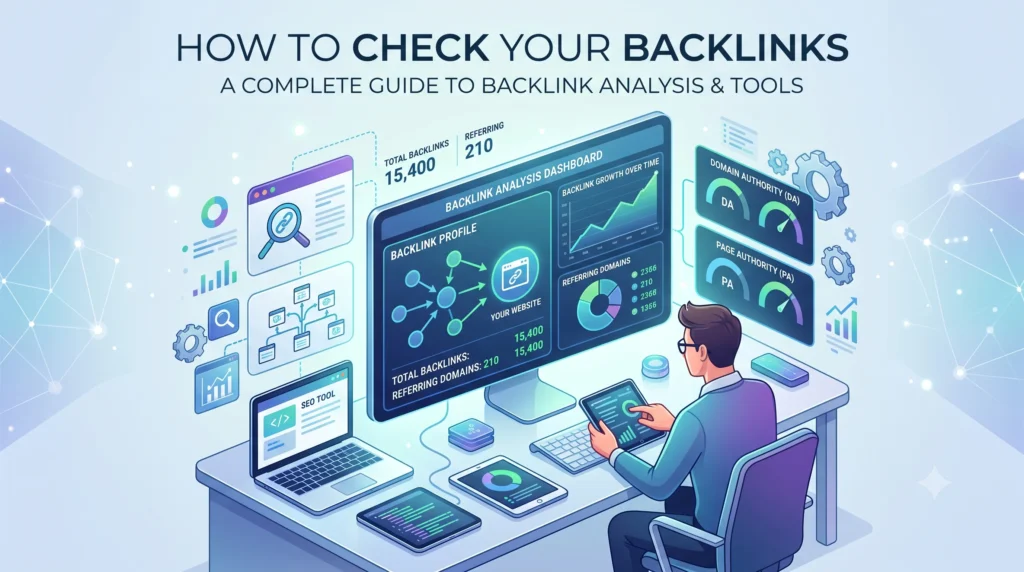
Once you start building backlinks, you need a way to track and evaluate them. This is where a backlink checker comes in.
Popular tools for backlink audits and analysis include:
- Ahrefs — one of the most comprehensive backlink checkers, offering referring domains data, anchor text reports, and link quality scores
- Semrush — provides backlink audit tools plus a “toxic score” to flag potentially harmful links
- Moz Link Explorer — offers domain authority and page authority metrics alongside backlink data
- Majestic — known for its Trust Flow and Citation Flow metrics, which help assess link quality
- Google Search Console — a free tool directly from Google that shows which external sites link to your website, along with your top linked pages
To run a basic backlink audit:
- Export your full backlink profile from a backlink checker tool.
- Sort links by referring domain authority to identify your strongest assets.
- Flag low-quality, spammy, or irrelevant domains.
- Check anchor text distribution for over-optimization.
- Monitor new and lost backlinks monthly to catch changes early.
Google Search Console remains a reliable, free starting point, since it shows exactly which links Google itself has discovered pointing to your site (Google Search Console Help).
Common Backlink Mistakes to Avoid
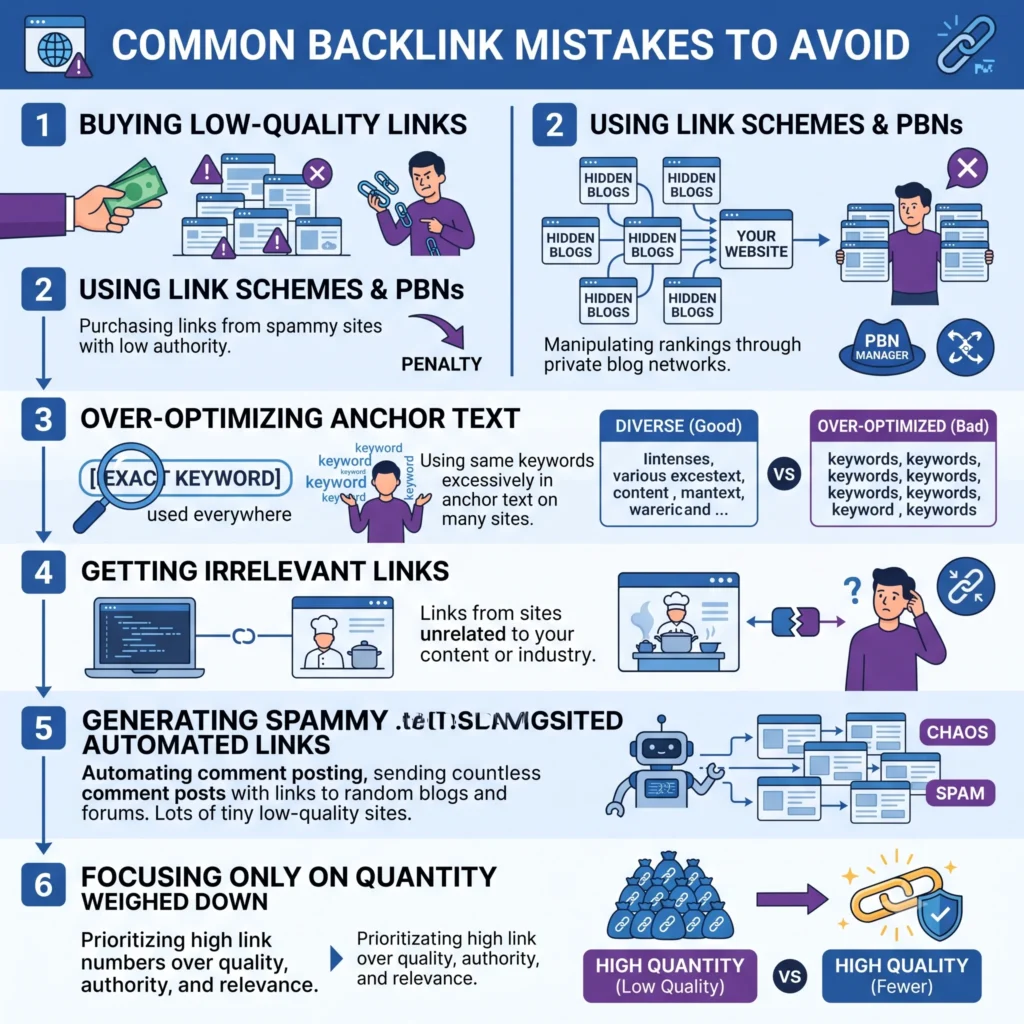
Even experienced site owners fall into these traps. Avoid them to protect your rankings. Understanding proper off-page SEO practices can help you build backlinks safely while avoiding tactics that may harm your rankings.
- Buying links in bulk. Paid link schemes violate Google’s spam policies and can trigger manual penalties.
- Over-optimizing anchor text. Using the exact same keyword-rich anchor text repeatedly looks unnatural and can raise red flags.
- Ignoring link relevance. A backlink from a completely unrelated industry offers little topical value and can look manipulative at scale.
- Chasing quantity over quality. Ten relevant, authoritative backlinks will typically outperform hundreds of low-quality ones.
- Failing to disavow toxic backlinks. If your site accumulates spam backlinks from negative SEO attacks or old low-quality directories, use Google’s disavow tool to distance your site from them.
- Neglecting a backlink audit. Without regular audits, it’s easy to miss toxic backlinks or lost high-value links until rankings already drop.
Google’s own spam policies specifically call out manipulative link schemes — including buying or selling links that pass ranking credit — as practices that can lead to lower rankings or removal from search results altogether (Google Search Central: Spam Policies).
Backlinks vs Internal Links: What’s the Difference?
It’s easy to confuse these two concepts, so let’s clear it up.
| Feature | Backlinks | Internal Links |
| Source | External websites | Same website |
| Purpose | Build authority and trust signals | Improve site structure and navigation |
| Impact on rankings | Passes link equity from other domains | Distributes authority across your own pages |
| Control | Earned or requested from others | Fully controlled by you |
| Example | A news site linking to your blog post | Your blog post linking to your homepage |
Both are essential. Backlinks help establish your website’s authority in the eyes of search engines, while internal links help search engines (and users) navigate your site, understand your content structure, and distribute authority across important pages. A well-rounded SEO strategy uses both — alongside thoughtful outbound links to relevant, trustworthy external resources.
Final Thoughts
So, what are backlinks, really? At their core, they’re digital endorsements — signals that tell search engines and users alike that your content is worth trusting. Understanding what backlinks are, and how to earn them ethically, is one of the most valuable skills you can build in SEO. To learn how backlinks fit into the bigger SEO picture, explore our complete off-page SEO guide covering link building, brand authority, and external ranking factors.
Focus on creating genuinely useful content, earning links from relevant and authoritative sites, and regularly auditing your backlink profile to catch problems early. Do that consistently, and your website’s authority — and rankings — will grow in a sustainable, Google-friendly way.
Frequently Asked Questions
What are backlinks in SEO?
Backlinks are links from other websites that point to your site, helping search engines understand your website’s authority and credibility.
Why are backlinks important for SEO?
Backlinks are important because they can improve search rankings, increase referral traffic, and build trust with search engines.
What is a high-quality backlink?
A high-quality backlink comes from a trusted, relevant website and includes natural placement, proper context, and meaningful anchor text.
How can I get backlinks for my website?
You can get backlinks by creating valuable content, guest posting, building relationships, earning digital PR mentions, and using link-building strategies.
What is the difference between backlinks and internal links?
Backlinks come from external websites pointing to your site, while internal links connect pages within the same website to improve navigation and SEO.
FluxSEO’s Team creates practical, beginner-friendly guides on SEO, blogging, keyword research and digital growth. Our goal is to simplify search engine optimization and help website owners improve visibility, rankings and organic traffic with clear, actionable advice.