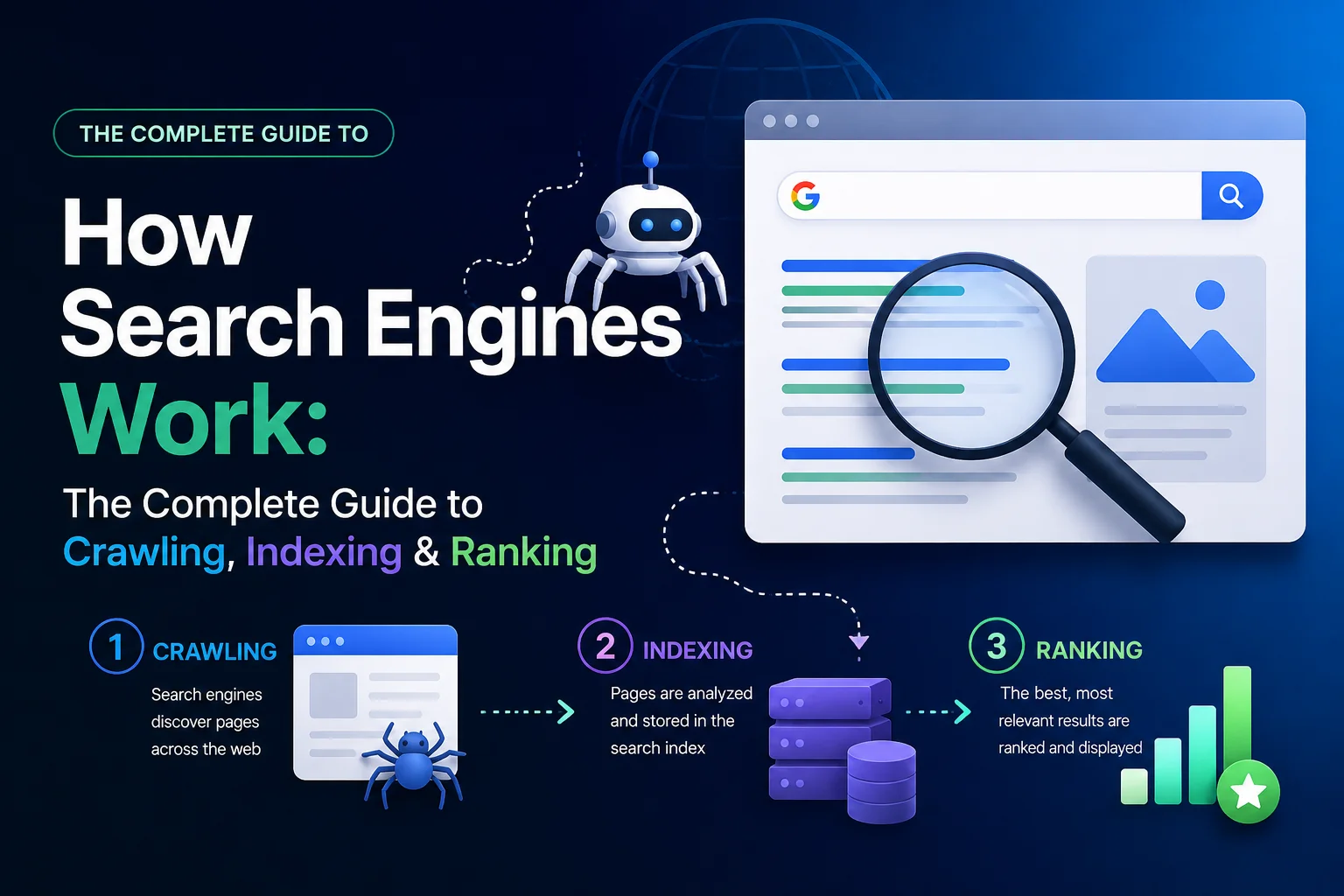
How Search Engines Work: The Complete Guide to Crawling, Indexing & Ranking
Every time you type a question into Google, an answer appears in less than a second. It feels like magic, but it isn’t. Behind that instant list of blue links sits one of the most complex systems on the internet—and understanding how search engines work is one of the most important parts of SEO. If you’re just getting started, our SEO Basics guide covers the core concepts every beginner should know before diving deeper into search engines.
In this guide, we’ll break down exactly how search engines work, step by step: how they discover web pages, how they store them, and how they decide which pages deserve the top spot on the search engine results page (SERP). By the end, you’ll understand the full journey — from crawling and indexing to ranking — and know what you can do to help your own website succeed.
What Is a Search Engine?

A search engine is a software system designed to help people find information on the internet. Think of it as a librarian for the entire web: it visits pages, reads what’s on them, files that information away, and then — when someone asks a question — pulls out the most relevant answers in a fraction of a second.
Google, Bing, Yahoo, and DuckDuckGo are all examples of search engines, though Google dominates the market in most countries, including the United States. Every search engine relies on the same basic mechanics to function, even if the exact search engine algorithm behind each one is different and closely guarded. That mechanic can be summed up in three words: crawling, indexing, and ranking.
Why Understanding How Search Engines Work Matters
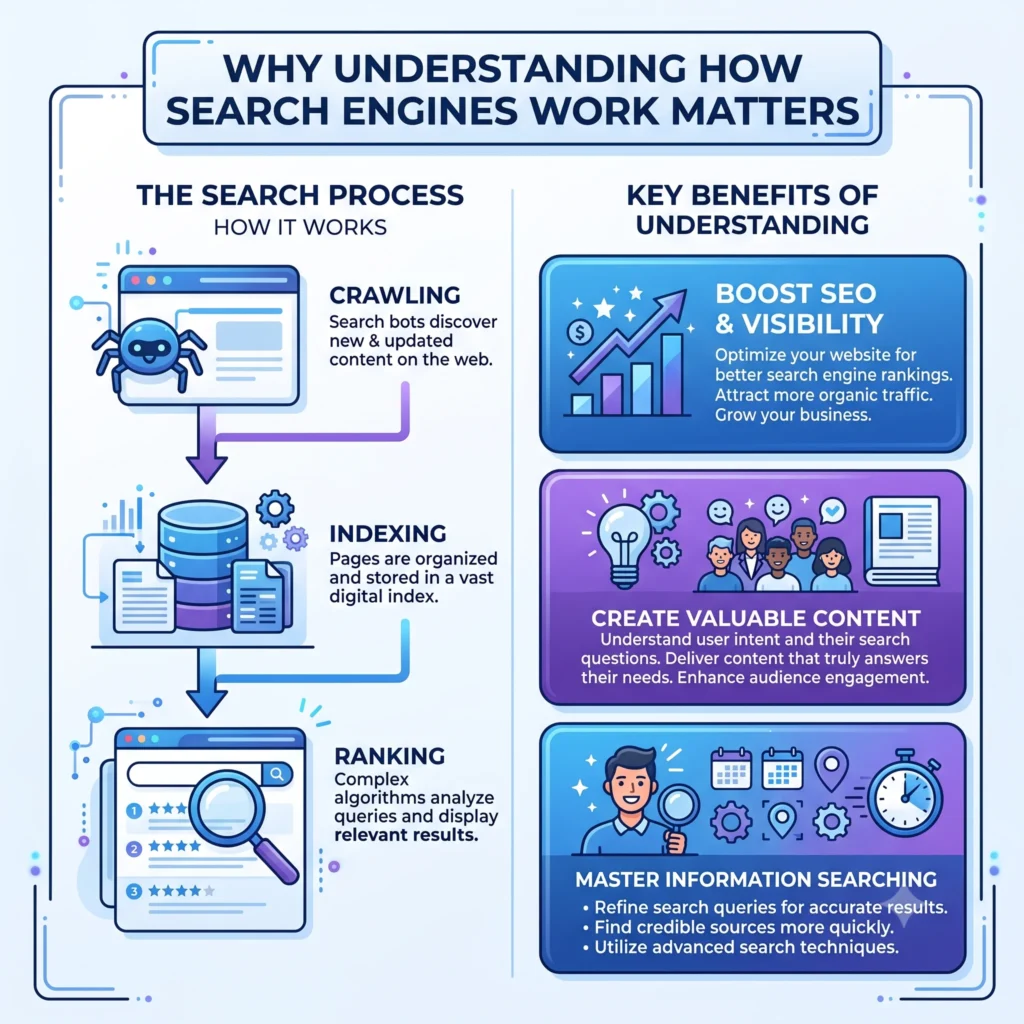
If you run a website, write content, or manage SEO, understanding how search engines work isn’t optional — it’s foundational. You can write the best article in the world, but if a search engine can’t crawl it, can’t index it, or doesn’t see it as relevant, it will never appear in organic search results.
Here’s why this knowledge pays off:
- It helps you diagnose why a page isn’t showing up in Google.
- It helps you prioritize technical SEO fixes instead of guessing.
- It helps you create content that aligns with search intent and ranking signals.
- It helps you avoid wasting crawl budget on low-value pages.
In short, knowing how search engines work turns SEO from guesswork into strategy. To build a stronger foundation, start with our Beginner’s Guide to SEO, which explains the essential concepts behind successful optimization.
How Search Engines Work: From Crawling to Search Results
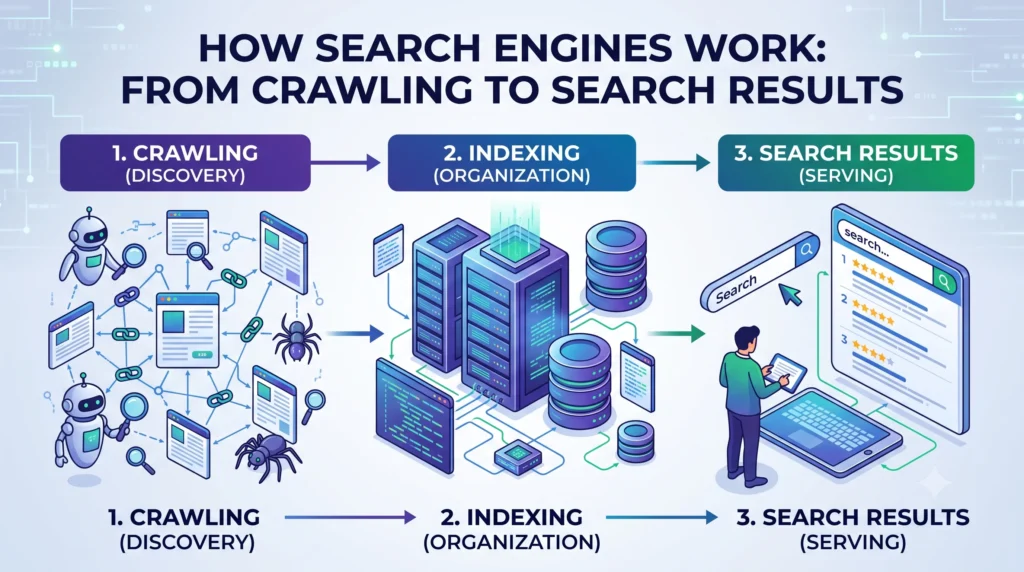
At a high level, how search engines work can be broken into three connected stages:
- Crawling – Search engine bots (also called web crawlers or spiders) discover web pages by following links across the internet.
- Indexing – The content of those pages is analyzed and stored in a massive search database called the search index.
- Ranking – When a user types a search query, the search engine scans its index and returns the most relevant, high-quality pages on the search results page.
These three stages happen continuously, around the clock, across billions of web pages. A page has to pass through all three before it can ever appear in organic search results — and if it stumbles at any stage, it simply won’t be visible, no matter how good the content is.
Let’s look at each stage in detail.
How Search Engines Crawl Websites
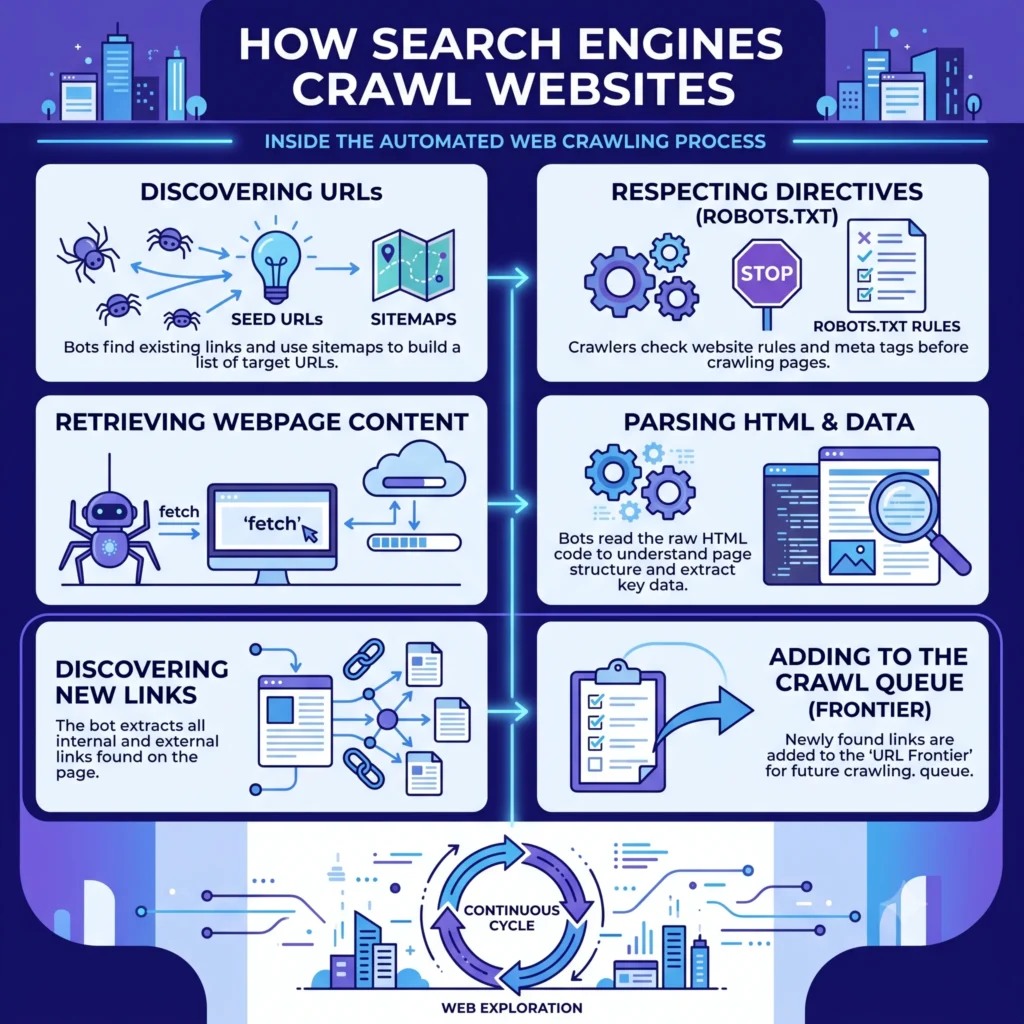
Search engine crawling is the discovery phase. This is how search engines find out that a page exists in the first place.
How Web Crawlers Discover Pages
Search engines use automated programs called web crawlers — Google’s is known as Googlebot — to browse the internet nonstop. According to Google’s official documentation on how Search works, there’s no central registry of every page online, so crawlers rely on links to find new content. A crawler starts with a known URL, reads the page, follows every link on it, and repeats the process endlessly. This is often called page discovery or URL discovery.
Pages can also be discovered through:
- XML sitemaps submitted via tools like Google Search Console
- Internal links from other pages on your site
- External links from other websites
- Manually submitted URLs
What Is Crawl Budget?
Crawl budget refers to the number of pages a search engine bot will crawl on your site within a given time frame. Large sites with millions of pages need to manage crawl budget carefully, while small websites rarely need to worry about it. Poor website architecture, broken links, and duplicate content can waste crawl budget on pages that don’t matter, leaving your important pages under-crawled.
Controlling Crawl Behavior
Website owners can guide crawlers using:
- Robots.txt – a file that tells crawlers which parts of a site they should or shouldn’t access. Google’s Crawling and Indexing documentation explains how to configure this correctly so you don’t accidentally block important pages.
- HTTP status codes – such as 200 (OK), 301 (redirect), and 404 (not found), which tell crawlers what happened to a URL
- Clean, logical website architecture that makes pages easy to discover
If a crawler can’t reach a page — because of a blocked robots.txt rule, a broken link, or poor crawlability — that page can’t move to the next stage: indexing.
How Search Engines Index Web Pages
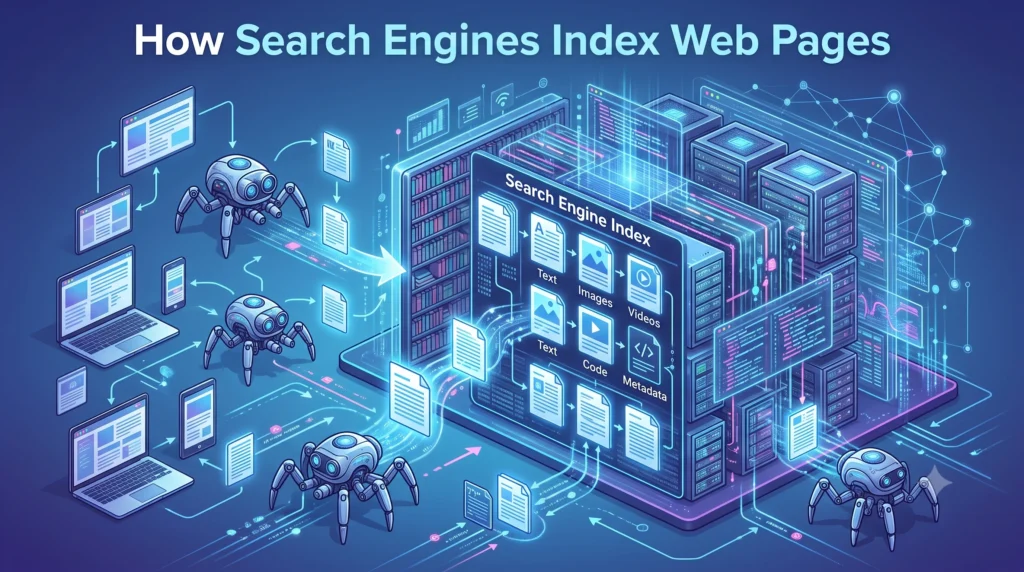
Once a page is crawled, it doesn’t automatically appear in search results. It has to be indexed first.
What Indexing Actually Means
Indexing is the process where search engines analyze a page’s content — text, images, videos, and structured data — and decide whether to store it in the search index. The search index is essentially a giant, organized database containing information about billions of web pages, built so that relevant results can be retrieved almost instantly.
During website indexing, a search engine looks at:
- The words and topics on the page (content relevance)
- Title tags, headers, and meta descriptions
- Structured data and schema markup
- Canonical tags, to identify the preferred version of duplicate pages
- Whether the page uses a noindex tag, which tells search engines not to index it at all
Why a Page Might Not Get Indexed
Not every crawled page makes it into the index. Common reasons include:
- Duplicate content across multiple URLs
- Thin content that offers little unique value
- A noindex tag applied intentionally or by mistake
- Poor page quality or low index coverage
- Canonical tags pointing to a different preferred URL
This is why “crawled” and “indexed” aren’t the same thing — a page can be fully crawled and still be left out of the search database entirely.
How Search Engines Rank Search Results
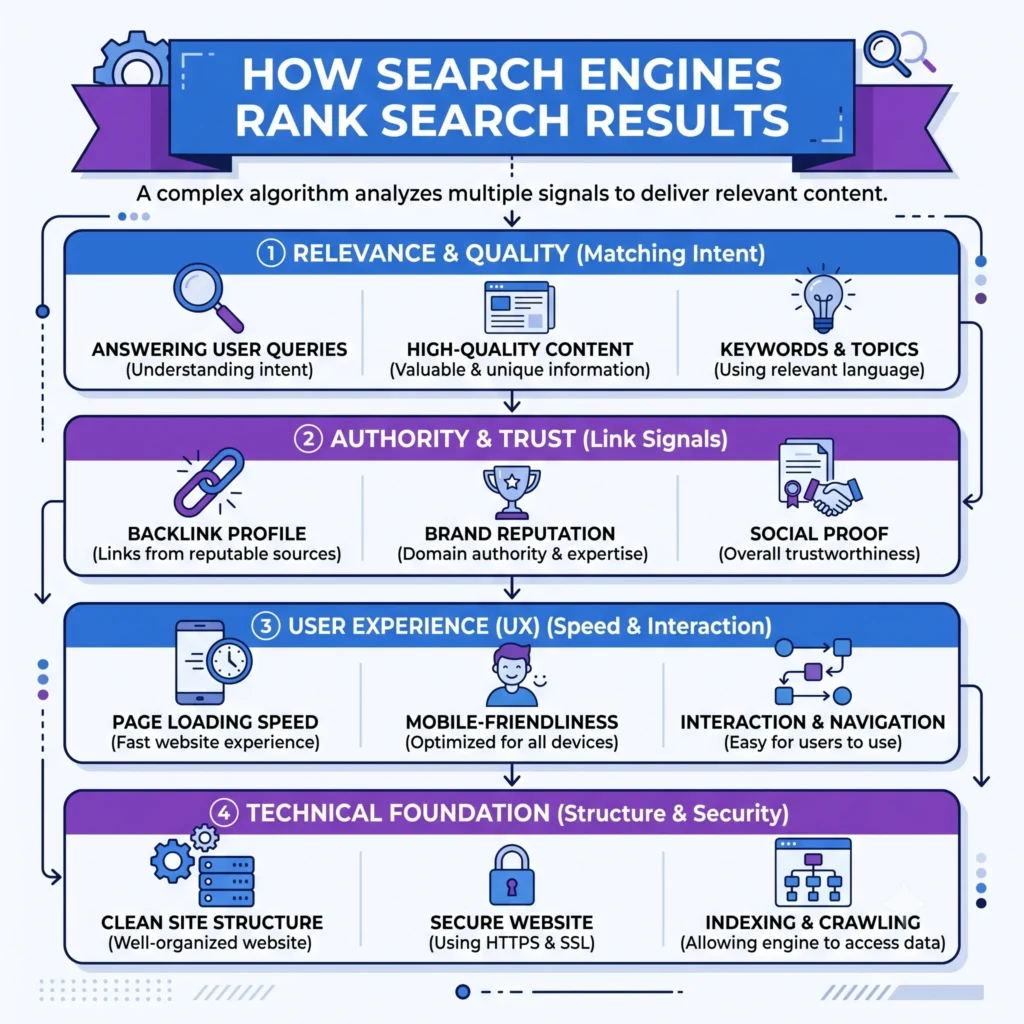
Ranking is the final — and most visible — stage of how search engines work. Once a page is indexed, the search engine has to decide where it belongs on the search engine results page whenever someone runs a matching search query.
This decision is made by the search engine algorithm, a complex, constantly updated system that evaluates indexed pages against hundreds of ranking signals to determine the best possible match for the searcher’s intent.
At a basic level, ranking works like this:
- A user submits a search query.
- The search engine scans its index (not the live web) for pages relevant to that query.
- Ranking signals are applied to score and order those pages.
- The best-matching results are displayed on the SERP, typically as organic search results alongside ads, featured snippets, or AI Overviews.
This is also where the search engine ranking process becomes highly competitive — millions of pages might be relevant to a query, but only ten or so will appear on page one.
Key Search Engine Ranking Factors
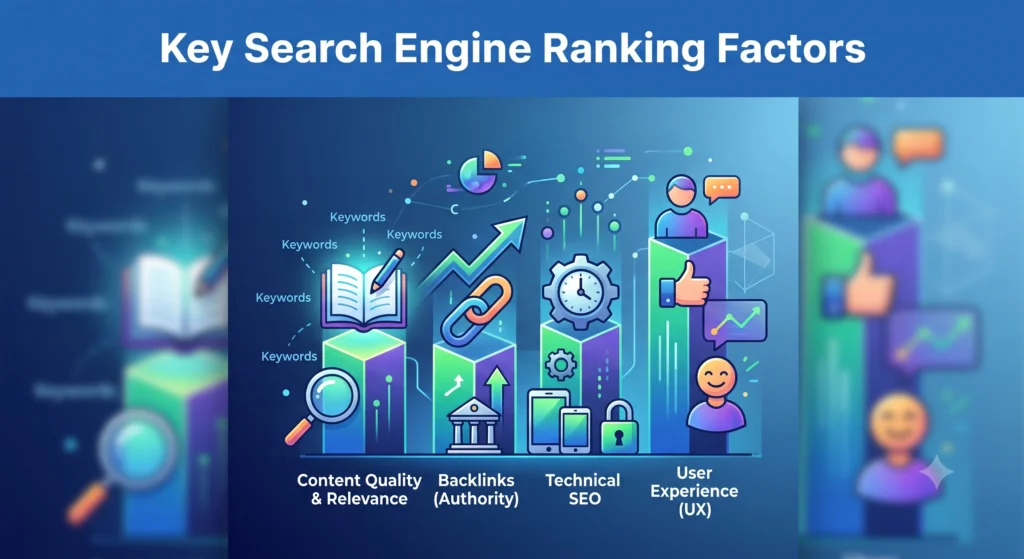
While no search engine publishes its exact formula, decades of SEO research — including Moz’s Beginner’s Guide to SEO — and official documentation point to several consistent ranking signals:
- Content relevance and quality – Does the page thoroughly answer the search intent behind the query?
- Website authority – Measured partly through backlinks and historically influenced by concepts like PageRank, which evaluates how many quality external links point to a page.
- Internal links – A strong internal linking structure helps both users and crawlers understand which pages matter most.
- Core Web Vitals and website performance – Page speed, interactivity, and visual stability all affect rankings.
- Mobile-first indexing – Since most searches happen on mobile, search engines primarily use the mobile version of a site for indexing and ranking.
- Structured data – Schema markup helps search engines understand context, which can improve visibility through rich results.
- User intent match – Pages that align closely with what the searcher actually wants tend to outrank pages that are merely keyword-relevant.
- Technical SEO health – Clean URLs, proper HTTP status codes, and secure, crawlable architecture all support strong rankings. These are all part of the SEO fundamentals every website owner should understand.
Google and other search engines combine these signals — along with hundreds of smaller ones — to compute a final ranking for every query, every time.
Common Crawling and Indexing Issues
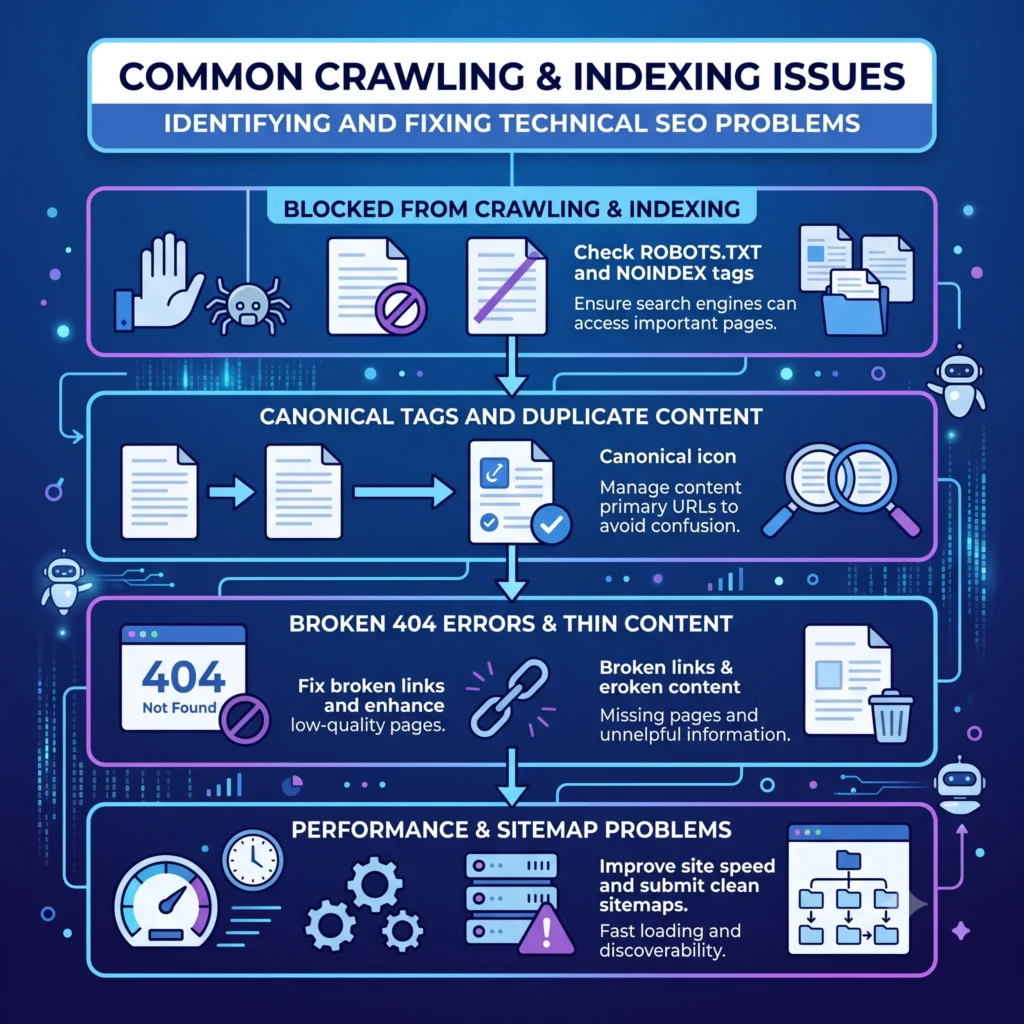
Even well-built websites run into problems that block search engines from doing their job properly. The most frequent indexing issues include:
- Blocked resources in robots.txt that accidentally prevent crawling
- 404 errors from broken or deleted pages with no redirect in place
- Redirect chains that waste crawl budget
- Duplicate content without a canonical tag to clarify the preferred version
- Thin content pages that add little value and get skipped during indexing
- Slow website performance, which can reduce crawl efficiency
- Missing or outdated XML sitemaps
- Accidental noindex tags left on important pages after a site migration
Regularly auditing your site in Google Search Console is the fastest way to catch these issues before they hurt your search visibility.
How to Help Search Engines Crawl, Index, and Rank Your Website
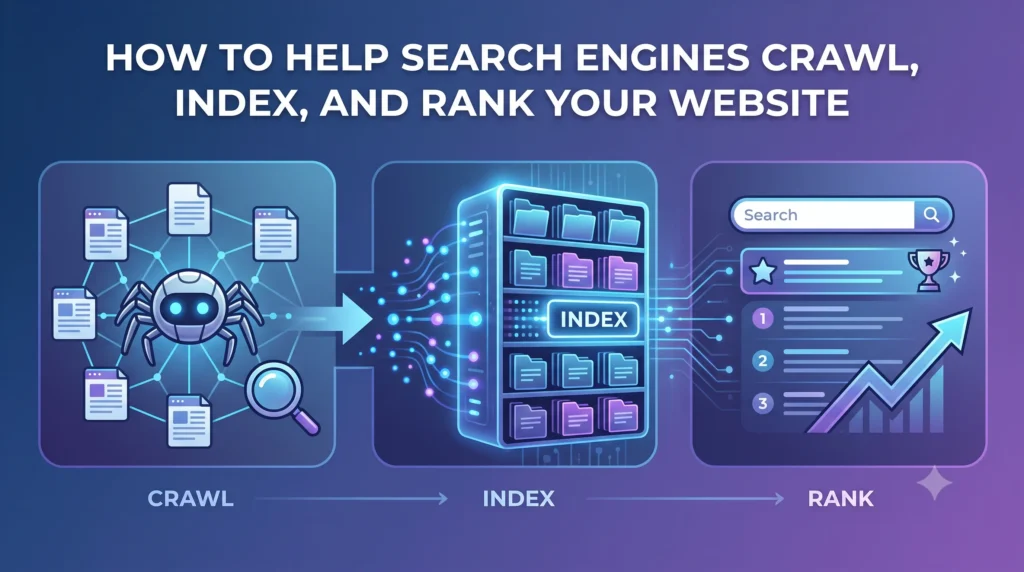
Now that you understand how search engines work, here’s how to make the process work in your favor. If you’re new to optimization, our SEO Basics guide provides a complete overview of the strategies that support better crawling, indexing, and rankings.
For crawling:
- Submit an updated XML sitemap through Search Console.
- Keep your robots.txt file accurate and intentional.
- Build strong internal links so crawlers can find every important page.
- Fix broken links and unnecessary redirect chains.
For indexing:
- Use canonical tags to resolve duplicate content.
- Avoid noindex tags on pages you want to rank.
- Write original, in-depth content instead of thin content.
- Add structured data to help search engines understand your pages.
For ranking:
- Match content to real search intent, not just keywords.
- Improve Core Web Vitals and overall website performance.
- Earn quality external links from relevant, trustworthy sites.
- Keep content fresh, accurate, and genuinely useful to readers.
Treat crawling, indexing, and ranking as three separate checkpoints in this process. A weakness at any one stage — even a technically excellent site with poor content, or a great article that’s accidentally blocked from crawling — can keep your pages out of organic search results entirely.
Conclusion: Mastering How Search Engines Work for Better SEO
At its core, how search engines work comes down to a simple pipeline: discover, store, and rank. Search engine crawlers explore the web and find pages, search engine indexing organizes and stores that content in a massive search database, and the search engine algorithm ranks the most relevant pages for every search query.
Once you understand this full picture—and how crawling, indexing, and ranking connect—SEO stops feeling like guesswork. For a complete introduction to search engine optimization, explore our complete SEO guide.You can diagnose problems at the right stage, prioritize technical fixes that actually matter, and build a website that search engines can crawl, index, and rank with confidence.
Frequently Asked Questions
How search engine works step by step
Search engines work in four main steps: they crawl web pages, index their content, rank pages based on relevance and quality, and display the best results in the search engine results pages (SERPs).
How search engine works diagram
A search engine diagram typically shows this flow: Website → Crawling → Indexing → Ranking → Search Results (SERPs), illustrating how pages move from discovery to appearing in search results.
How search engine works PDF
A PDF guide on how search engines work explains the complete process of crawling, indexing, ranking, and optimization, making it a useful resource for learning SEO fundamentals offline.
Ahrefs how search engines work
Ahrefs explains that search engines work by crawling the web, indexing discovered pages, and ranking them using hundreds of ranking factors to deliver the most relevant results for each search query.
How does search engine work Wikipedia
According to Wikipedia, a search engine uses web crawlers to collect information from websites, builds a searchable index, and retrieves and ranks the most relevant pages when users enter a query.

FluxSEO’s Team creates practical, beginner-friendly guides on SEO, blogging, keyword research and digital growth. Our goal is to simplify search engine optimization and help website owners improve visibility, rankings and organic traffic with clear, actionable advice.