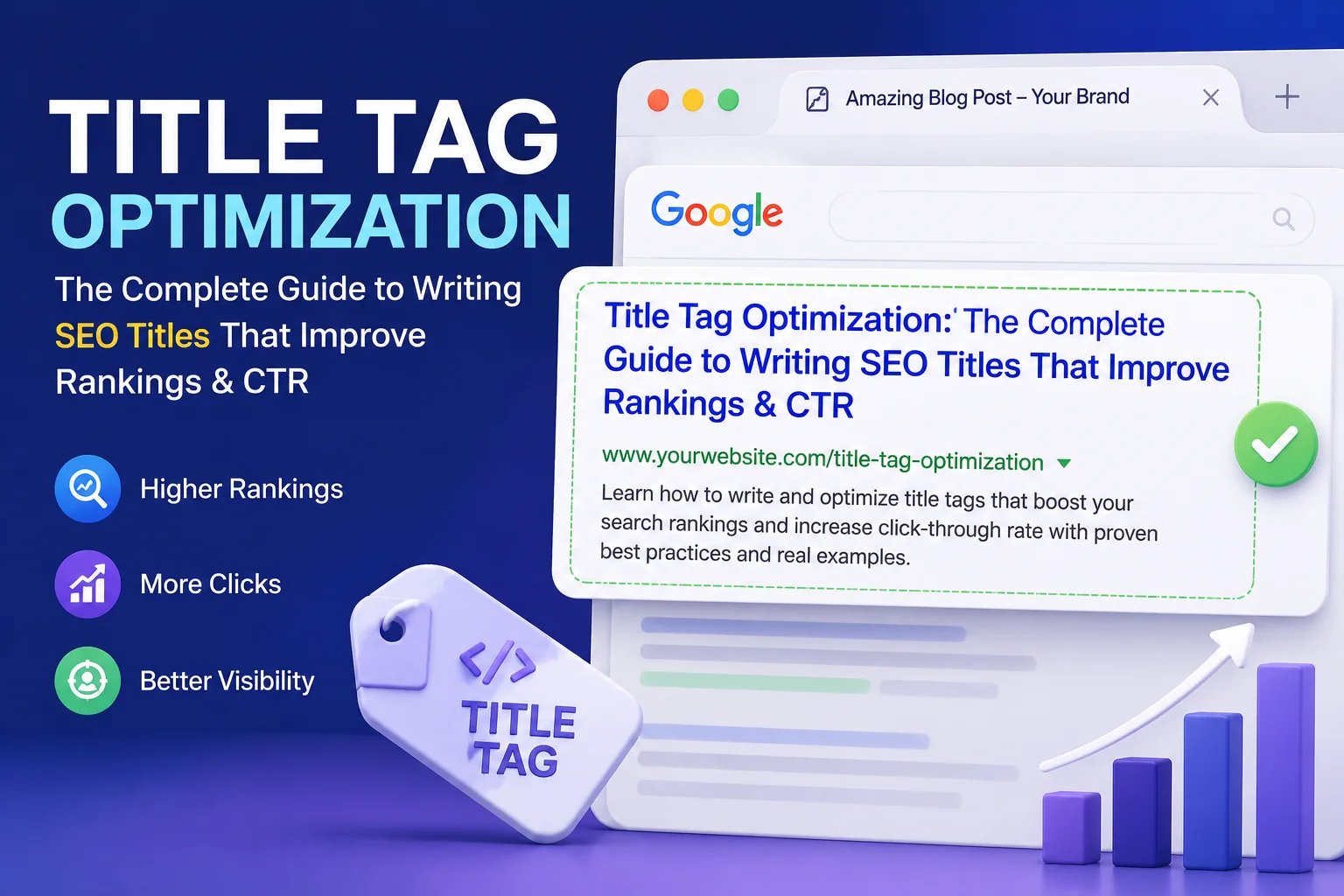
If you want more clicks from Google, more organic traffic, and better rankings, title tag optimization is one of the fastest and easiest places to start. Your title tag is often the very first thing a searcher sees in the search engine results page, and it’s also one of the strongest on-page signals search engines use to understand what your page is about.
In this guide, you’ll learn exactly what a title tag is, why title tag optimization matters for SEO, and how to write compelling, keyword-rich titles that improve both rankings and click-through rate. Whether you’re a beginner or a seasoned marketer, this is your complete playbook for title tag SEO.
What Is a Title Tag?
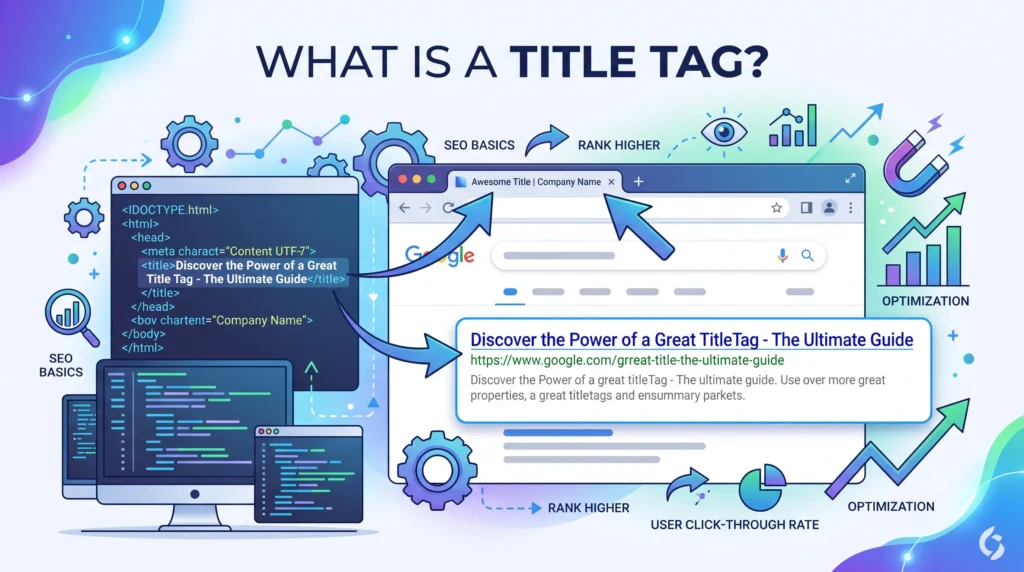
A title tag is an HTML title tag element placed inside the <head> section of a webpage. It looks like this:
html
<title>Title Tag Optimization: The Complete Guide</title>The text inside this tag becomes the clickable title you see in Google search results, in browser tabs, and often when a page is shared on social media. It’s different from your H1 heading, which appears in the visible body content of the page — a distinction we’ll cover in more detail later.
In simple terms, the title tag is your page’s headline for both search engines and searchers. It’s a small piece of metadata, but it carries enormous weight in search engine optimization.
Why Title Tag Optimization Is Important for SEO
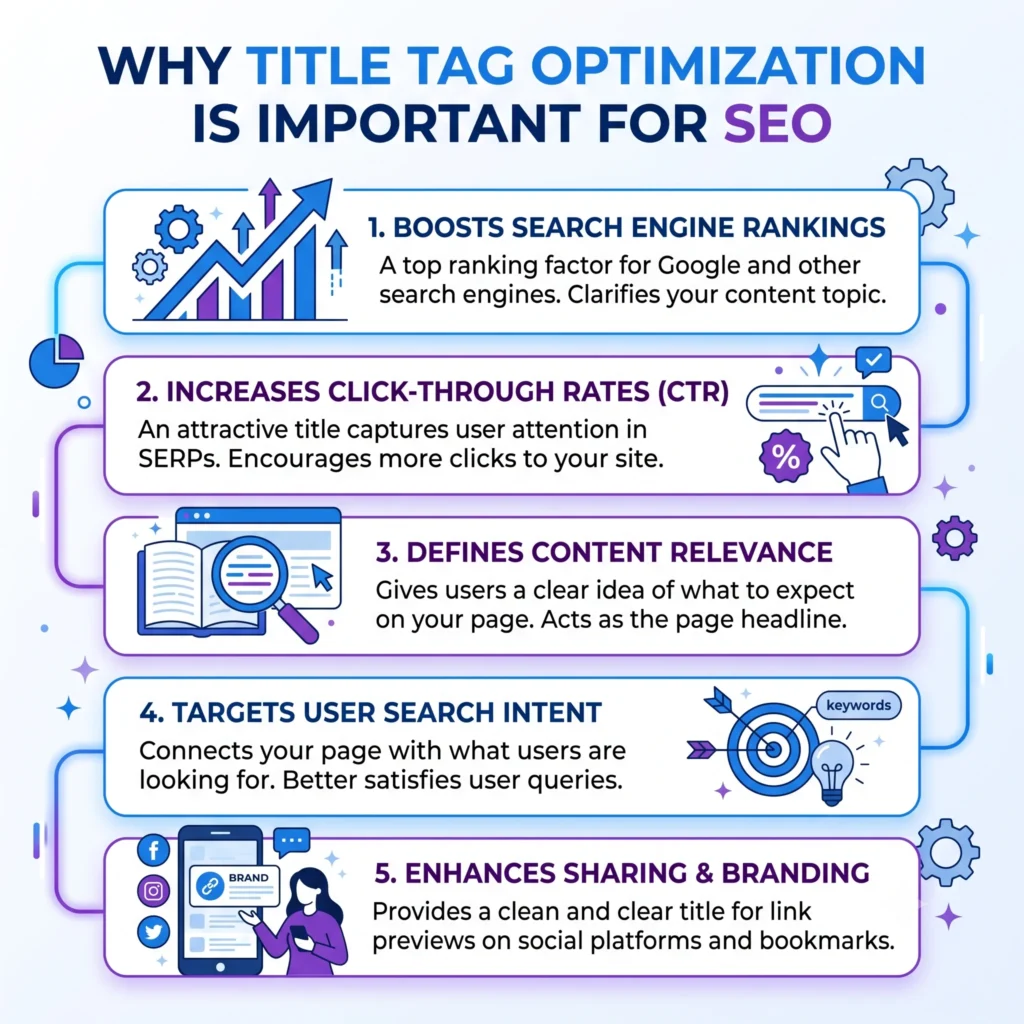
Title tag optimization matters because your SEO title is doing double duty: it helps search engines understand page relevance, and it convinces real people to click. Here’s why it deserves your attention.
It influences rankings. Google has confirmed that the title tag is a ranking factor, since it helps the algorithm match your page to relevant search queries. According to Google’s developer documentation on title links, a good title tag briefly describes what a page is about so Google can figure out how the page’s content relates to searches.
It drives click-through rate. Even if you rank in position one, a boring or vague SEO title can cause searchers to skip your result. A clear, benefit-driven title tag improves CTR, which sends positive engagement signals back to the search engine.
It shapes your brand’s first impression. Your title tag appears in the SERP, the browser tab, bookmarks, and shared links. A well-optimized, unique title tag builds trust before a visitor even lands on your site.
It supports AI-driven search. Tools like Google’s AI Overviews, ChatGPT, Gemini, and Perplexity often use page titles and metadata to understand and summarize content. Strong title tag optimization improves your chances of being cited in these AI-generated answers, not just traditional organic rankings.
How Search Engines Use Title Tags
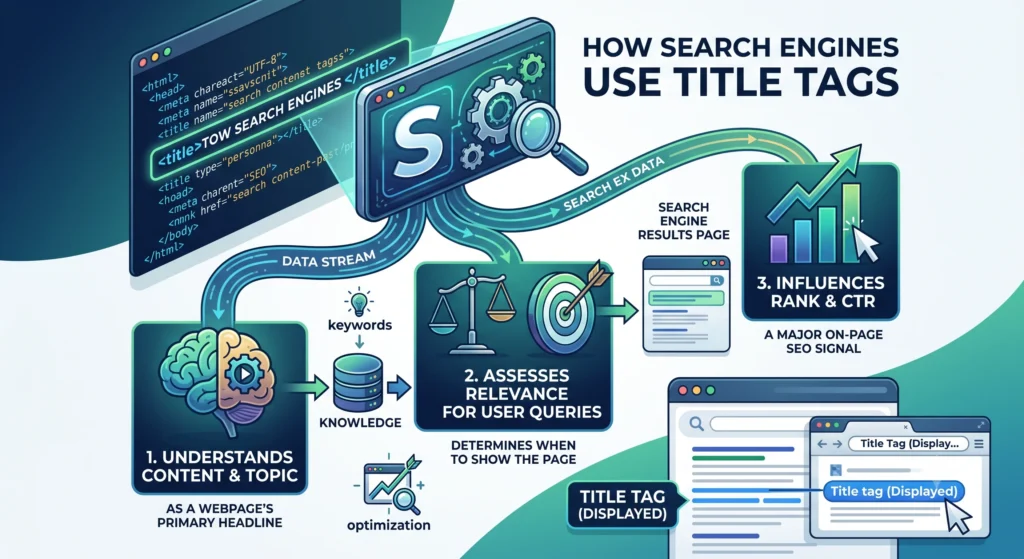
Search engines like Google and Bing use your title tag in several ways. First, during page indexing, crawlers read the title tag to understand the page’s topic and how it fits into the site’s overall content structure. Second, the title tag is compared against search queries to determine page relevance — if your target keyword appears naturally in the title, it signals to the algorithm that the page may satisfy that search intent.
Third, and importantly, Google doesn’t always display your exact title tag in the search results. Google sometimes creates a different title for a search result if it believes an alternative title would be more helpful to users — a behavior documented in Google Search Central’s guidance on title generation. This can happen when a title is too long, stuffed with keywords, or doesn’t accurately reflect the page content — another reason clean, honest title tag SEO practices matter.
The Difference Between a Title Tag and an SERP Title
It’s worth understanding that the title tag you write in your HTML and the SERP title Google actually displays aren’t always identical. Google may rewrite titles using content from your H1, breadcrumbs, or even other text on the page. Writing a strong, accurate, and well-structured title tag reduces the chances of Google rewriting it and increases the odds your intended SEO title shows up exactly as written.
How to Write an SEO-Friendly Title Tag
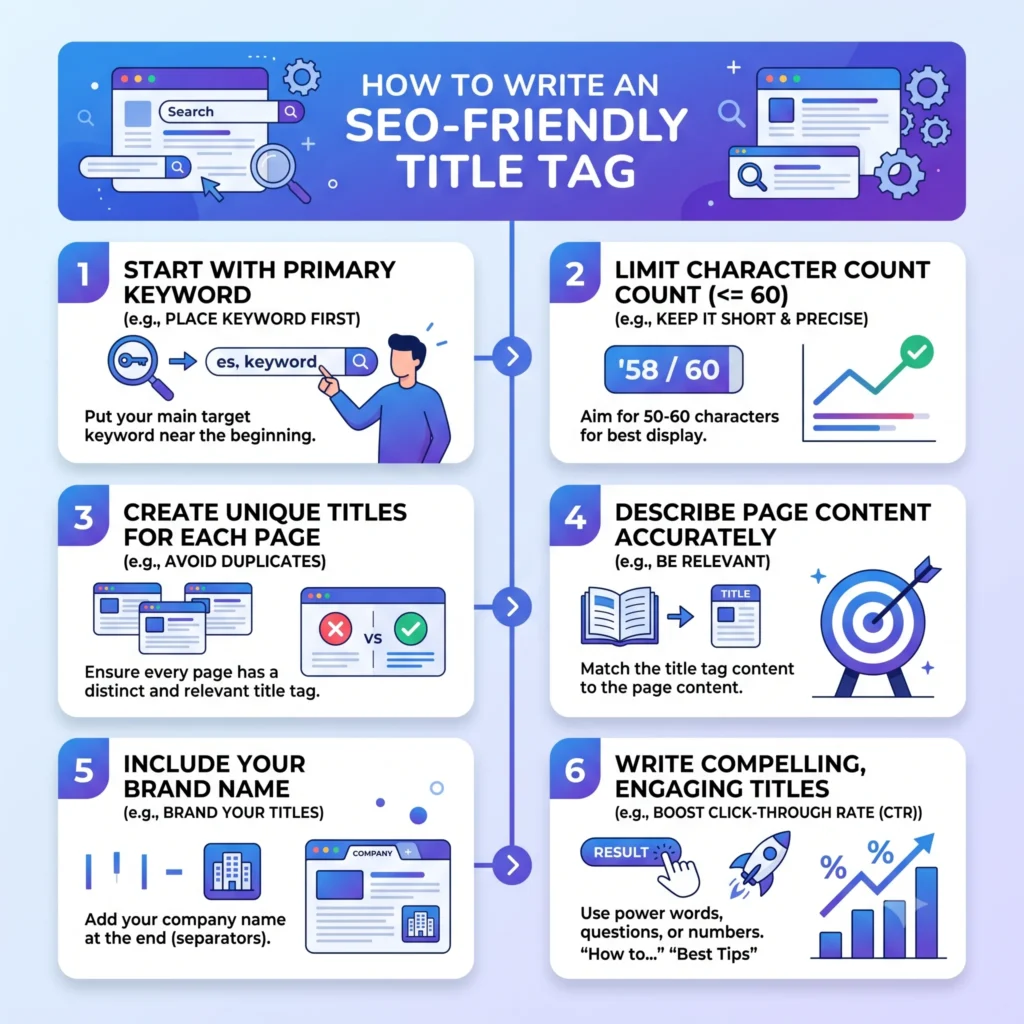
Writing a strong SEO title tag is part art, part science. Here’s a simple process for how to write title tags that work.
Want to learn more? Read our complete guide on title tag optimization to discover proven techniques for writing SEO titles that improve rankings, click-through rate, and search visibility.
Start with your primary keyword. Place your main target keyword naturally near the beginning of the title. This helps both search engines and users immediately understand page relevance.
Keep it human-readable. Avoid keyword stuffing. A title tag should read like a natural phrase or sentence, not a list of keywords crammed together.
Highlight the benefit or angle. What makes your page worth clicking? Numbers, outcomes, and specificity (“Complete Guide,” “2026 Checklist,” “Step-by-Step”) often outperform generic titles.
Include your brand name when appropriate. Adding your brand at the end of the title (e.g., “– YourBrand”) can build recognition, especially for homepages or well-known brands.
Match search intent. If someone is searching for a guide, your SEO title should signal a guide. If they’re comparing products, your title should reflect a comparison. Aligning with intent improves both rankings and CTR.
Write a unique title for every page. Duplicate title tags confuse search engines about which page to rank for a given query and can hurt overall site indexing.
Title Tag Optimization Best Practices
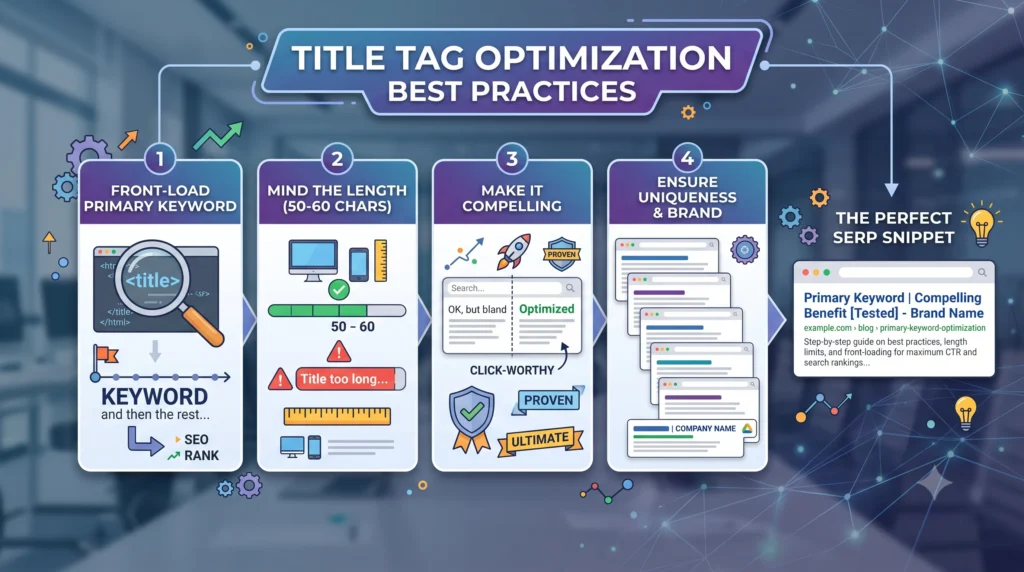
Once you understand the basics, these title tag best practices will help you fine-tune every page on your site.
- Stick to an ideal title tag length. Most SEO title tags perform best between 50–60 characters, though this varies by title tag pixel width rather than character count alone, since letters have different widths.
- Respect the title tag character limit. While there’s no strict title tag character limit enforced by Google, titles beyond roughly 580–600 pixels wide are typically truncated with an ellipsis in the SERP.
- Front-load important keywords. Search engines and users tend to scan the left side of a title first, so lead with your most important terms.
- Avoid keyword stuffing. Repeating the same keyword multiple times in a title tag looks spammy and can actually hurt rankings and trust.
- Make every title unique. Unique title tags across your site prevent keyword cannibalization and duplicate title tag issues in tools like Google Search Console.
- Use title case or sentence case consistently. Consistency improves readability and looks more professional in the SERP.
- Test and refine using data. For a more detailed walkthrough, see our complete title tag optimization guide and learn how to create titles that attract more clicks and higher rankings.
Common Title Tag Mistakes to Avoid
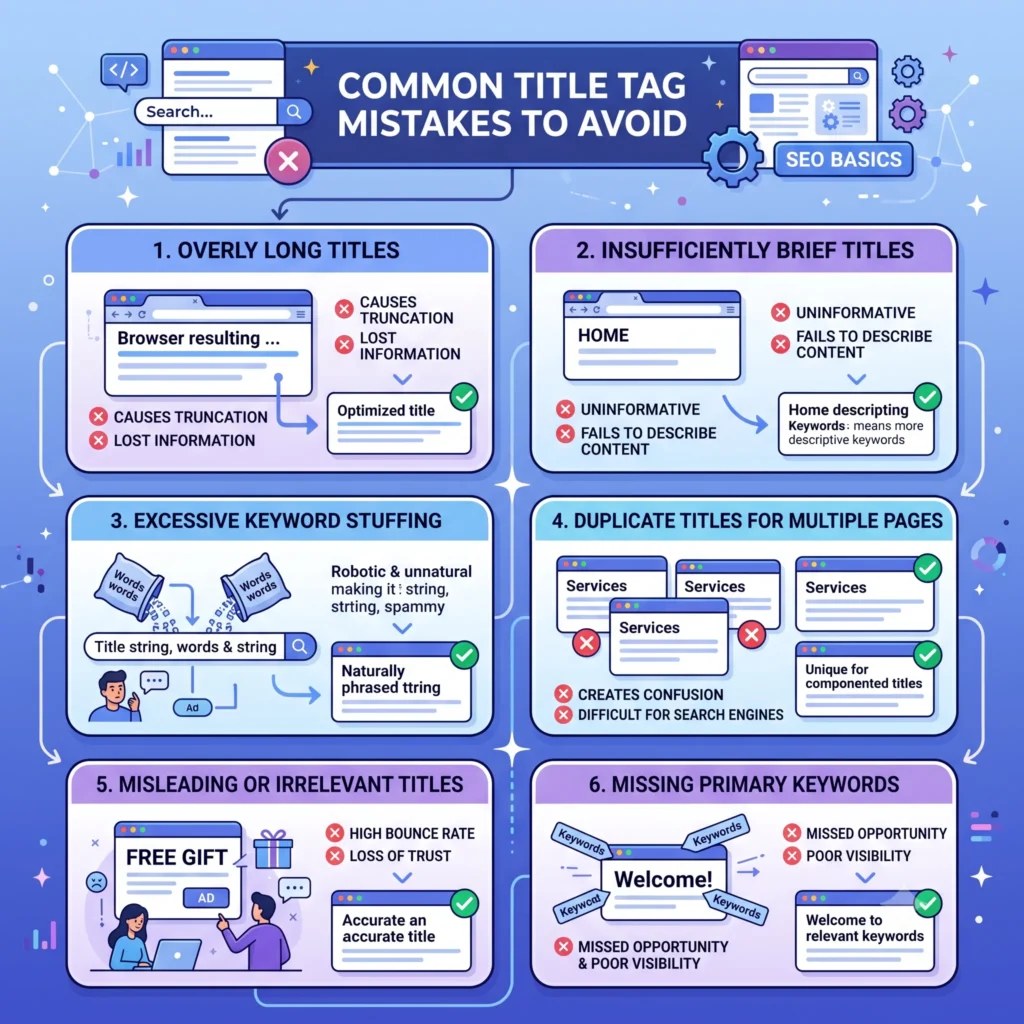
Even experienced marketers make title tag mistakes that quietly hurt SEO performance. Watch out for these common issues during a title tag audit:
Missing title tags. Pages without any title tag give search engines nothing to work with, and Google will often auto-generate a title — usually not in your favor.
Duplicate title tags. Using the same SEO title across multiple pages confuses search engines about which page should rank, splitting your ranking potential.
Overly long or truncated titles. Titles that exceed the practical title tag pixel width get cut off in search results, hiding important information from searchers.
Keyword stuffing. Cramming in every variation of a keyword makes your title tag look unnatural and can trigger algorithmic rewrites or reduced trust. If you’re unsure how to write effective SEO titles, our title tag optimization guide covers everything from keyword placement to CTR optimization.
Vague, generic titles. Titles like “Home” or “Untitled Page” tell search engines and users nothing about page relevance.
Ignoring title tag vs H1 differences. Some site owners assume the title tag and H1 must be identical. In reality, they can be similar but serve different purposes — the title tag is metadata for search engines and browser tabs, while the H1 is the on-page headline for readers.
Title Tag Examples and Templates
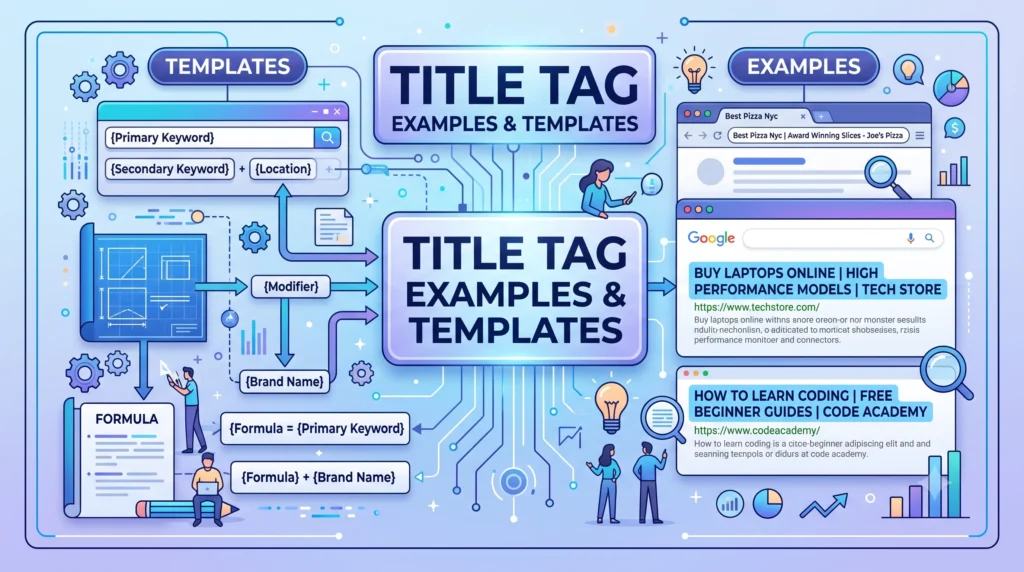
Here are some proven title tag examples and templates you can adapt for different page types:
- Guide/How-to: “How to [Achieve Result]: [Number]-Step Guide for [Year]”
- Listicle: “[Number] Best [Products/Tools] for [Use Case] in [Year]”
- Product Page: “[Product Name] – [Key Benefit] | [Brand Name]”
- Comparison: “[Option A] vs [Option B]: Which Is Better for [Use Case]?”
- Local Business: “[Service] in [City] | [Brand Name]”
- Blog Post: “[Primary Keyword]: [Compelling Angle or Benefit]”
These templates naturally support page title optimization by combining keyword placement with a clear, click-worthy angle.
How to Audit and Improve Existing Title Tags
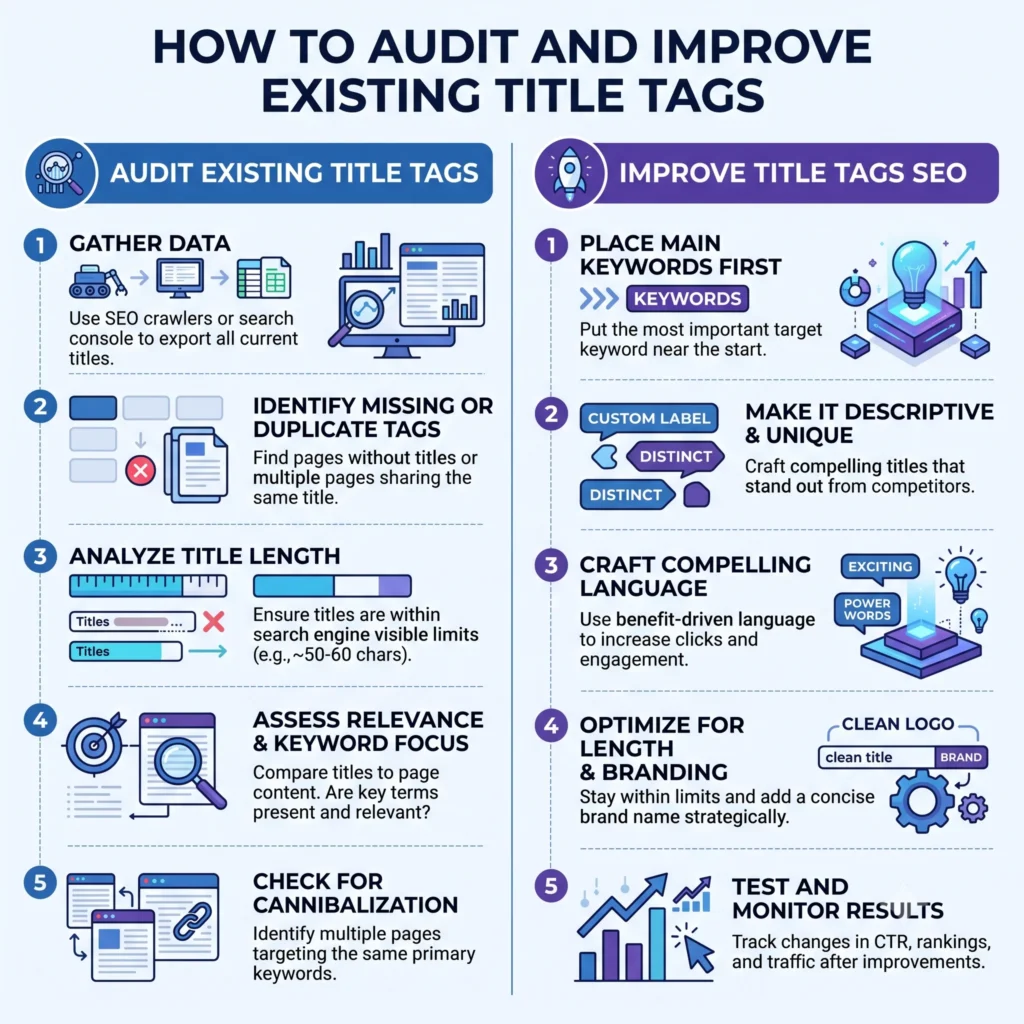
A regular title tag audit helps you catch issues before they hurt your search visibility. Start by exporting all page titles using Google Search Console, which shows impressions, clicks, and average position for each URL. Look for pages with high impressions but low CTR — these are strong candidates for title tag optimization since they’re already appearing in search but failing to earn clicks.
Next, use an SEO crawling tool such as Ahrefs’ Site Audit or Semrush’s Site Audit to scan your entire site for missing title tags, duplicate title tags, and titles that exceed recommended length. Platforms like WordPress and Shopify often rely on plugins such as Yoast SEO or Rank Math to manage and preview title tags before publishing.
Once you’ve identified problem pages, rewrite each title tag following the best practices above: unique wording, front-loaded keywords, accurate representation of page content, and a length that fits within typical pixel width limits. Re-check performance in Search Console a few weeks after changes to measure the impact on rankings and click-through rate.
Conclusion
Title tag optimization is a small technical detail with an outsized impact on SEO performance. A well-crafted SEO title improves how search engines interpret your page, strengthens your search visibility, and — just as importantly — convinces real searchers to click through to your content. By following the title tag best practices in this guide, avoiding common title tag mistakes, and regularly auditing your pages, you can steadily improve rankings and click-through rate across your entire website. To dive deeper into writing high-performing SEO titles, check out our title tag optimization guide for step-by-step best practices and real-world examples. Start with your highest-traffic pages, apply consistent title tag optimization principles, and let the data from tools like Google Search Console guide your next round of refinements.
Frequently Asked Questions
What is title tag optimization?
Title tag optimization is the process of writing SEO-friendly page titles that improve search rankings and click-through rates (CTR
What is a title tag example?
An example of a title tag is “Title Tag Optimization: Best Practices to Improve SEO & CTR
What are the 4 types of SEO?
The four main types of SEO are On-Page SEO, Off-Page SEO, Technical SEO, and Local SEO.
What is the 80/20 rule of SEO?
The 80/20 rule of SEO suggests that 20% of your optimization efforts often generate 80% of your organic traffic and results.
What is the golden rule of SEO?
The golden rule of SEO is to create high-quality, user-focused content that satisfies search intent while following SEO best practices.

FluxSEO’s Team creates practical, beginner-friendly guides on SEO, blogging, keyword research and digital growth. Our goal is to simplify search engine optimization and help website owners improve visibility, rankings and organic traffic with clear, actionable advice.